
Defender of the Crown (1986)
I dug out the legendary Amiga game Defender of the Crown, in which the player seeks to conquer Britain in the early Middle Ages. It was the first release from the renowned Cinemaware, and it occupies a special place in Amiga history as a showcase for the computer’s groundbreaking multimedia capabilities. Audiences accustomed to 8-bit machines were astonished by such impressive graphics in the mid-1980s. The music was equally novel, based on samples and making use of four-channel sound. Defender of the Crown, like Cinemaware’s other productions, was guided by the idea of interactive movies. There are no video sequences, which only became common in games during the 1990s, but the concept is reflected in the scene-by-scene narrative and the game’s dramatic atmosphere. Defender of the Crown is a strategy game, although its strategic depth is fairly limited. The game relies heavily on randomness, and victory is by no means guaranteed.
Deja Vu Collector's Edition (2020)
While browsing the Adventure Games category on Big Fish Games, I came across a hidden-object adventure that looked somewhat different from the usual mainstream fare — Deja Vu. First I noticed the retro-realistic visual style, and then the promise of a journey through the remnants of the former Soviet Union. On Steam, the game’s description is downright confrontational: the mainstream hidden-object scene is dragged through the mud while promising a “different” experience. In practice, the gameplay does not deviate from the usual formula — the familiar hidden-object and puzzle sequences are embedded within an adventure-style narrative and inventory tasks. Yet the setting carves out its own thematic space: places frozen somewhere in the 1980s, unfashionable people, and systemic corruption. I couldn’t help thinking of Adam Wolfe, another atypical hidden-object title I have reviewed earlier on Samooja. Deja Vu does not reach the same level, but it remains a curious title worth a look.
The Procession to Calvary (2020)
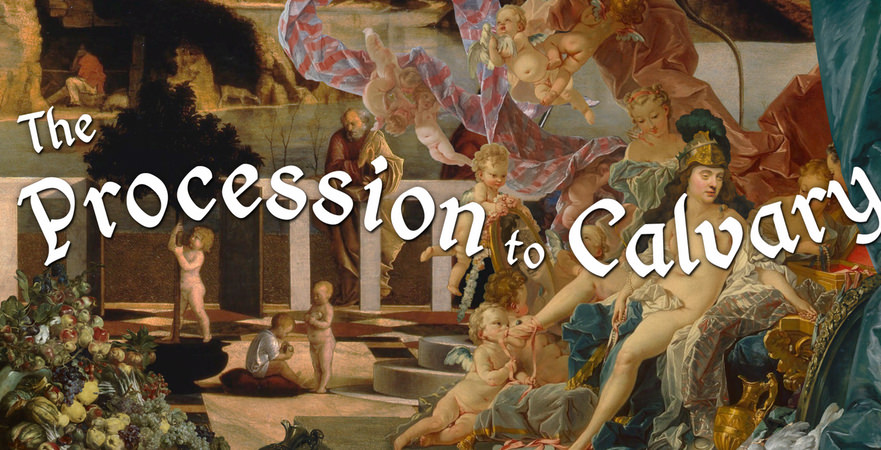
The 2020 point-and-click adventure The Procession to Calvary follows in the footsteps of Joe Richardson’s previous game, Four Last Things. It takes place in the same, or at least a similar, world collaged and composed from Renaissance paintings. However, both the protagonist and the driving force have changed. This time, the player controls a female warrior who uses a religious war as an excuse for her own bloodlust, while Christianity is subjected to cruel, carnivalesque satire. The Procession to Calvary is a journey to the dark side of Christianity and its obscure outskirts.
Antiquarium (2023)
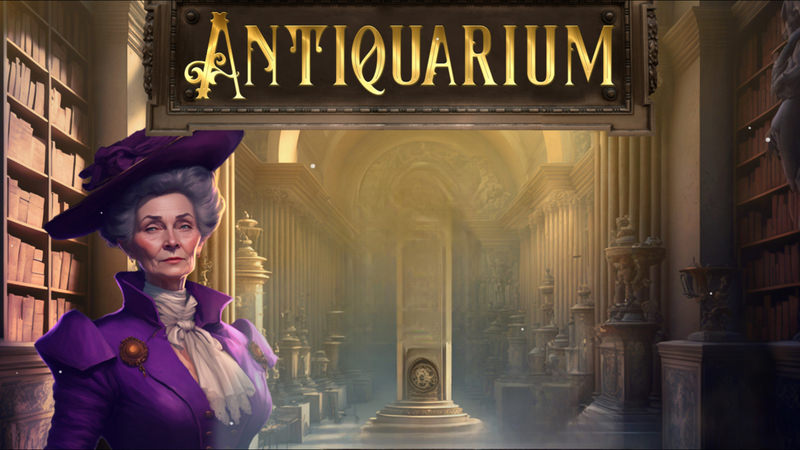
Released in mid-September 2023, the hidden object game Antiquarium combines an old-school game structure with AI-assisted visuals in an intriguing way. The player takes a job in an antique shop, where the work consists not only of serving customers but also of searching for lost — or rather scattered — decorative objects, accompanied by assorted words of wisdom attached to them. There are six different task types, which always repeat in the same fixed sequence. The visuals also repeat themselves quite heavily — or perhaps it would be more accurate to say they vary versions of the same motifs — but in a curiously compelling way. The vagueness produced by AI felt to me fantastical and suitably challenging.
Mystery Case Files: Dire Grove Collector's Edition (2009)
The sixth entry in the Mystery Case Files series, Dire Grove, was released toward the end of 2009. It follows in the footsteps of the previous game, Return to Ravenhurst, as a full-fledged adventure game, but it does not continue the Ravenhurst storyline. Instead, it tells its own tale inspired by Celtic mythology. Dire Grove features remarkably few mini-games, with tasks revolving primarily around the inventory. There are no bizarre door-lock mechanisms, even though the core actions still involve opening, activating, and gaining access. There are plenty of hidden object scenes — one could say enough to make up for the missing mini-games.
Mystery Case Files: Return to Ravenhurst (2008)
I continued my playthrough of the Mystery Case Files series with its fifth instalment, Mystery Case Files: Return to Ravenhurst, released in 2008. The game is a direct narrative continuation of the series’ third entry, Ravenhurst. This time, the series makes a decisive leap into adventure-game territory. Free exploration of the manor grounds and the use of an inventory are now woven into a single, continuous story arc. At the same time, the player character moves to the centre of the experience as its primary subject. Whereas in Ravenhurst the task was to recover missing pages of a lost woman’s diary, here those pages are written dynamically into the player character’s own journal. The series’ earlier humour is replaced entirely by horror, and stereotypical characters give way to overtly psychopathological figures. Haunting no longer relies on looping sound effects alone: ghosts appear as animated characters who speak directly to the player. The series thus takes a major step forward — but is its new direction a sound one?
Mystery Case Files: Ravenhurst (2006)
I continued my exploration of the Mystery Case Files hidden object series with its third entry, released in December 2006: Ravenhurst. Within the series, Ravenhurst forms its own five-part mini-series, indicating that its setting proved fertile ground both narratively and commercially. Among fans of Mystery Case Files, Ravenhurst holds a particular status. It won me over as well, and the fatigue I experienced while playing Prime Suspects was entirely absent. What distinguishes Ravenhurst from the series’ first two games is its strong narrative cohesion. The story binds the mechanical elements together and gives the experience a clearer sense of purpose. This is where one can observe hidden object games edging closer to adventure games. I also suspect that Ravenhurst, unintentionally, marked the beginning of the genre’s later obsession with locks.
Dracula: Love Kills Collector's Edition (2011)
Released in 2011, the hidden object puzzle adventure Dracula: Love Kills is a sequel to Dracula: Origin from 2008. For me, it turned out to be an unexpected and enjoyable discovery. Perhaps carried along by Halloween, my attention shifted toward the horror games collecting dust in my library, and in a rather lazy frame of mind I assumed a hidden object game would offer some light entertainment. I expected it to be just another mass-produced title, played through without leaving much of an impression or provoking any deeper thought. At most, I imagined I would simply be annoyed by yet another reminder of how formulaic and clichéd hidden object adventures often are. I was wrong. Dracula: Love Kills is genuinely charming in all its formulaic predictability.
Titanic: Adventure Out of Time (1996)
Released in 1996, Titanic: Adventure Out of Time conveniently anticipated the following year’s successful Titanic film and sold well in its wake. Just over a week ago, at the end of 2017, it was officially released for modern Windows computers — officially, it should be added, as the game had long been available under the false assumption that it was abandonware. Awareness of the ship’s inevitable sinking creates a particular tension in this adventure game. A four-part main objective, side tasks, and a large cast of characters make it fairly complex, and navigating the long, multi-deck ship is challenging. In terms of premise and period, it immediately brought The Last Express to mind, and I could not help comparing the two.
The Curious Expedition (2016)
Released in September 2016 by a small German studio, The Curious Expedition has held me captive for nearly sixty hours. There is a thin line between enjoyment and compulsion, and the game is built precisely around that tension. It combines irresistible repetition with the thrill of discovery. Anthropology, archaeology, hunting and trade come together under an opportunistic spirit — and a proper explorer does not shy away from risk. Randomised events ensure frequent surprises.