
Technobabylon (2015)
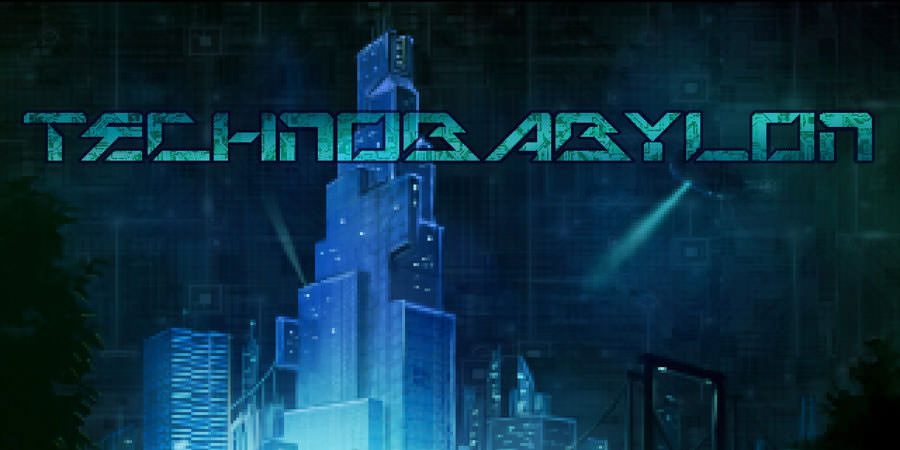
Technobabylon, a recent collaboration between Wadjet Eye Games and Technocrat Games, is a modern cyberpunk thriller built in the spirit of classic point-and-click adventures. It offers a winding plot and a sequence of clever puzzles. Characters and their relationships drive the experience, yet the world of the game — more an alternative than a plausible future — constantly tests their credibility and relatability.
The founder of Technocrat Games, James Dearden, now living in the UK, has said that the idea for Technobabylon originated during a socially withdrawn period in 2010 while he was staying in South Korea. It began as a series of freeware episodes made as a learning exercise, before being shown to Dave Gilbert of Wadjet Eye Games and developed into a unified, polished commercial release.
A future both utopian and dystopian
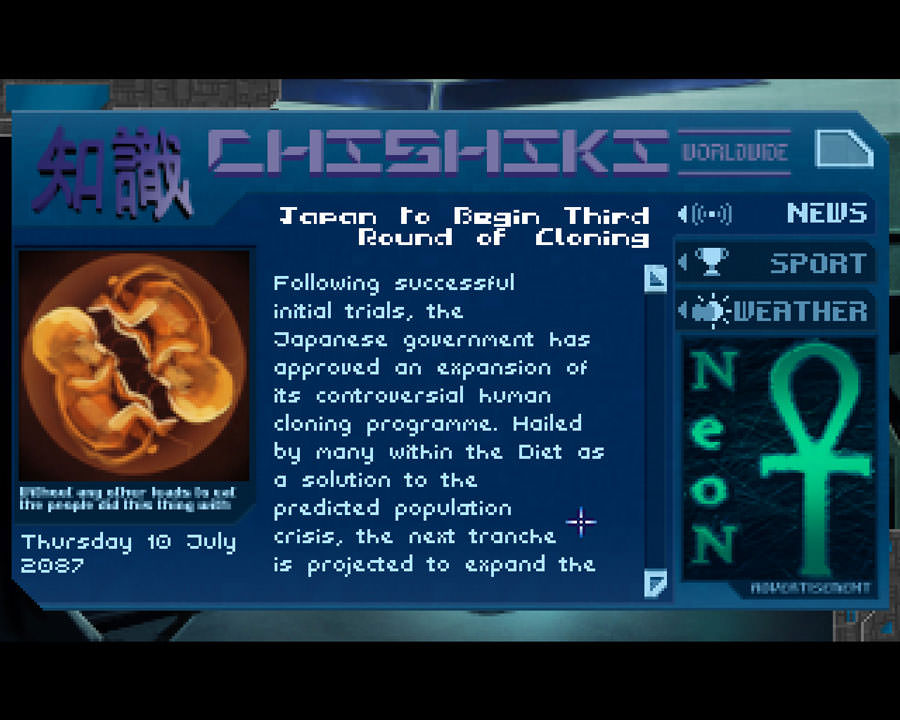
Technobabylon takes place in 2087, in the newly built city of Newton on the African coast. Its population is multinational, and its loose legislation permits extensive genetic manipulation and advanced organic artificial intelligence. Central, the governing AI at the heart of the city, has near-total awareness of all activity. Synthetic humans are commonplace.
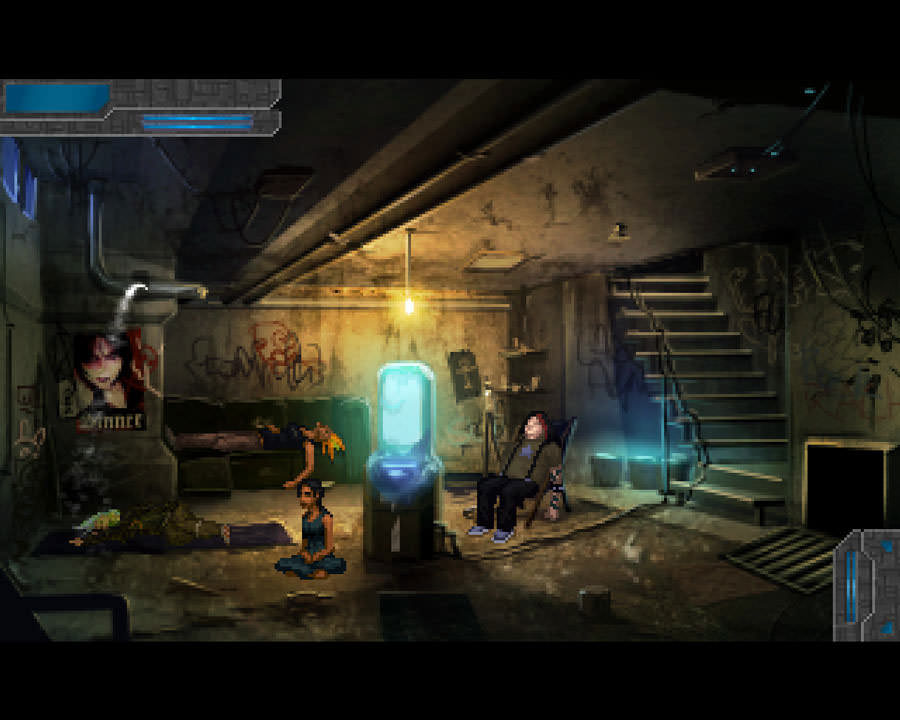
The player controls four characters in total, three of whom are central to the plot. The game opens with a familiar “escape the room” scenario. Latha Sesame — a Trance addict, meaning someone dependent on the virtual reality network — is young, unemployed and deeply disconnected from the physical world. She wakes up to find her food dispenser broken and her apartment security system locking her in. She has no idea of the real threat approaching, nor of her involvement in a coup attempt shaking the core of the city.
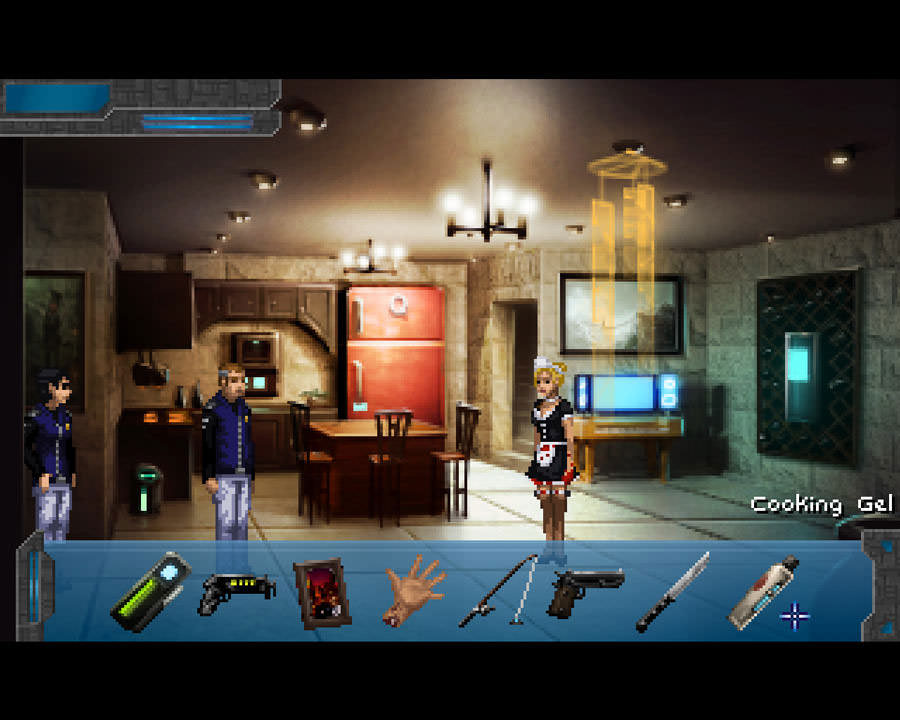
Latha is later joined by two police investigators: the difficult fifty-something Charles Regis and the level-headed late-twenties Max Lao. Charles is a refugee from the post–civil and nuclear war USA. Max is the daughter of parents from the authoritarian Han state and genuinely believes in Newton’s ideals. Charles is sceptical and old-fashioned, especially regarding Central. Max, like Latha, is neurologically connected to the Trance, allowing them to enter and manipulate technical systems. The Trance is presented as virtual reality.
As the story unfolds, Charles’s difficult past resurfaces and becomes inseparable from the present. The AI is not the villain — people are.
Convincing characters in an unbelievable world — or not?
Technobabylon strongly recalls Wadjet Eye’s earlier title Resonance. Both offer long and multi-layered narratives rooted in science and research, presented through multiple playable protagonists. With all their twists, both stories are rather unbelievable — not negatively, but dramatically heightened. Still, I am not convinced that “save the world” themes built around exaggerated contemporary issues make the player more aware of those issues.
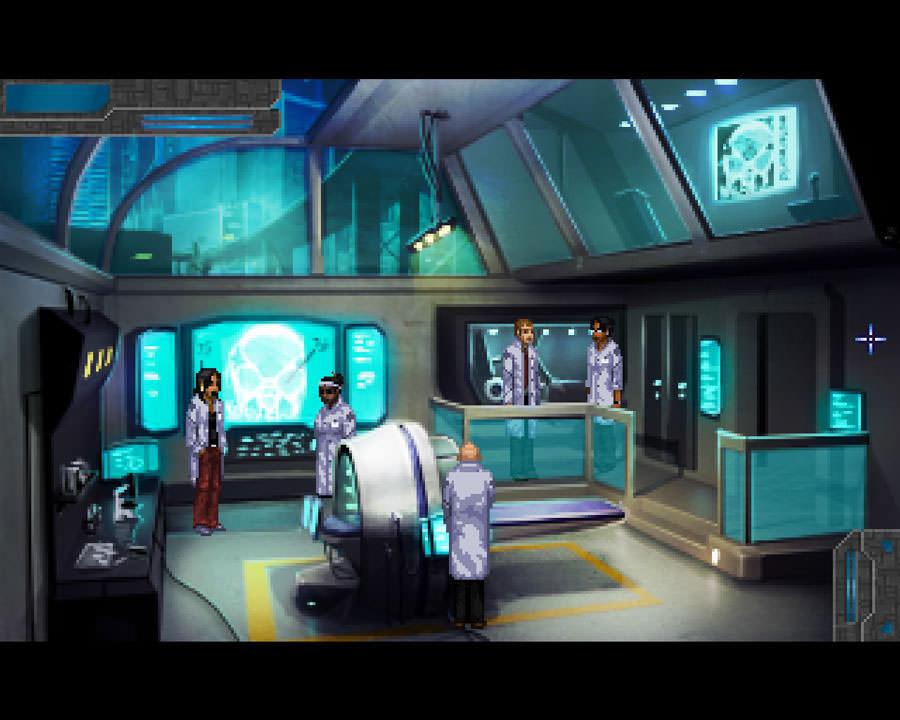
The cyberpunk setting makes creating believable characters especially difficult. Technobabylon addresses this with extensive backstories: character profiles, even video teasers, were released before the game launched as marketing built around “strong characters”. For me, this did not make them feel more real. They work well within the narrative, but I never felt a deeper connection at the character level.
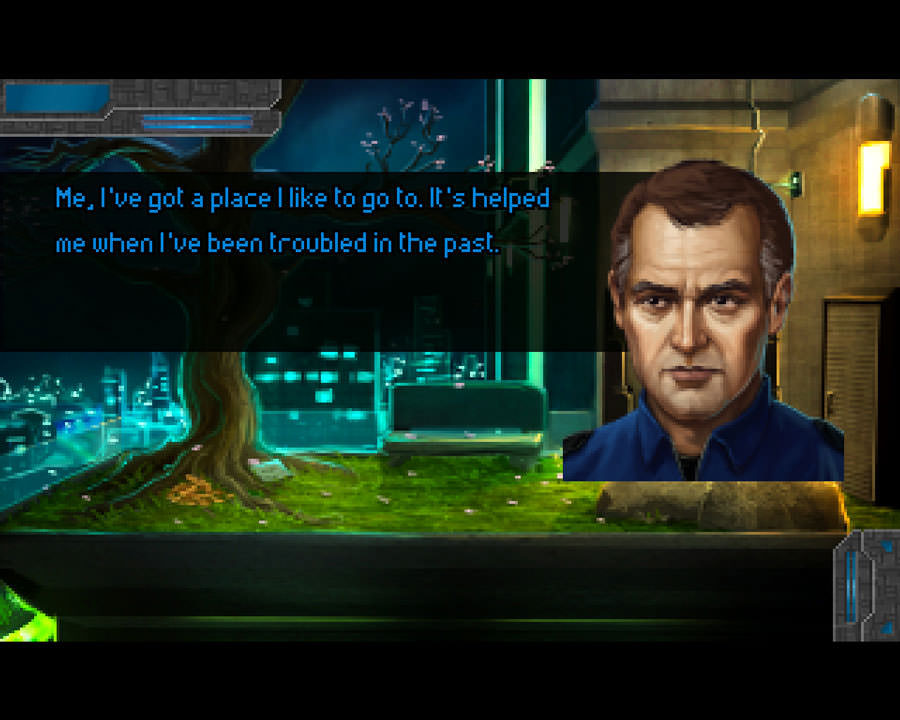
I would not say the characters behave implausibly, but Charles’s motivations never resonated with me. As he sits at the centre of the story, his perspective should feel justified to the player from the beginning. I never quite broke through to the character layer — and for a game that is so clearly character-driven, that feels like a missed opportunity.
Where it shines
I spent around twelve hours with the game. It was not a speed run — there was leisurely exploration and extensive dialogue. The puzzles were logical but not obvious, offering enough challenge to stay satisfying. Some felt unique, others creatively reinterpreted familiar structures, and as a whole the experience remained consistently rewarding.
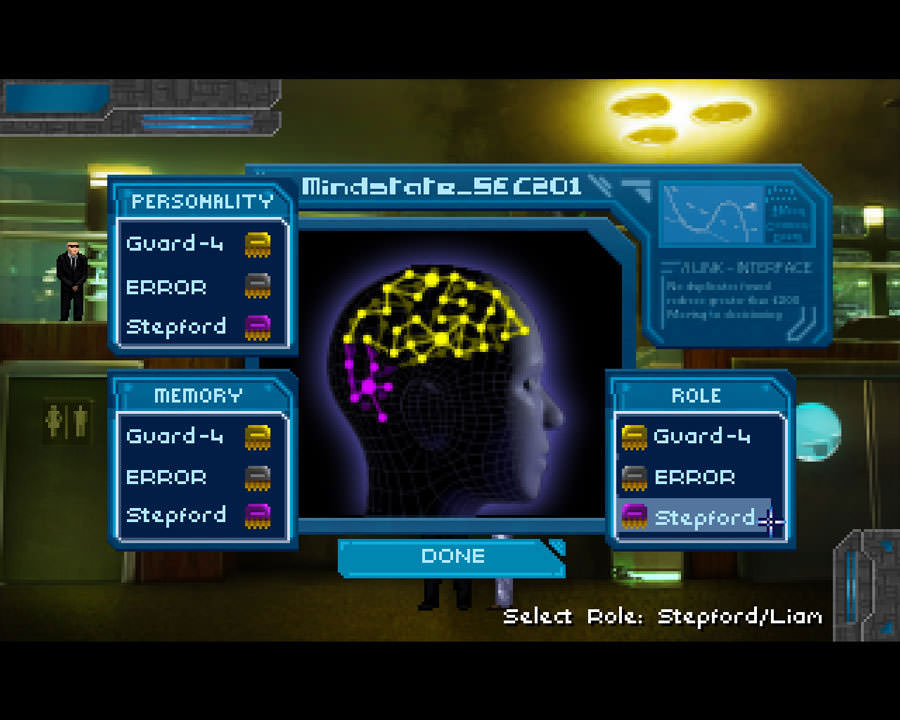
Ben Chandler’s pixel art is at its finest here — detailed environments that work in harmony with the ambient soundtrack. The music, by Nathan Allen Pinard (also known from Gemini Rue), has a soft New Age quality that keeps it mostly in the background. Personally I preferred the more expressive and varied score of Gemini Rue.
The voice acting suits the characters well. A small detail worth noting: fans contributed voice lines that play when cycling through the contact list of a deceased man.
Verdict
This is an indie game created in AGS, and it remains true to that identity without feeling formulaic or cheaply made. The worldbuilding, narrative, design and audiovisual presentation form a high-quality whole. My overall score: 84 out of 100.
Availability
Technobabylon is available on GOG.com, the Humble Store and Steam for Windows. A Mac OS X version is planned. A free demo can be downloaded from the Wadjet Eye Games website.