
Neuromancer (1988)
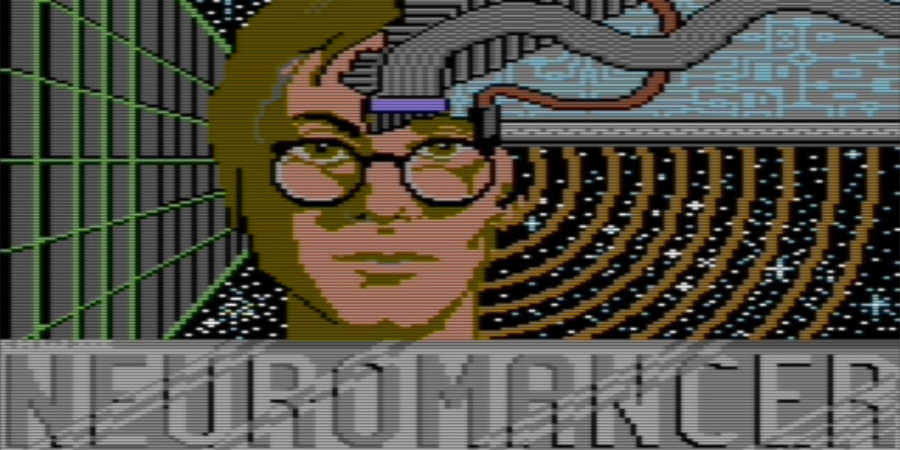
Neuromancer is an adventure game with strategic and action elements, released in 1988 and based on William Gibson’s cyberpunk novel of the same name. It is a remarkably sophisticated and multilayered work, and not merely as a product of its time. I played the Commodore 64 version through the VICE emulator.
The game takes place in the world of the novel, but its story differs: the player character is not Case, the book’s protagonist, but another hacker freely named by the player. The locations and many characters are shared, and the game even includes direct text quotes from the novel. The gameplay is not strictly linear and feels more action-driven than narrative-driven.
The game was created by Interplay, which still exists today. The credited designers are Bruce Balfour, Brian Fargo, Troy A. Miles, and Michael Stackpole, with Troy A. Miles also serving as a programmer.
A hacker in decline
The game starts in squalor. You wake up with your face in a plate of spaghetti, while a rusty bartender demands payment for last night’s tab. The only solution is to log into one of the game’s three “internets,” the open PAX system, and transfer funds from your account to your cash card. You can also read the news and check discussion boards. The game delivers personal messages addressed to you directly.
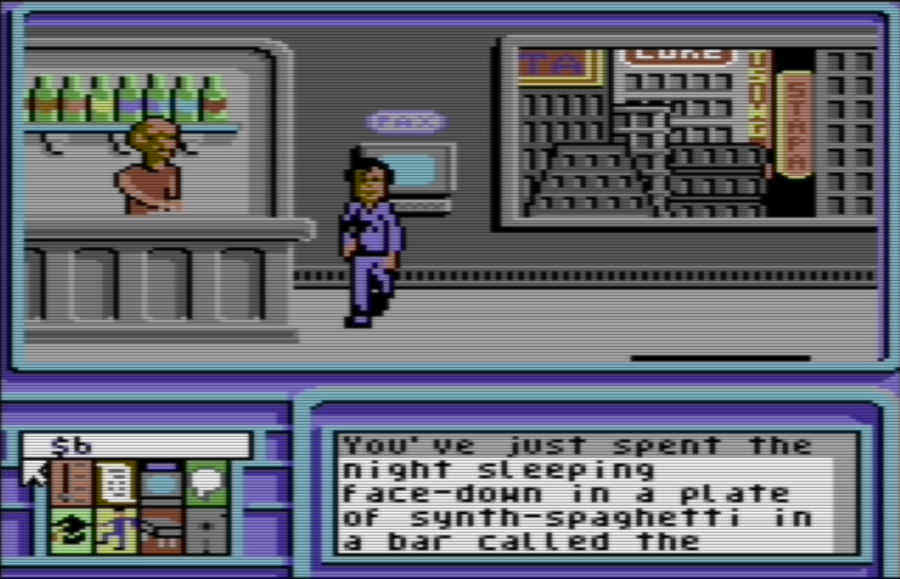
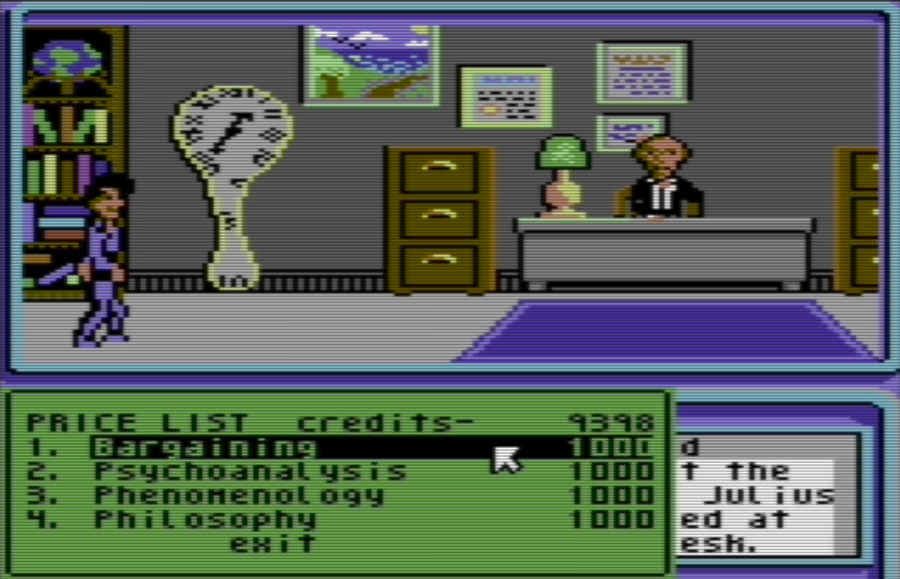
Outside unfolds a futuristic Japanese city where high technology meets cultural decay. An unseen power governs through robots and automation with an iron fist, and arrest comes easily. When short on money, you can sell your internal organs and replace them with artificial ones.
You are a cyberspace cowboy who has lost his deck and abilities — and must find a way back into the Matrix.
The three-tiered internet
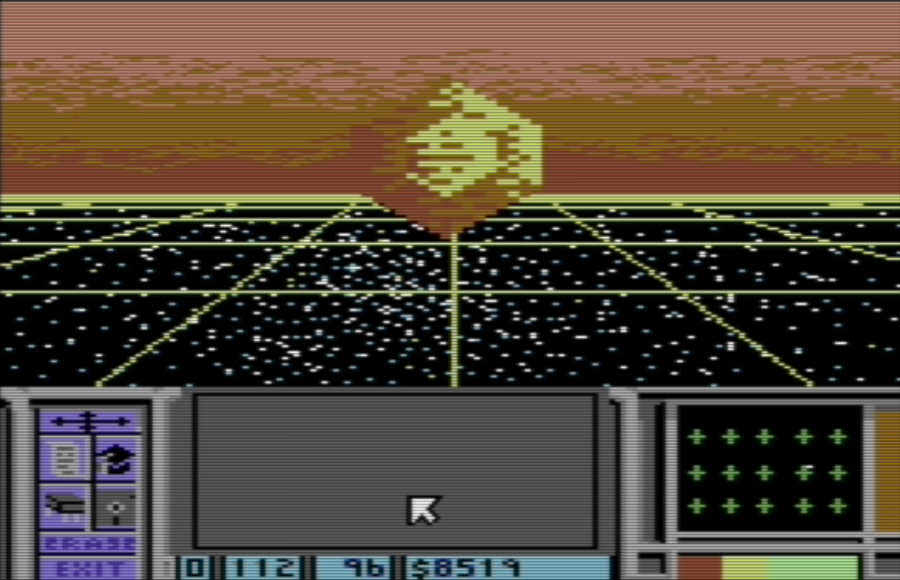
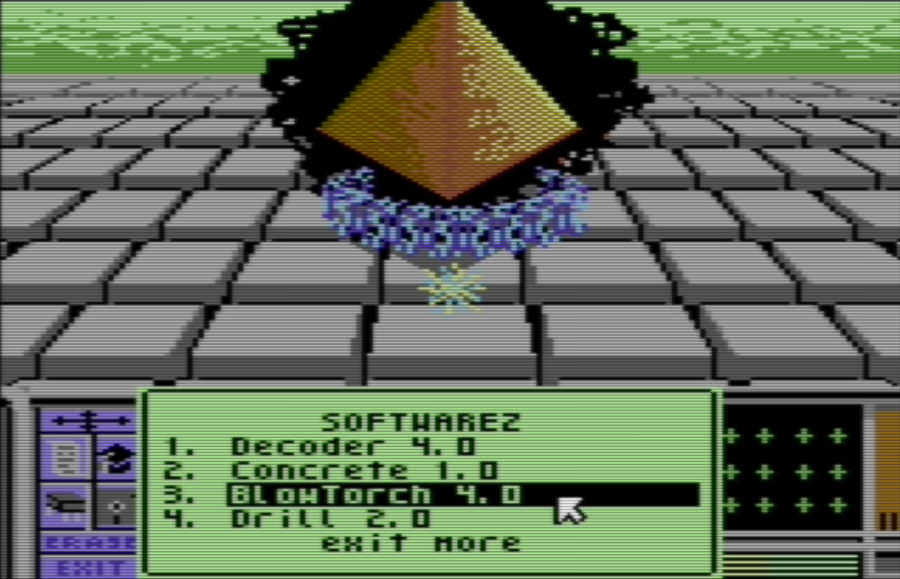
The Matrix is the highest form of the “internet,” home to corporate and institutional databases as well as artificial intelligences. It is represented as a virtual reality with a coordinate grid and polygonal vector graphics.
Between the open PAX network and the Matrix lies the “BBS world.” Access to company and organisation boards requires knowing the correct code link. As a hacker, your goal is of course to reach the material hidden behind passwords. During roughly the first third of the game, you gather address links and passwords — requiring cunning and code-breaking skill. Pen and paper are needed outside the game, as it does not store collected links or passwords.
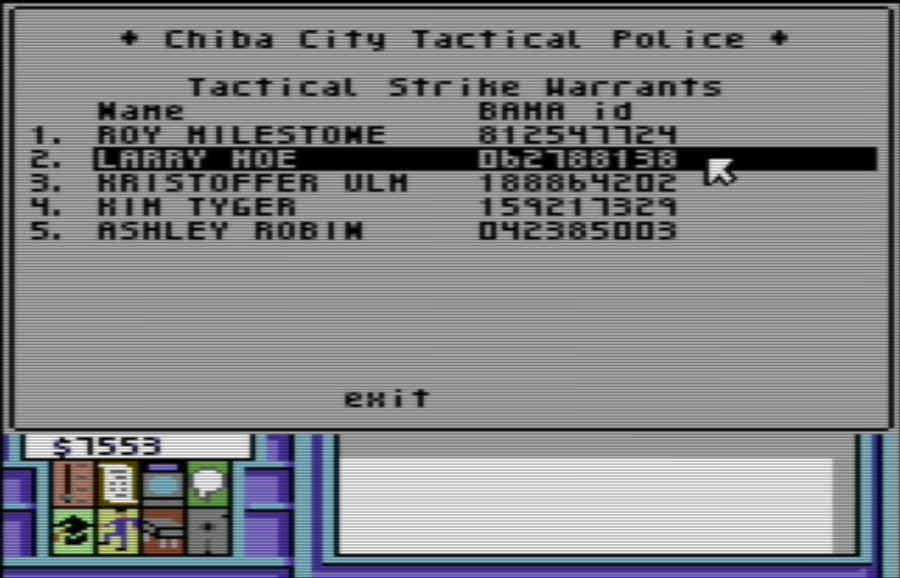
Access to the “internets” is location-based. The BBS world and Matrix are reached by connecting to special wall sockets.
To dive deeper — or higher — into cyberspace, you must replace your old deck with a more advanced model. You’ll also need various programs for database intrusion. In addition to acquiring software, you must develop or upgrade your own skills. All this costs money and requires hacking, forgery, and other illicit acts. Substantial funds are also necessary because time spent “online” is charged by the minute.
Missing hackers and power-hungry AIs
The central task is to discover what happened to your fellow hackers. It remains somewhat unclear what “disappearance” truly means — besides vanishing inside the Matrix, there are hints of physical disappearance as well. How the physical and virtual are linked remains a mystery. Since the Matrix requires a neural interface, one might imagine that the hackers suffered neural shock and died, though the game never says so outright.
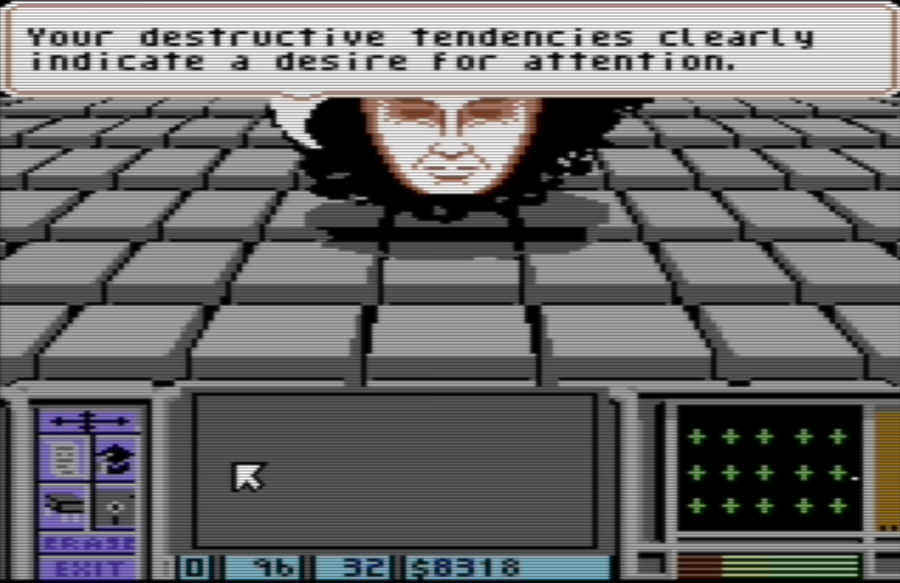
The theme is timely. In recent years, many prominent voices have warned of the dangers of artificial intelligence. In Neuromancer, these fears had already taken shape 27 years earlier: super-intelligent AIs have seized control of the Matrix, challenging humanity. The player’s mission is to destroy them — not with hacking tools or viruses, but with mental abilities such as logic, psychology, and phenomenology.
Audio-visual presentation
Considering the hardware limitations, the graphics and sound are quite decent. The game’s cyberpunk world is sparse and minimal, but its other content offers plenty to marvel at. The textual descriptions of places and people enrich the visuals. Colours are used well, and the graphics rarely repeat. The recurring theme music is classic C64 style: catchy and charming.
Difficulty
Neuromancer is an intelligent and demanding game. The world is horizontally limited — each city or Matrix zone has only a few locations — but the experience deepens vertically. Shopping, managing money, navigating the three levels of the “internet,” conducting conversations, and mastering the software and skill systems require constant attention. Understanding and operating all in-game functions takes real dedication.
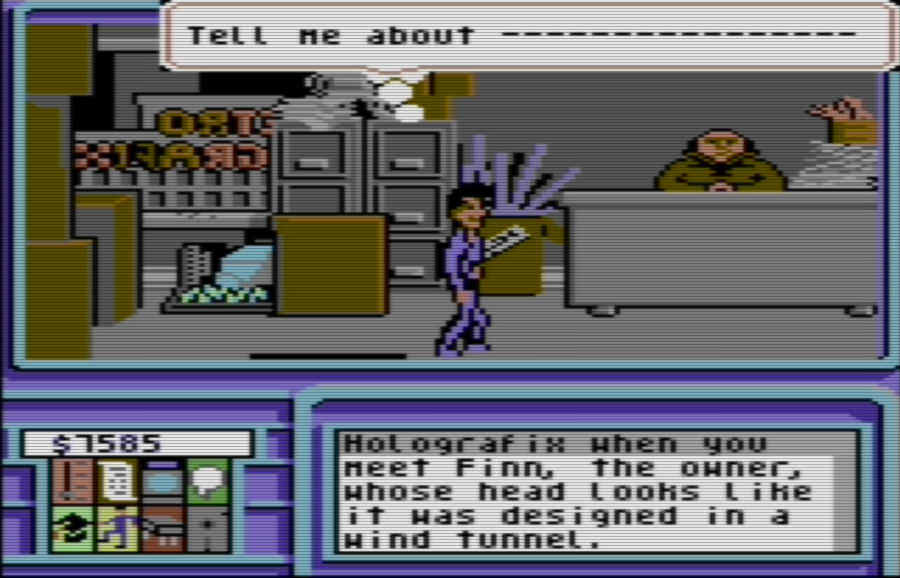
Money is easily lost — often in unfair ways — so frequent saving is essential. Mistakes are also easy without a walkthrough or strategy guide.
I eventually hit a wall after progressing some way through the Matrix. The action sequences, where you break through database security and sometimes battle the AIs behind them, proved too difficult and I gave up. I suspect my mistake concerned viruses, which are single-use items and therefore best stockpiled in large quantities.
I did try, and I usually handle the slow rhythm of old games quite well; even the routine disk swapping didn’t frustrate me much. Still, for today’s player, Neuromancer demands special, almost obsessive perseverance.
Verdict
Neuromancer is long — or perhaps more accurately, slow — and challenging, yet undoubtedly a brilliant adventure classic. The design is of high calibre and never underestimates the player. Hacking itself doesn’t strike me as “cool,” and the humour felt a bit juvenile, but even that serves the game’s message about the absurdity of reality — ours included. My overall rating for Neuromancer is 92 out of 100.
Availability
Neuromancer was released not only for the Commodore 64 but also for Amiga, Apple II, and DOS computers, each version differing in graphics. Authentic original disk editions can still be found on online marketplaces. Downloadable copies playable via emulator are available, for instance here. As for legality, I make no claims.