
Antiquarium (2023)
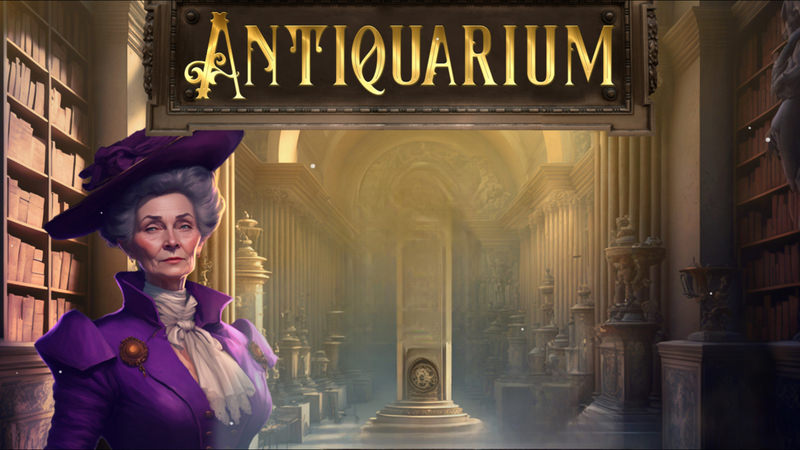
Released in mid-September 2023, the hidden object game Antiquarium combines an old-school game structure with AI-assisted visuals in an intriguing way. The player takes a job in an antique shop, where the work consists not only of serving customers but also of searching for lost — or rather scattered — decorative objects, accompanied by assorted words of wisdom attached to them. There are six different task types, which always repeat in the same fixed sequence. The visuals also repeat themselves quite heavily — or perhaps it would be more accurate to say they vary versions of the same motifs — but in a curiously compelling way. The vagueness produced by AI felt to me fantastical and suitably challenging.
Behind Antiquarium is the small Brazilian studio Seven Sails, whose founder Mario Russo appears to be responsible for a bit of everything. This is clearly a low-budget game made with limited resources. In a charming way, it returns to the early days of hidden object games, when they were pure puzzle games without adventure-game features. There is no inventory and no story in Antiquarium, and only a handful of locations, all of them static views inside the antique shop.
In addition to the simple structure and modest graphical needs, cost-cutting is also evident in the sound design. The sparse music, ambient sounds, and sound effects are sourced from stock libraries rather than created specifically for the game. There is no background music during gameplay, for example, and the overall soundscape is extremely minimal. Some players have considered this a positive feature.
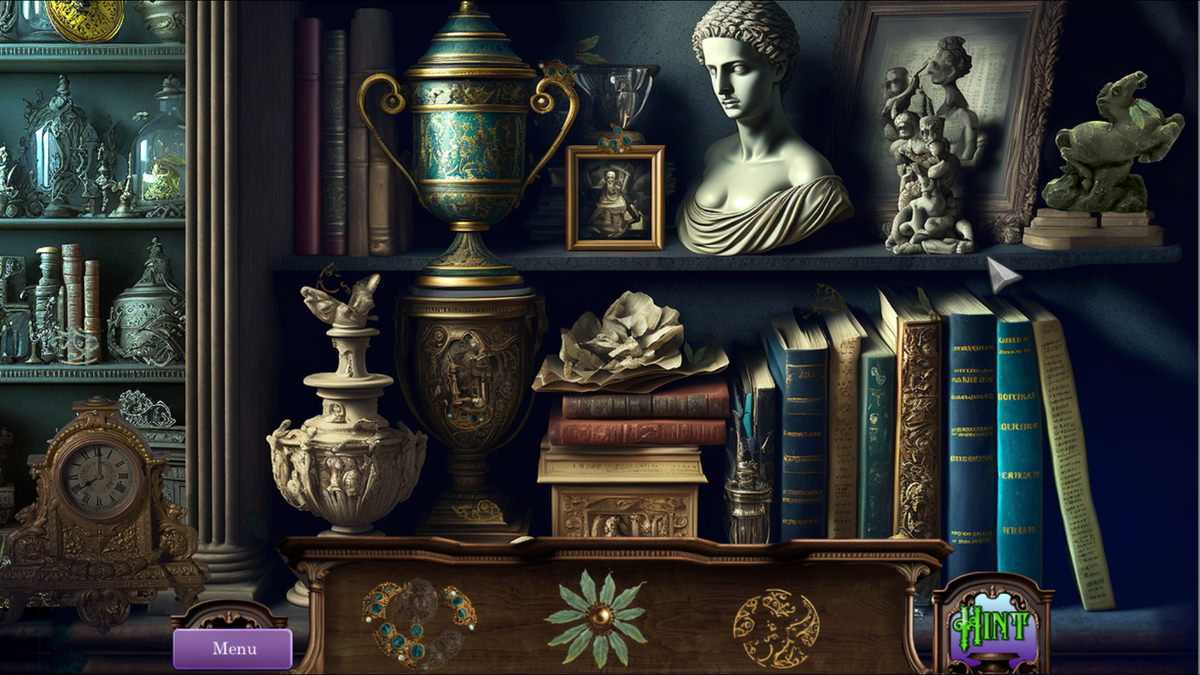
The game’s credits do not disclose it, and I could not find confirmation online either, but it is obvious that AI has been used to generate the visuals. In my view, the use of AI suits this game well, and perhaps it could be used more widely in hidden object games. AI gives the antique shop a fantastical dimension. The objects are historical in spirit yet fictional. On closer inspection, shapes are distorted and edges remain indistinct.
The horror of formula — or its hidden beauty?
The player’s task in Antiquarium is to serve customers who buy all sorts of things. The weakest element of the game lies precisely in these purchasable items. They are not antiques at all but resemble the random contents of a lost-and-found office, ranging from cameras to lollipops. This incongruous clutter did not, however, spoil or even dampen my enthusiasm for searching. The customers’ portraits also break the visual coherence, as they are cartoon-like and brightly coloured. The rest of the game’s graphics lean towards painterly realism, darker tones, and a historically restrained palette.
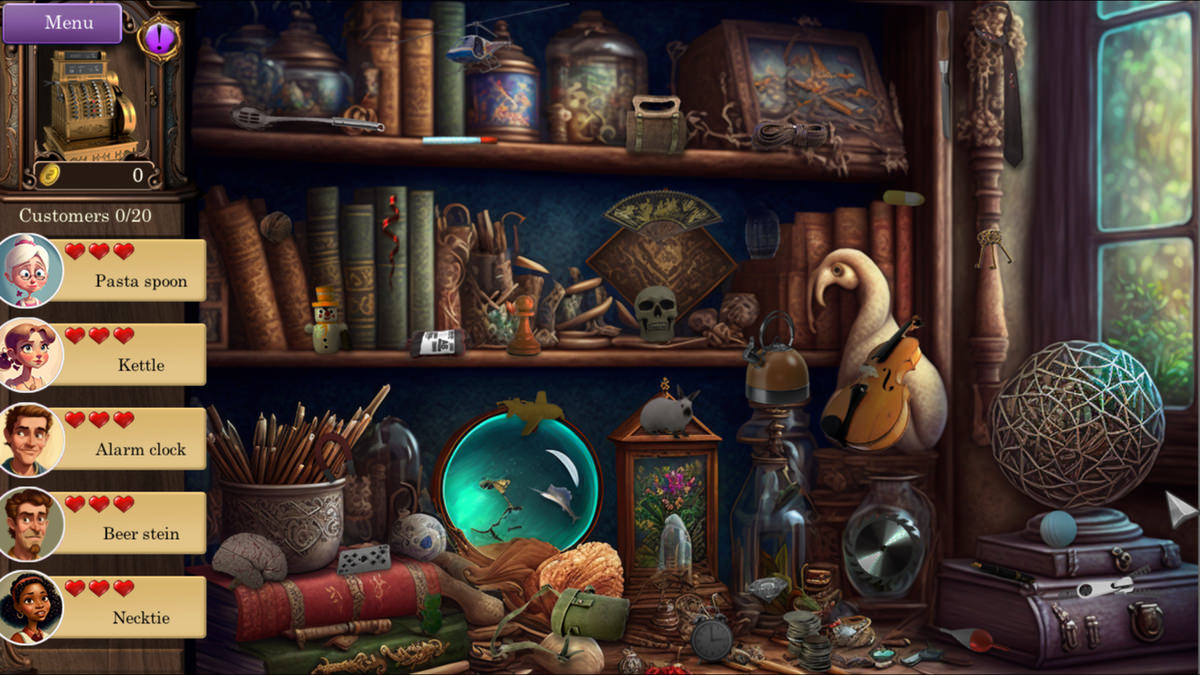
Customers have patience worth three hearts. If you take too long to find an item, hearts are lost, which in turn reduces the price you receive. Once a customer has been served, they leave behind a pile of coins that must be collected before the next customer arrives. There are always 20 customers per working day. The money earned can be spent on collectibles for a gallery accessible from the main menu. These collectibles serve no particular gameplay purpose.
In addition to the shop view, Antiquarium features two other hidden object scene types. In one, you search for a single object type — such as feathers or stamps — in a fixed quantity, again typically 20. In the other, you search for fragments of decorative objects.
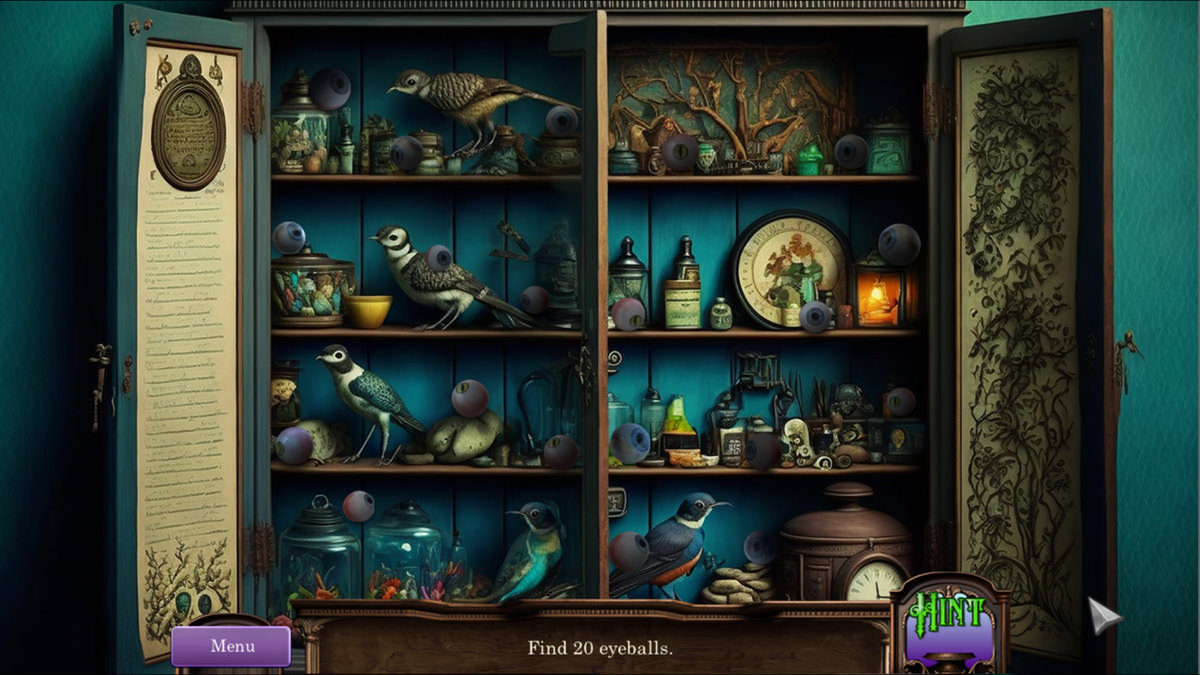
I found the shop scenes the easiest. In the single-object searches (feathers, stamps, eyeballs), the objects blended into the background more effectively, and the last few were usually the hardest, often prompting me to use hints. Searching for decorative object fragments was the most difficult of all, as they blended into the background almost perfectly. The best strategy there turned out to be clicking on anything that stood out even slightly from the background, without trying to identify a specific shape. The game does not punish so-called misclicks. Some player reviews complain about objects being hidden in dark corners. I did not find this a major issue, and increasing screen brightness can help.
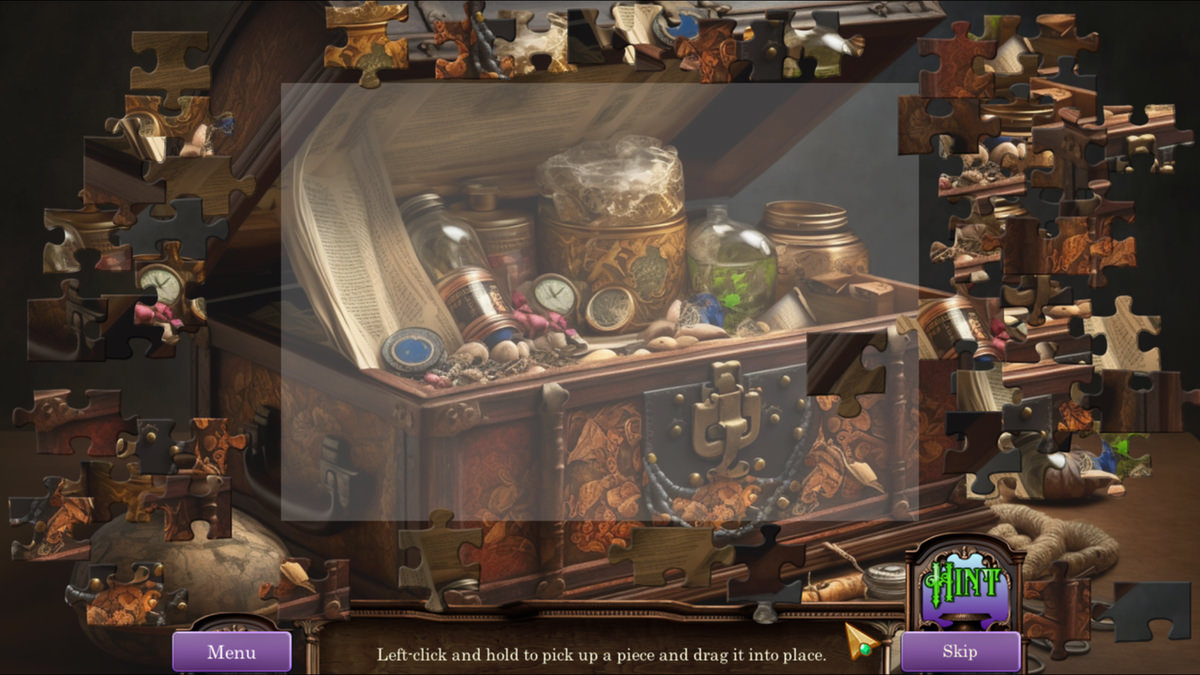
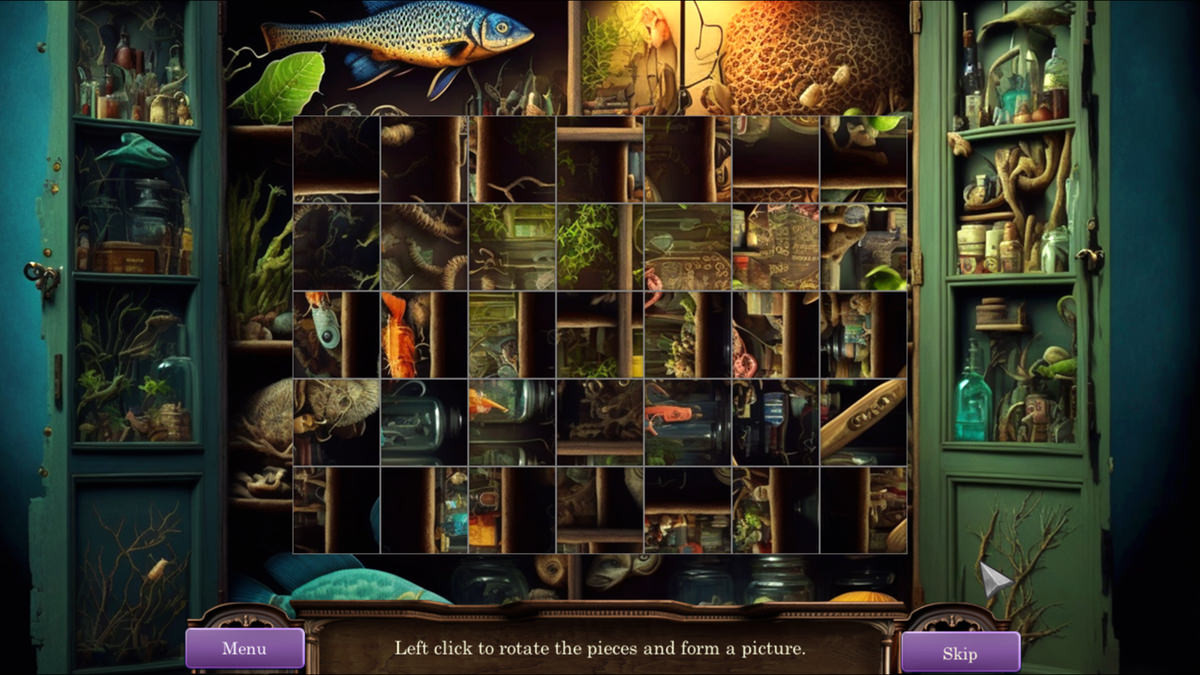
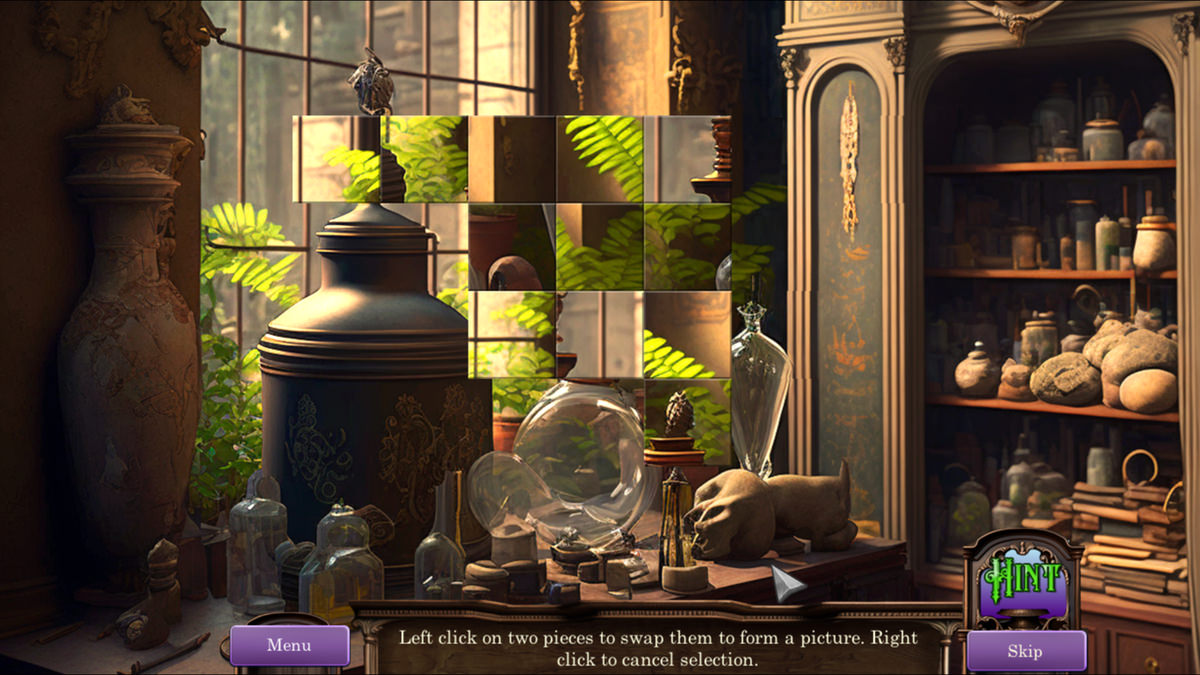
In addition to the hidden object scenes, Antiquarium includes three different puzzle types: a standard jigsaw puzzle with interlocking pieces, and two square-tile puzzles — one where you swap the positions of two tiles, and another where you rotate a single tile clockwise. The six different task types make the game varied enough, but over time the repetition of graphical elements became noticeable. Antiquarium is not very long, and that works in its favour. It is also extremely casual, especially on the easier settings. Big Fish Games offers a generous one-hour free trial, which gives a clear picture of what the full game has to offer.
At the end of each working day, you can talk to the shop’s owner, who delivers a short philosophical lecture on the significance of old objects. These musings made me suspect that AI may also have been used for the written content. They felt vague and oddly phrased, and the owner welcomed me each time as if I were not already a familiar employee of her antique shop.
Verdict
Antiquarium feels like a kind of paracronism: it resembles the early, original hidden object games, yet it has been released in the age of modern AI. In my view, the result is far from bad, and I would certainly play another similar game set in a different environment. The lack of resources is clearly visible and audible in Antiquarium, and there is nothing mechanically new or outstanding — only functionality. Sometimes, however, familiar, formulaic, and easy is exactly what a game needs. I would give my overall experience a score of 54 out of 100.
Availability
Antiquarium is available for Windows PCs, and Big Fish Games offers a generous free trial.