
Mystery Case Files: Ravenhurst (2006)
I continued my exploration of the Mystery Case Files hidden object series with its third entry, released in December 2006: Ravenhurst. Within the series, Ravenhurst forms its own five-part mini-series, indicating that its setting proved fertile ground both narratively and commercially. Among fans of Mystery Case Files, Ravenhurst holds a particular status. It won me over as well, and the fatigue I experienced while playing Prime Suspects was entirely absent. What distinguishes Ravenhurst from the series’ first two games is its strong narrative cohesion. The story binds the mechanical elements together and gives the experience a clearer sense of purpose. This is where one can observe hidden object games edging closer to adventure games. I also suspect that Ravenhurst, unintentionally, marked the beginning of the genre’s later obsession with locks.
As with the first nine entries in the series, Ravenhurst was developed by Big Fish Games’ internal studio, with Adrian Woods as lead designer. My intention is to play precisely these nine games to see what state the series was in before development was handed over to a third party. My personal aim is to trace when and where hidden object games began to go astray. I assume this happened before 2012. Mystery Case Files thus serves as a representative of the genre as a whole.
So far, I have reviewed the series’ first entry Huntsville and the second Prime Suspects on Samooja. Originally, however, it was the fourth game, Madame Fate, that led me to the Mystery Case Files series in the first place, and I wrote about it on Samooja three years ago.
A cluttered mansion of horrors
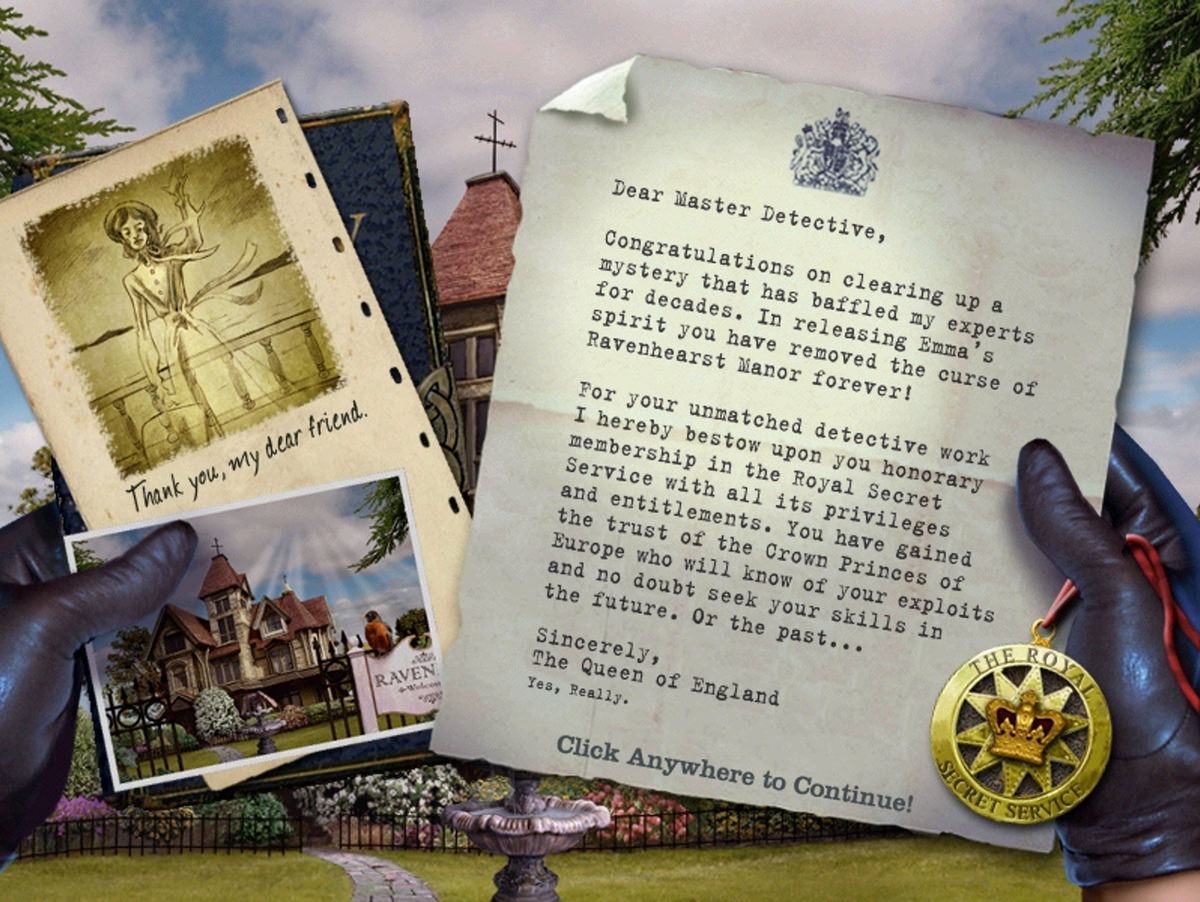
In Ravenhurst, the player character — an FBI agent — receives an assignment directly from the British Queen herself. Strange stories have been circulating about Ravenhurst Manor in Blackpool, England, and the Queen wishes to uncover its secrets once and for all after obtaining the diary of the manor’s former resident, Emma Ravenhurst.
Most of the diary’s pages are missing, and the Queen assumes they may be hidden behind the manor’s locked doors. I am not sure what this assumption is based on, but regardless, our agent proceeds to investigate the manor room by room.
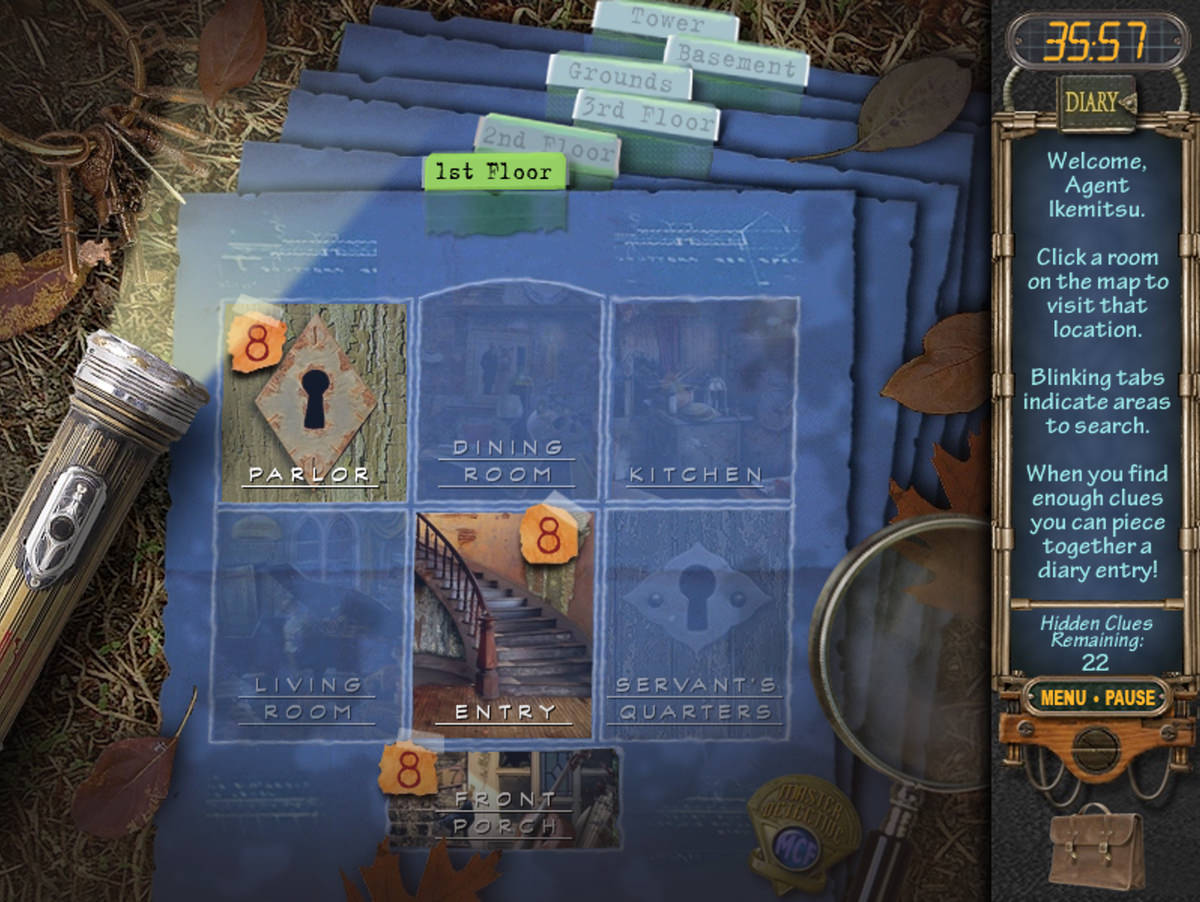
The game is structured around a floor plan of the estate. The property consists of a five-storey building and its surrounding grounds. Each floor contains between two and seven rooms, along with a handful of outdoor areas.
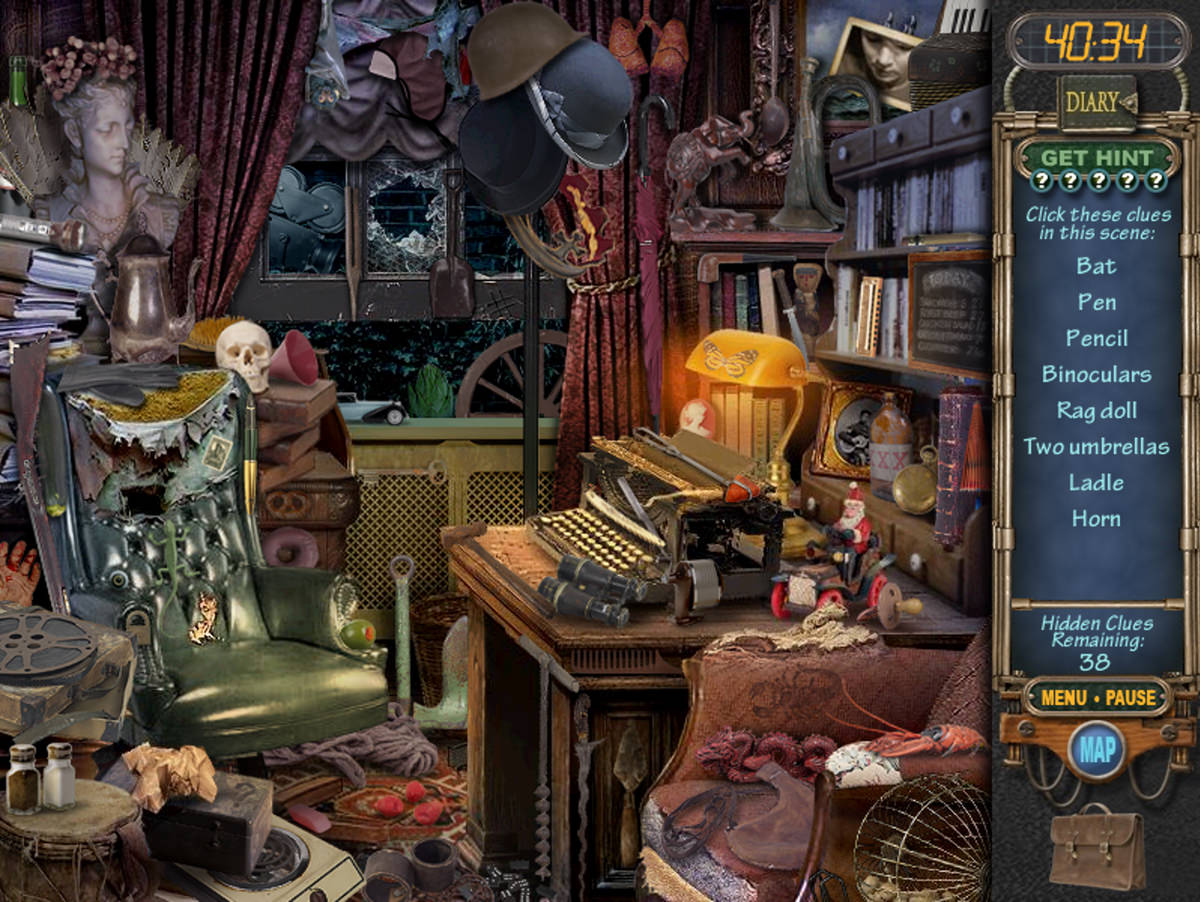
The rooms and outdoor sections are static hidden object scenes where players search for items listed in randomly generated word lists. This randomisation leads to varied playthroughs, but also to situations where the same objects must be found repeatedly within a single playthrough, as locations are revisited time and again.
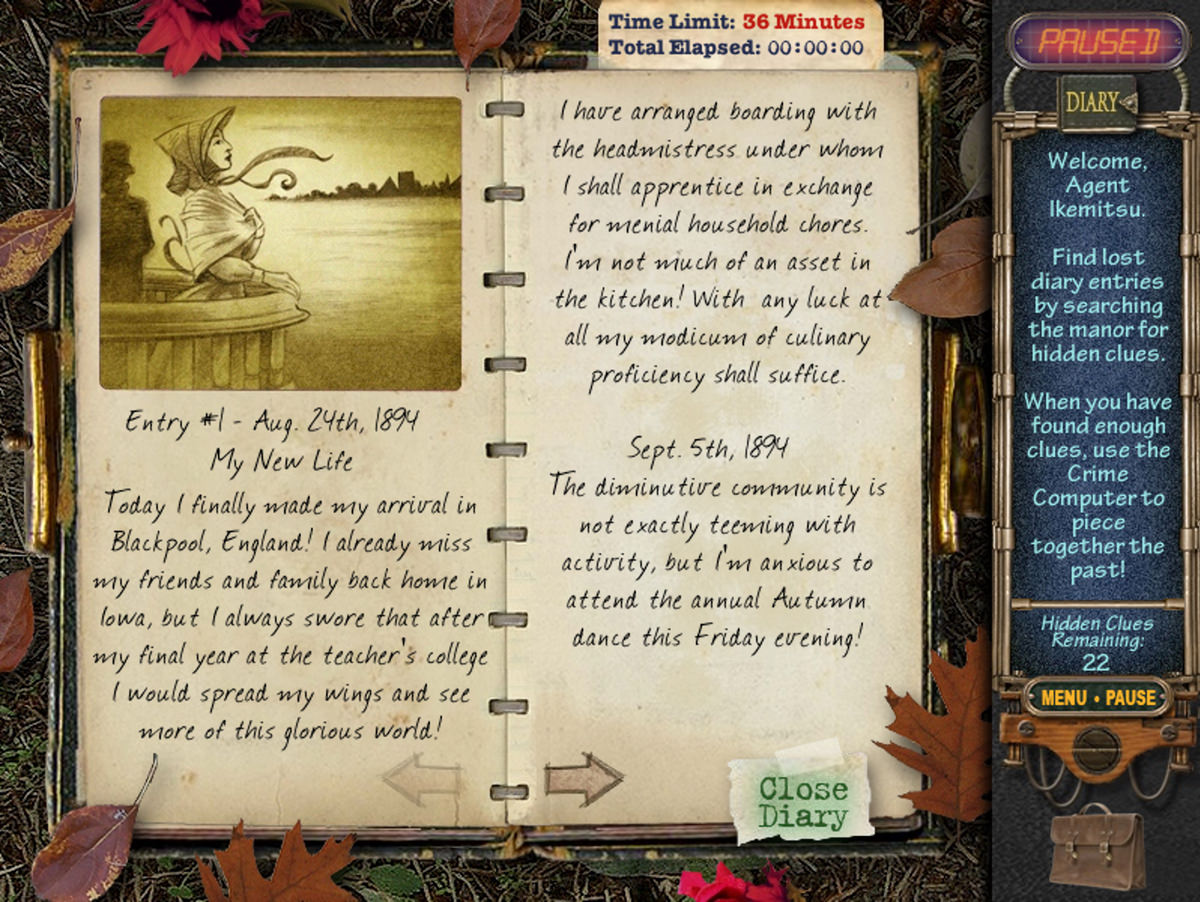
The word lists lack any real narrative justification, and in this respect Ravenhurst continues the same unrealistic approach found in the series’ first two games. The player never physically discovers any diary pages. Instead, once a required number of objects has been found, a new diary page — or rather, a two-page spread — is revealed.
The diary’s author, Emma Ravenhurst, is a young American woman trained as a teacher who arrives in England full of curiosity about life and the world. The diary spans the years 1894–1895 and recounts her relationship with a mysterious gentleman named Charles Dalimar. Emma rejects Dalimar’s proposal, yet later moves into the manor he had built after falling seriously ill. The diary consists of twenty chapters.
Emma’s story is a horror tale — a shallow one, but resonant in its broad themes. Based on Ravenhurst alone, I would not expect the story to continue, which makes it somewhat surprising that it went on to spawn several sequels. The seriousness of the narrative, or at least its semi-serious tone, stands in sharp contrast to the humour of the series’ first two entries.
The late-19th-century setting also gives the game a clear historical frame of reference. The game’s present-day framing likely takes place sometime in the 1950s.
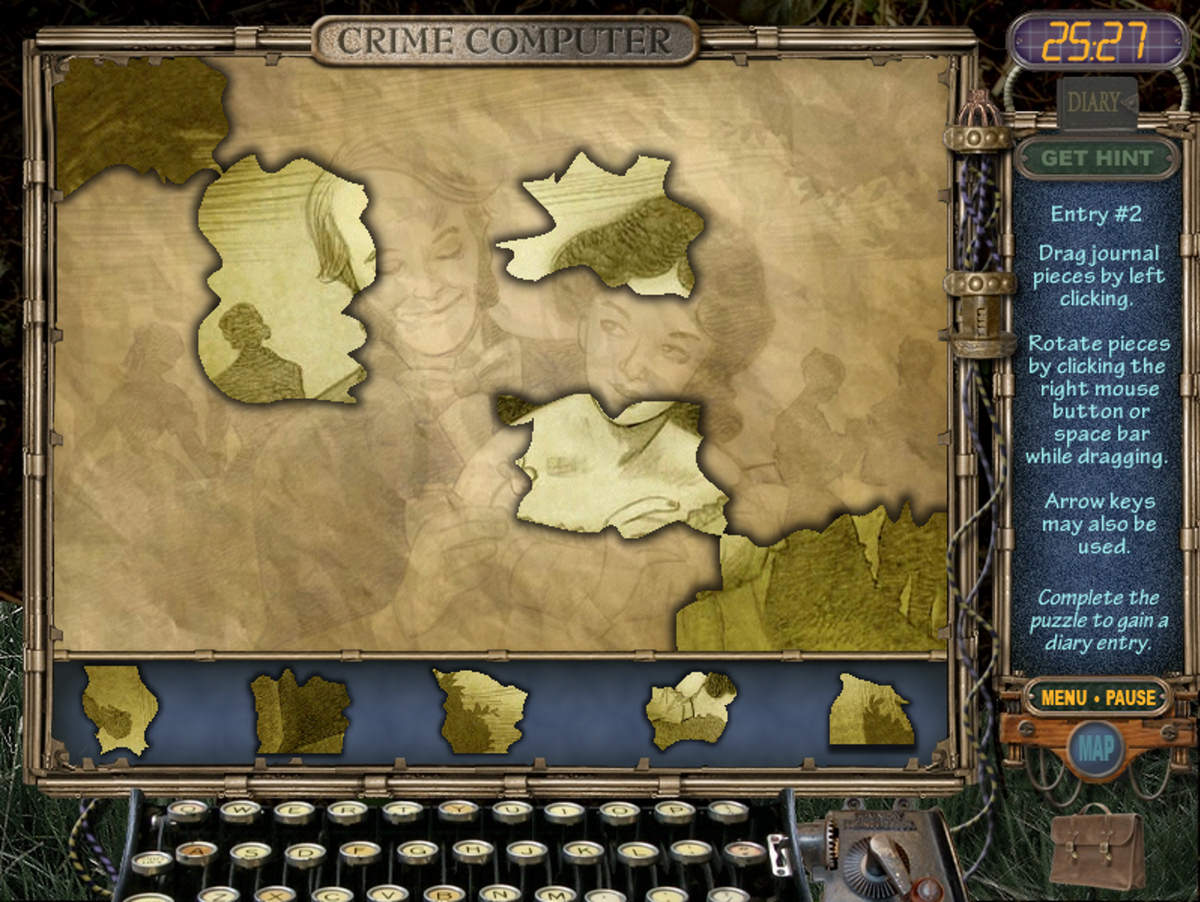
Ravenhurst’s visuals feel more refined than those of Huntsville and Prime Suspects, at least in that the search scenes appear clearer. Objects no longer seem quite as aggressively layered on top of one another. The scenes remain messy, but the identification problems I encountered earlier were gone.
I cannot say for certain whether the resolution itself has improved, but the presentation has clearly been cleaned up. Finding objects posed very little difficulty for me; the task was almost too easy.
The agent’s working environment is defined not only by visuals but also by sound. The background music aims for a mysterious tone, but it tends to blur into the ambient noises: creaking doors and floorboards, a cat’s meow, ticking and chiming clocks, ghostly voices, and other thoroughly clichéd horror sounds. Over several hours of play, the soundscape became overly familiar.
Locked doors — where it all began?
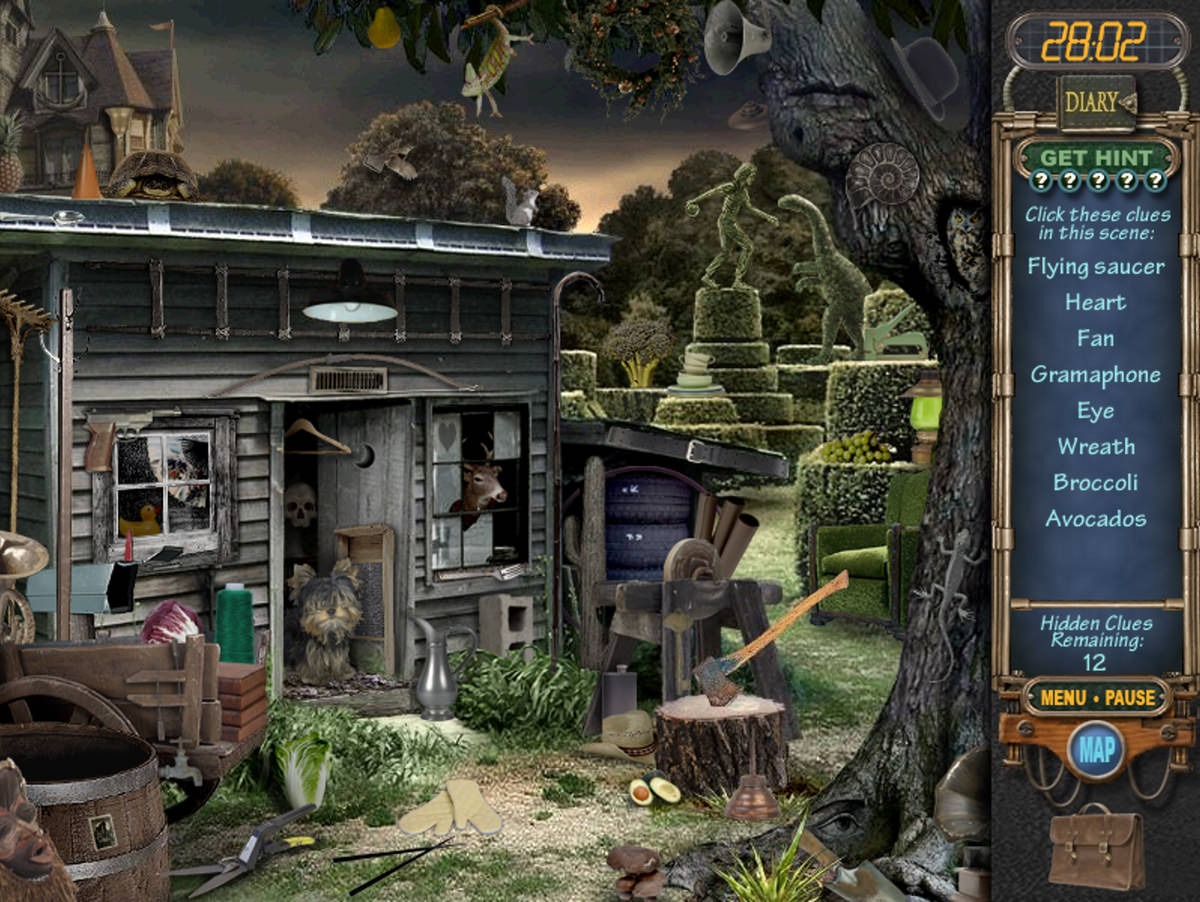
The defining feature of Ravenhurst is its locked doors — or more precisely, their locking mechanisms. One cannot help but wonder whether this is where hidden object games’ obsessive relationship with locks began. It is possible. In Ravenhurst, however, these mechanisms are not yet a cliché, but a genuinely interesting new feature.
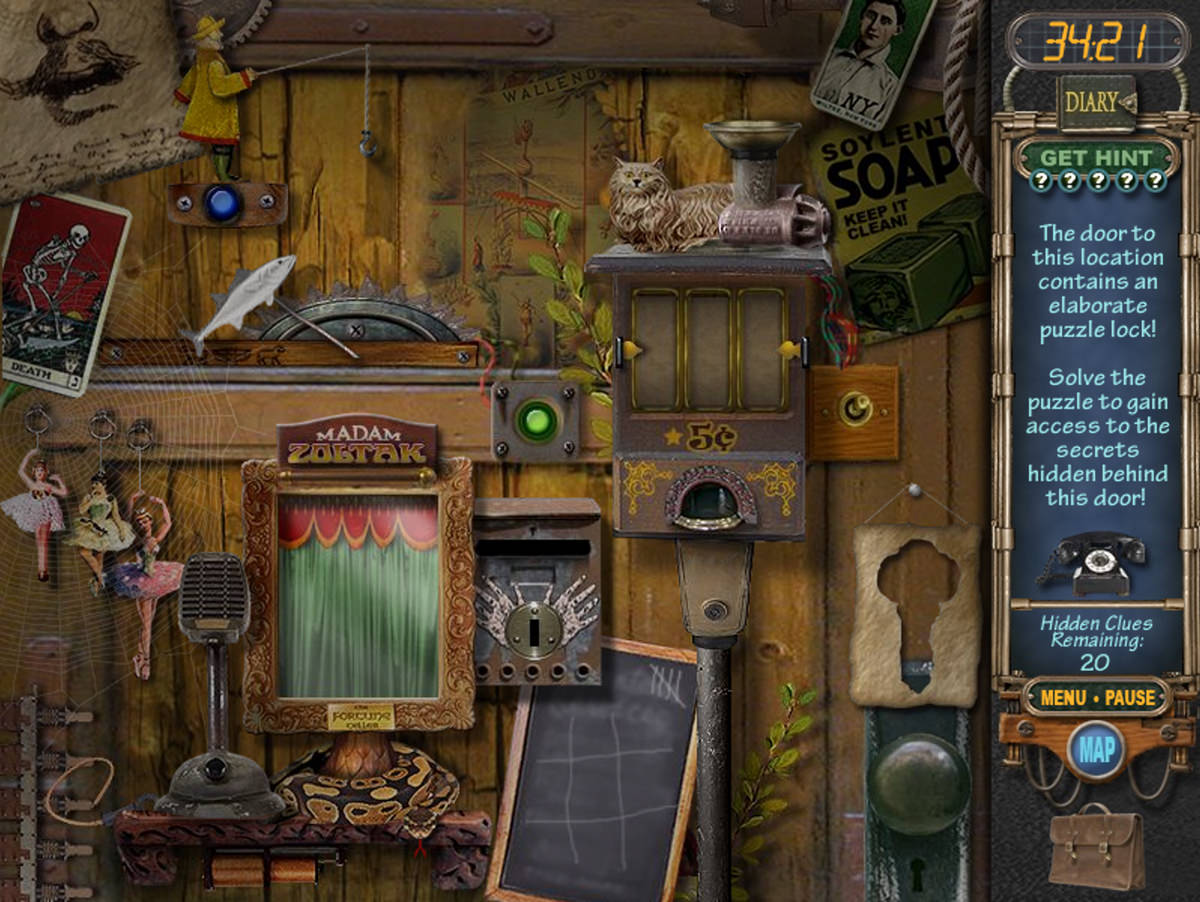
The manor’s locks are wildly imaginative constructions. They have been compared to the machines of American inventor Rube Goldberg. They can be seen as early minigames — a concept that would later become standard in the genre — but in Ravenhurst they function as a central gameplay mechanic.
Each locking mechanism presents a different puzzle. These are multi-stage mechanical processes that the player must initiate and set in motion. While the door puzzles can be skipped if they become too difficult, Big Fish Games also sold a strategy guide specifically for them.
Ravenhurst’s puzzles impressed me in much the same way as those in Madame Fate. They are not particularly difficult or mechanically sophisticated, but they are creative and, in their own grotesque way, surprising. These are precisely the kinds of minigames I enjoy: genuinely individual ones.
In more recent hidden object games, the same puzzle types are repeated endlessly with only minor variations. Imagination disappears, and the player becomes an automatic problem-solving machine, guided purely by prior experience.
Verdict
I completed Ravenhurst in six and a half hours. At the start of the game, the player may choose whether to play with or without time limits. I opted for timed play but did not fail even once. This likely reflects either the game’s ease or the fact that I had already played the two previous entries. Perhaps I had learned the series’ logic for hiding objects and refined my strategy accordingly. I had also grown accustomed to playing with time limits and no longer found them stressful. That said, I did make some use of hints when I felt stuck.
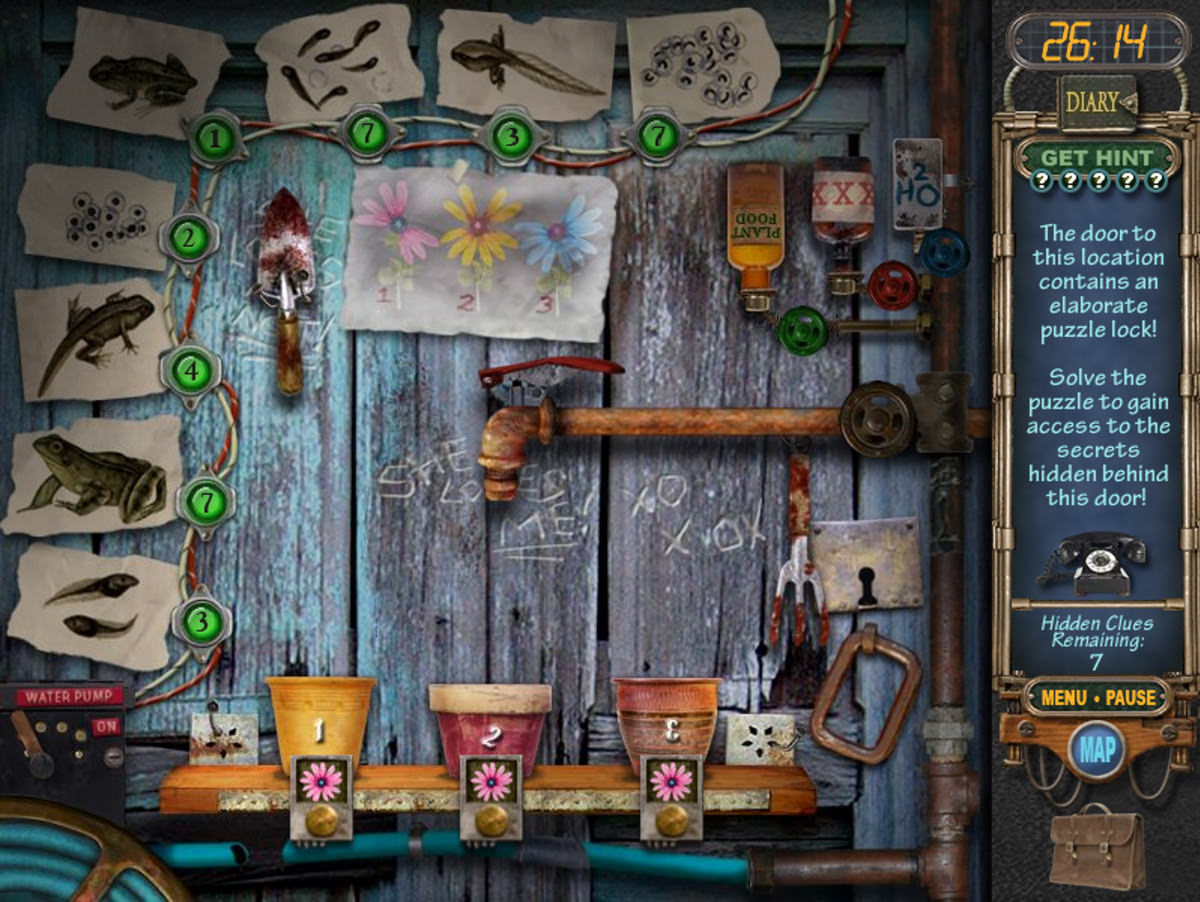
Ravenhurst feels like a harbinger of features that would later become standard in hidden object games — to the point where they eventually came to signal the genre’s decline. It introduces locked doors, a more adventure-like narrative, and reinforces the minigame concept through jigsaw puzzles. In Ravenhurst, the player does not truly live the story but encounters it indirectly, through fragments. Even so, the difference compared to the first two Mystery Case Files games is substantial. Their narratives are so fragmented that they barely qualify as stories at all; they are little more than crime investigations. Ravenhurst, by contrast, I would not even classify as a detective story.
The game’s seriousness and historical framing resonated with me, even though it is, of course, a light casual game. The unusual locking mechanisms were another clear highlight. I rate my overall experience at 64 out of 100.
Availability
Ravenhurst is available for Windows and macOS, and was also released for the Nintendo DS.