
Mystery Masterpiece: The Moonstone (2009)
The Victorian Mysteries trilogy, released between 2009 and 2012, follows in the footsteps of the long-running hidden object staple Mystery Case Files. Instead of original backstories, however, The Moonstone, Woman in White, and The Yellow Room draw directly from literature — specifically from pioneering detective classics by Wilkie Collins and Gaston Leroux. I was interested in these games precisely as literary adaptations. As hidden object, puzzle, or adventure games, there is nothing particularly distinctive about their mechanics. I hesitate to call them good, but they are certainly playable and easy enough, and the historical character of both the games and their stories appealed to me. In this blog post I focus on the first game and will return to the other two later in their own articles.
Victorian Mysteries is a production by the American studio Freeze Tag, with Craig Holland as the lead designer. The Moonstone is released under a different prefix (Mystery Masterpiece) than the other two parts of the trilogy (Victorian Mysteries), but they can nevertheless be grouped under the same series.
Smoothing out the novel’s twists
The first entry in the trilogy, The Moonstone, is based on the epistolary novel of the same name by the English author Wilkie Collins (1824–1889), originally published in 1868 and considered one of the earliest works of modern detective fiction. The story centres on a valuable diamond that the young Rachel inherits on her eighteenth birthday — only for it to vanish immediately.
The game is presented from the perspective of Detective Cuff, who seeks both the thief and the motive. In this respect it diverges from the novel’s structure and viewpoint, as the book’s active agent is Rachel’s beloved Franklin, and the narrative is shared between multiple narrators. The game also compresses the timeline considerably: the case is solved the day after the theft, whereas the novel unfolds over more than a year. Furthermore, the novel’s multiple locations are reduced to a single setting in the game — Rachel’s family estate. The culprit is the same in both book and game, but the game attempts to emphasise the thief’s premeditation, which in fact undermines the story’s credibility.
Expanding suspect profiles
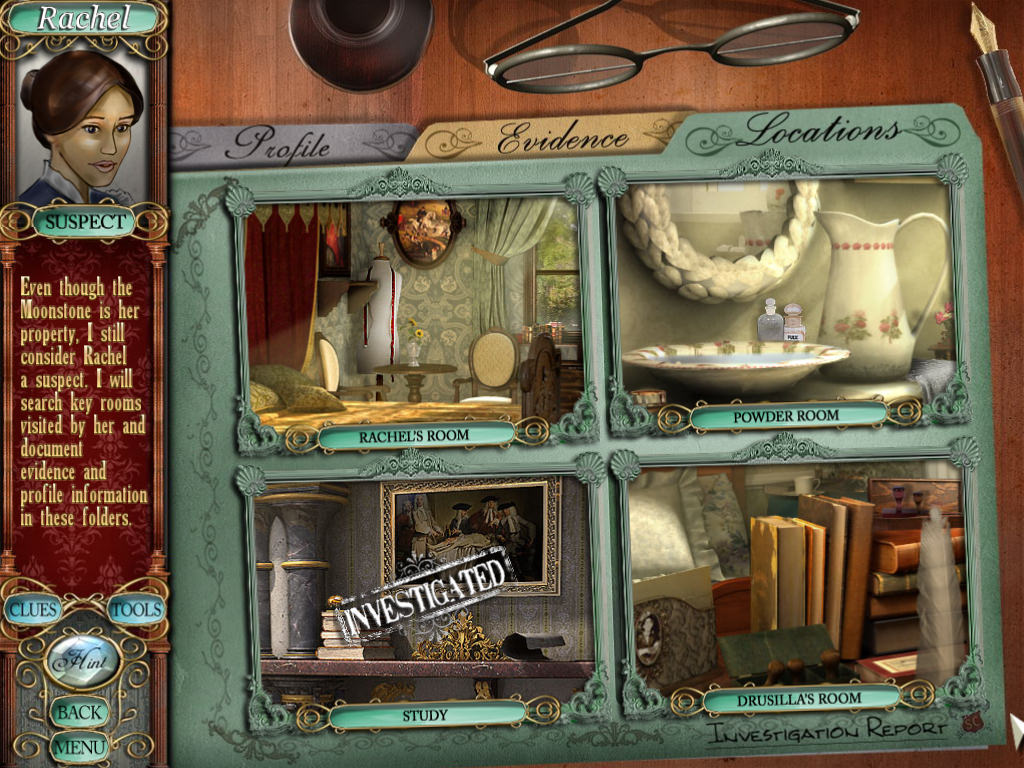
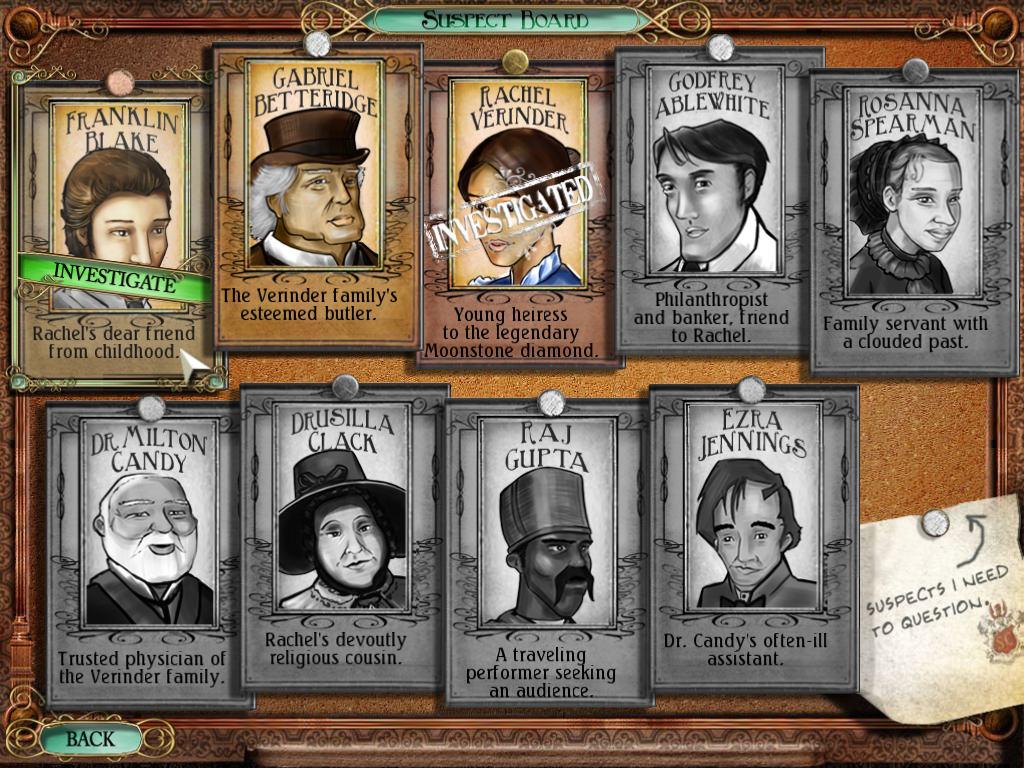
Detective Cuff considers all those present in the house at the time of the crime as suspects — including Rachel herself, the owner of the diamond, and Franklin Blake, who summoned the detective. There are nine suspects in total. For each suspect, evidence is gathered from four rooms. Some locations overlap, and the game features eighteen rooms in total. Objects are searched for based on word lists.
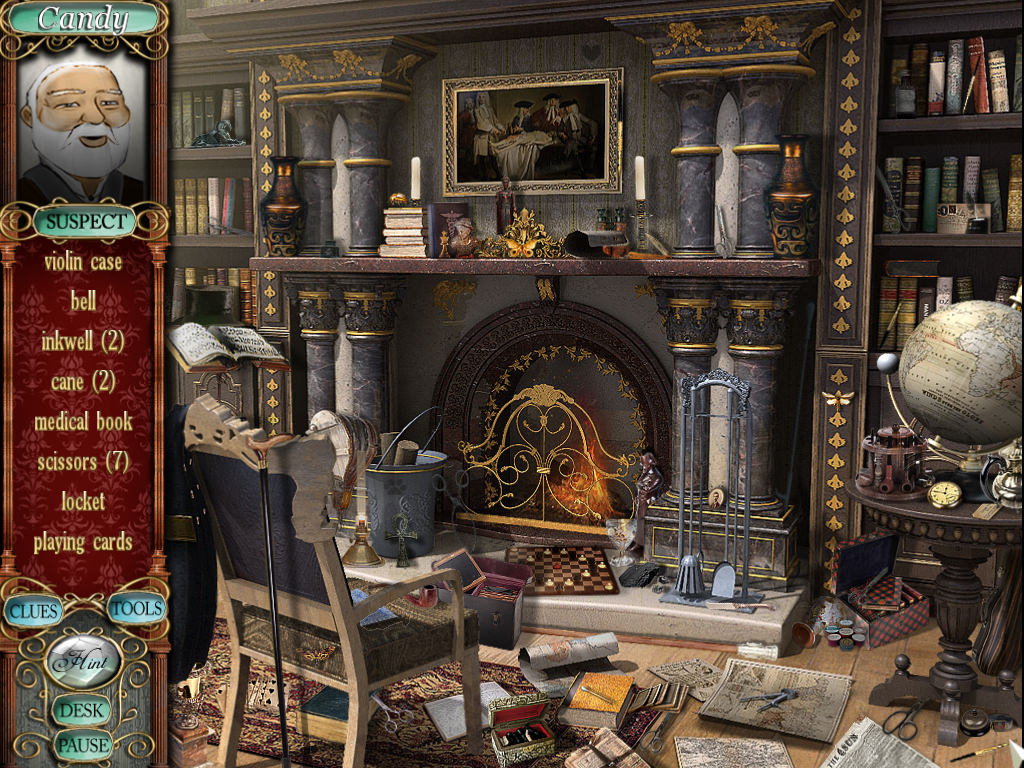
In each room, one item on the word list is either a piece of evidence or a “key” to that evidence. The game uses a simple inventory system, through which these keys are transferred to another room where they are needed to find, assemble, decipher, or open evidence. Evidence items take the form of mini-games, such as translating text or revealing hidden writing. These are not true puzzles but simple inventory-based interactions.
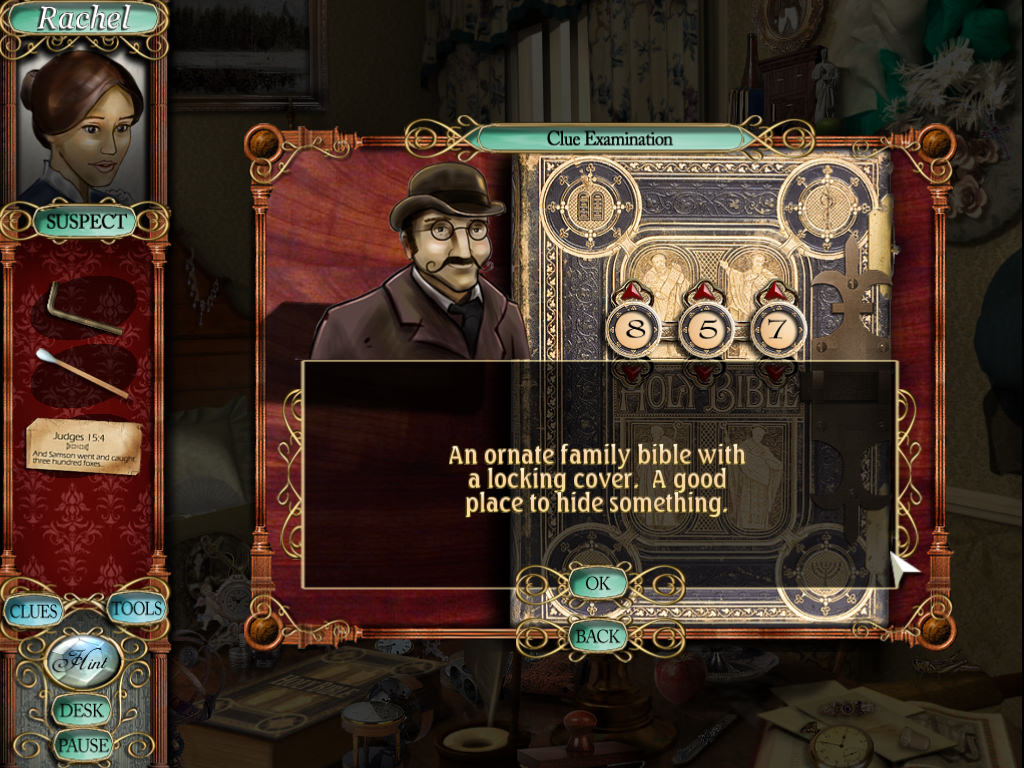
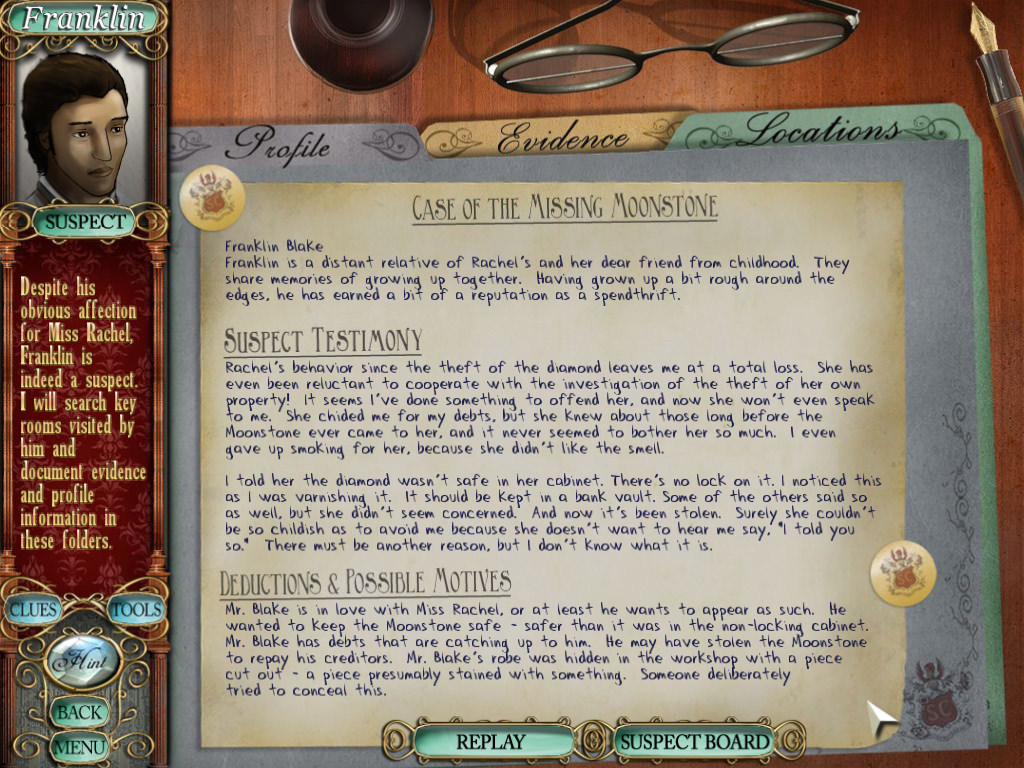
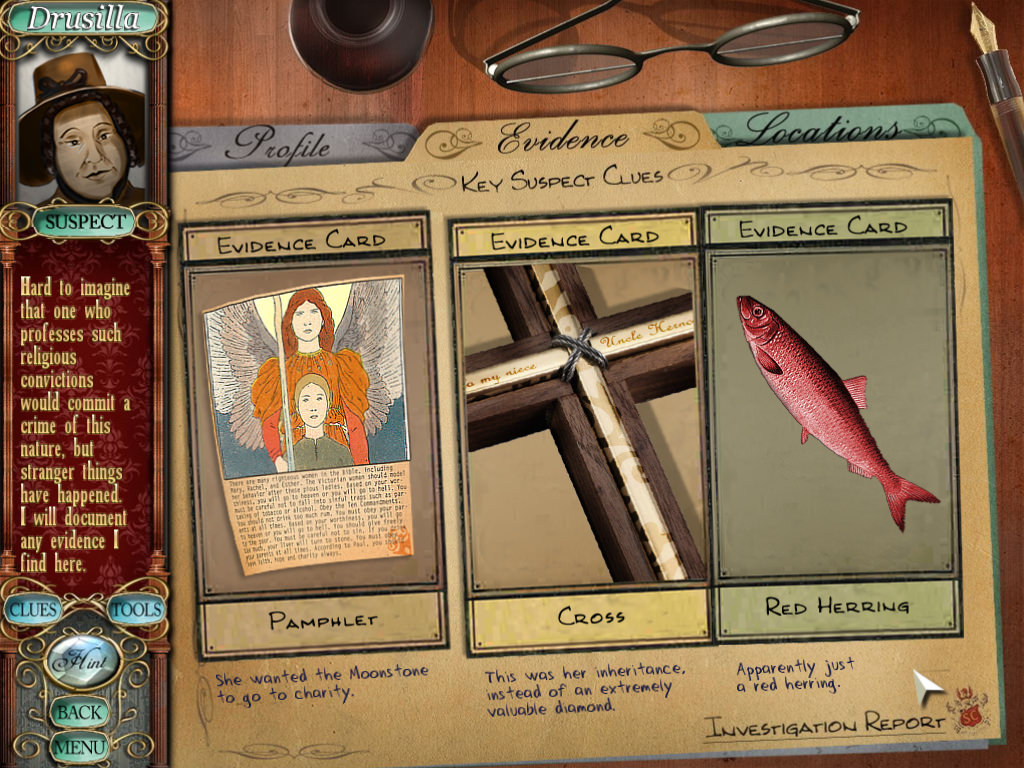
Once three pieces of evidence have been found for a suspect, Cuff interrogates them and their file is updated. It turns out that all suspects have a motive to steal the diamond. If you know the novel’s plot, the culprit is obvious, but if you do not, I would argue that anyone could be guilty based on the evidence presented. In that sense, the game does not really work. The player cannot deduce the culprit with certainty. Clues do exist, but the plot twist is surprising enough that the game fails to guide the player towards it. Incorrect accusations do not matter, however — you can accuse suspects repeatedly until the correct one is found.
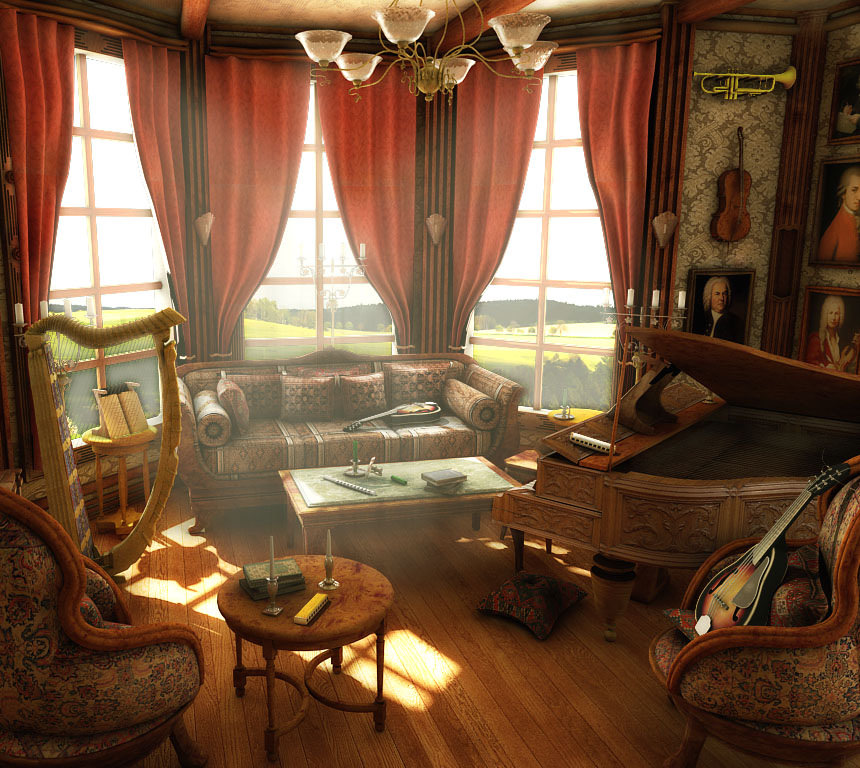
The hidden object scenes are forgiving: the game does not penalise random clicking, and hints will reveal item locations when needed. The most challenging aspect is hitting items accurately, as the hitboxes are tight — effectively pixel-precise. This is somewhat contradictory, given the low resolution and slight blur of the graphics. Even so, I found the 862×768 backgrounds acceptable on a 2560×1140 display, and even small objects were discernible. Aside from the precision issue, difficulty in the search scenes ranged from easy to moderate. Repeated visits to the same locations made searching easier.
Finding and reading everything took me about three hours.
On a tight budget?
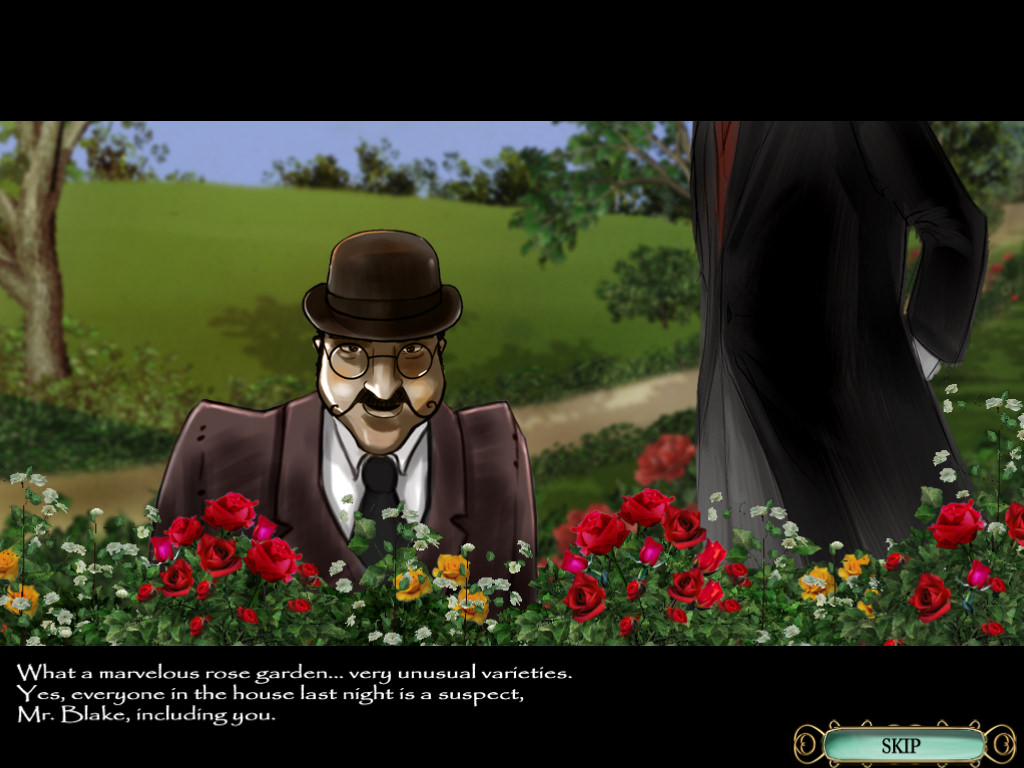
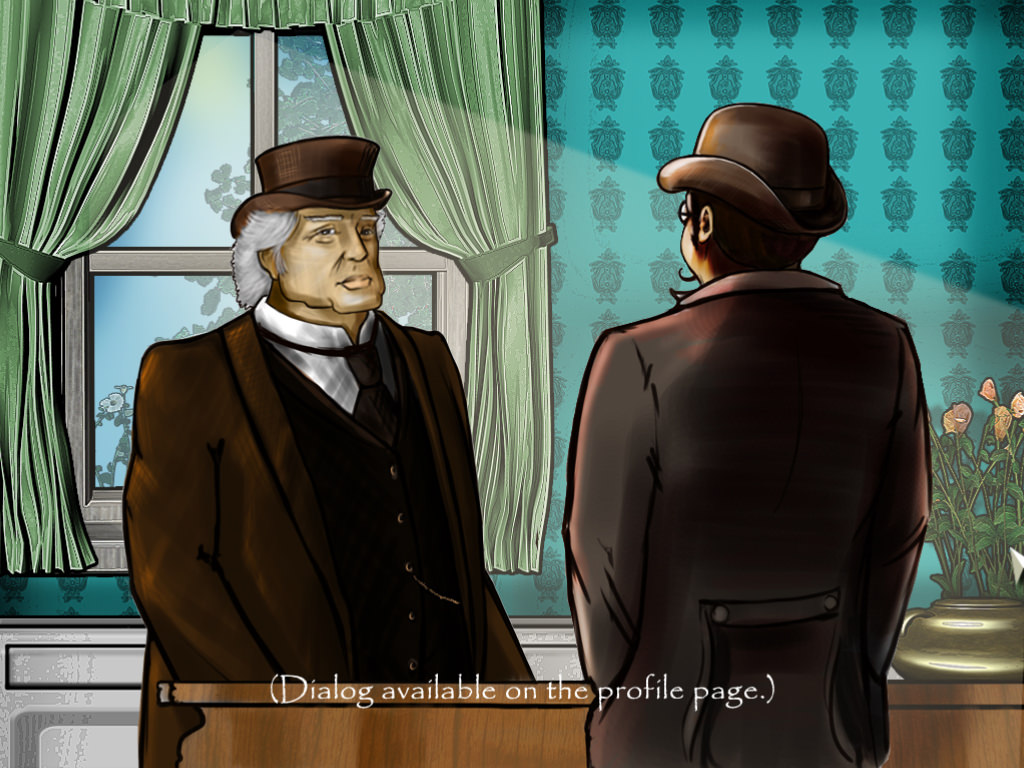
The game’s visuals are somewhat inconsistent, and not in a good way. I liked the photographic backgrounds of the search scenes, and the interface has an appropriately historical feel, but the character portraits are less impressive. A graphical exception is the game’s opening intro, which uses a line-drawing style.
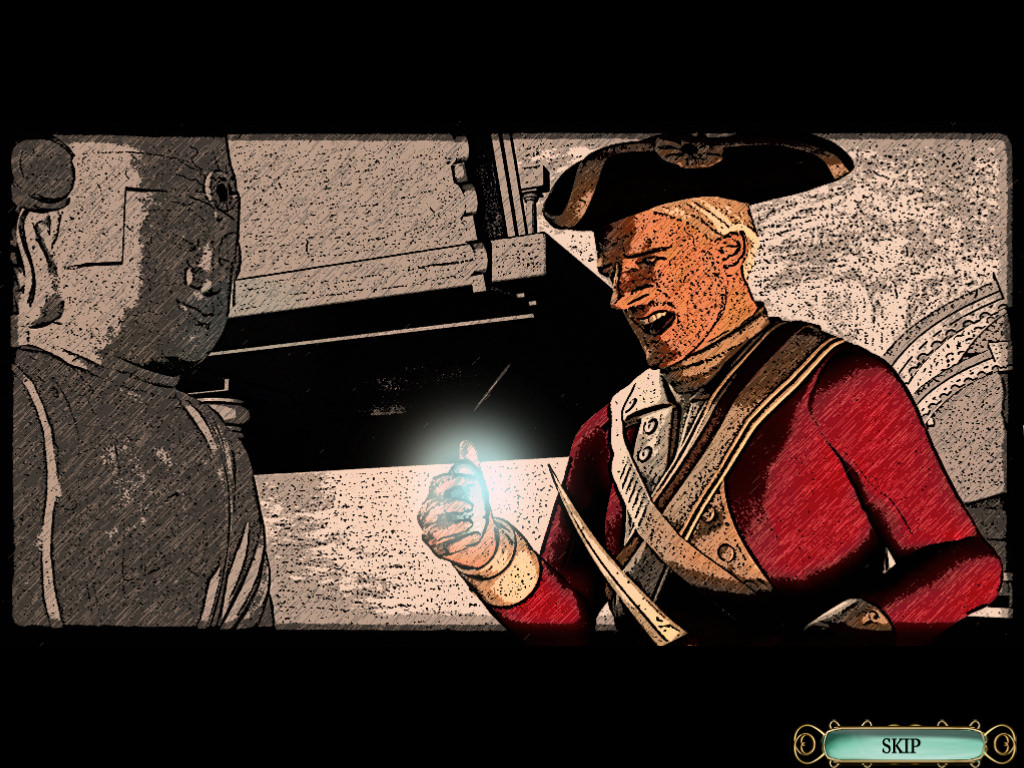
The game is fully voiced. I found Cuff’s voice and those of a few other characters appropriate, but Rachel’s and Franklin’s voices did not suit such young characters. In the interrogation scenes, spoken dialogue is present, but there is no animation and no subtitles. The lack of subtitles felt like a genuine shortcoming. The suspect’s statement can, however, be read in text form in their file.
Beautiful classical music by Tchaikovsky plays in the background. Each suspect has their own piece. Together, the music and graphics give the impression of a production made on a tight budget. The game’s age alone does not sufficiently explain this.
Verdict
Released in 2009, The Moonstone clearly borrows from the first two entries in the Mystery Case Files series — Huntsville and Prime Suspects — which I have previously reviewed on Samooja. Those games were released as early as 2005 and 2006. The Moonstone’s strengths lie in its seriousness and its attempt at an authentically historical tone. The underlying detective novel is, of course, of high quality as well.
In my own experience, basic searching in a historical setting was engaging enough to carry the game. The combination of inventory use and word lists is handled very simply but quite nicely, preventing the game from drifting too far towards a full adventure game. The attempt to gamify a detective classic is not entirely successful, but the game did make me aware of the novel on which it is based — a work I had not previously known. I would rate my overall experience at 52 points out of 100.
Availability
Mystery Masterpiece: The Moonstone is available for Windows and macOS computers as well as for iPad and iPhone — though compatibility with newer Apple platforms is not guaranteed, and availability is inconsistent. I played the Windows version via Steam.
The games in the trilogy have also had compatibility issues on Windows 10 and Windows 11. I resolved my own launch problems by installing Microsoft Visual C++ Redistributable X86. Steam forum discussions also suggest disabling fullscreen optimisations in the executable’s compatibility settings, but in my experience this did not help. Installing the C++ X86 library did, and fullscreen optimisation should in fact remain disabled (that is, the box checked), as screenshots would not work otherwise.