
Loom (1990)
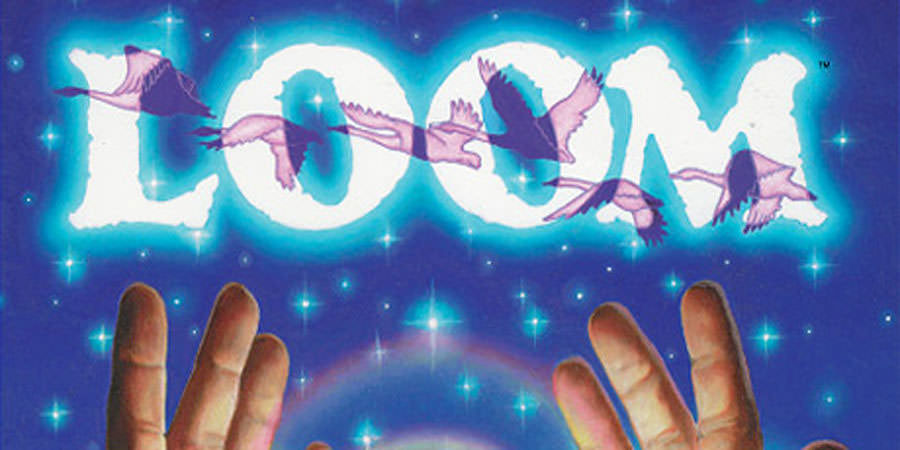
Loom is an adventure game released by LucasArts in 1990. It is very simple, yet mechanically quite interesting. The typical inventory-driven problem-solving of adventure games is taken to an extreme: the protagonist can carry only one single item, but it is remarkably versatile. It is a magical tool used to cast spells through musical notes.
Loom is set in a slightly ominous fantasy world. Visually, it draws inspiration from Disney’s 1959 film Sleeping Beauty. The game’s music is arranged from Tchaikovsky’s Swan Lake.
Loom was designed by Brian Moriarty (born 1956), and it was his first graphic adventure game. Before that, he had designed text adventures, including titles for Infocom. At the time of Loom, LucasArts (then Lucasfilm Games), founded by film director and producer George Lucas, was still a fairly small game studio. Two sequels were planned for Loom, but they were never made. This was not because Loom failed commercially, but rather due to limited resources.
Concrete groundwork
The backstory functions as a kind of myth about world ages. When the game begins, a “third shadow” is about to sweep across the world. When Loom was originally released on floppy disk and CD-ROM, it came with an audio cassette containing a half-hour radio play that explains events leading up to the game.
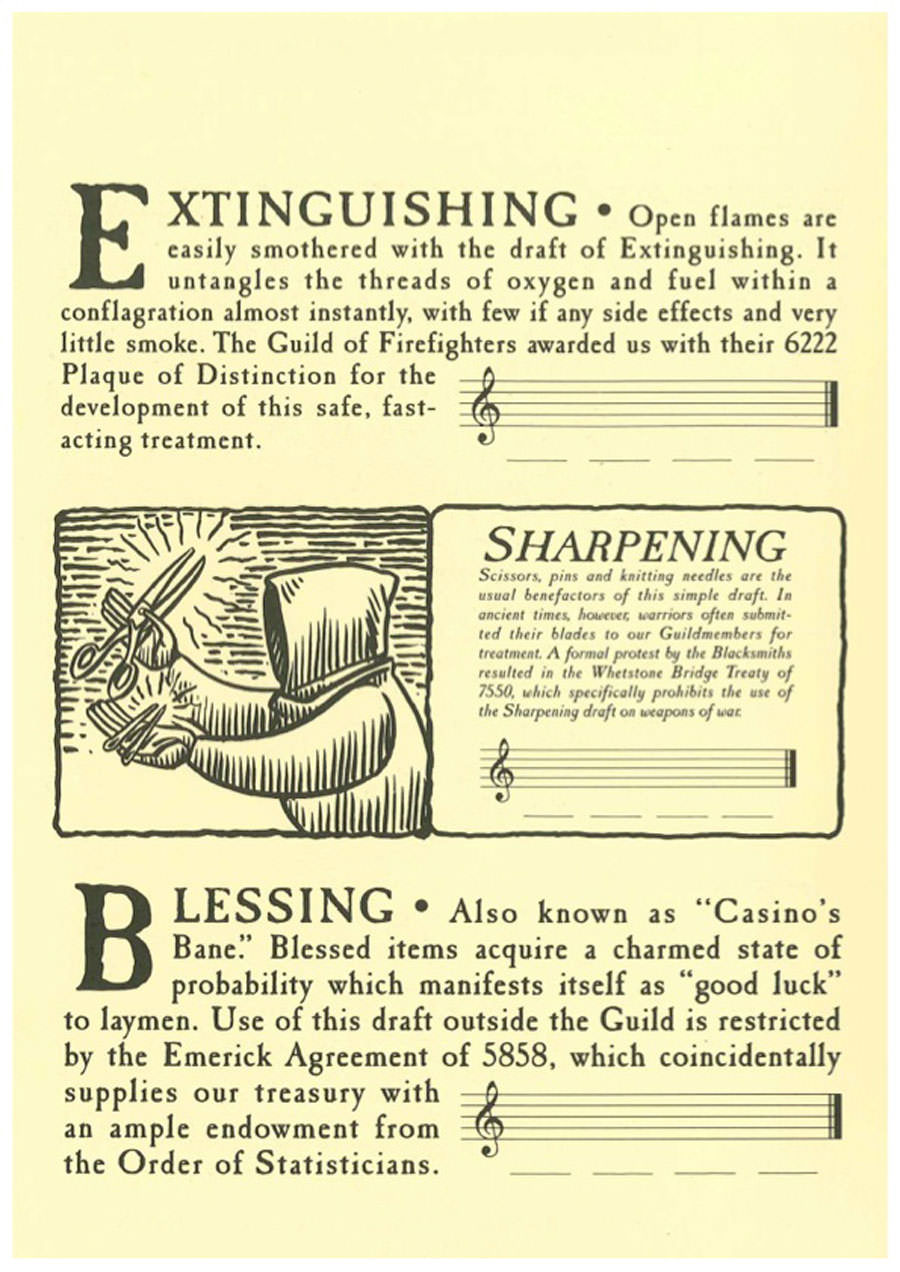
The package also included a Book of Patterns booklet. It contains empty musical staves for writing spells down, along with background information on each spell. I bought Loom as a downloadable version, which did not include the radio play, but the booklet was provided as a PDF.
An unfortunate young weaver
The player controls a 17-year-old weaver boy named Bobbin. The world is inhabited by various trade guilds, and the Weavers are one of them. Their craft has risen to an elevated, almost immaterial level. They can reshape the world using only light and sound. This has made others fearful. The Weavers’ Guild has been shunned by the other guilds, and lives in isolation on its own island.
The Weavers’ gradual move towards the immaterial has also led to an inability to reproduce, and children are no longer born naturally. Their numbers have dwindled, and the guild is dying out. It would be possible to weave children on the Great Loom, but the Elders consider this dangerous, believing it would summon Chaos into the world.
Despite the ban, a woman threads a single grey strand into the Great Loom, and Bobbin comes into being. When the Elders learn what she has done, they punish Bobbin’s mother by turning her into a swan and casting her out. Bobbin, however, is allowed to live until the age of seventeen. When the game begins, the day has arrived when the Elders will decide Bobbin’s fate.
Suddenly, Bobbin’s mother appears at the gathering in swan form. Events unfold so that Bobbin is left as the only Weaver still in human shape, while the others flee as swans into another plane. Bobbin wants to follow them, and decides to leave the island to search for the swans. He asks everyone he meets whether they have seen any swans, but the search is hopeless, because the swans are not part of this world.
The difficulty of weaving
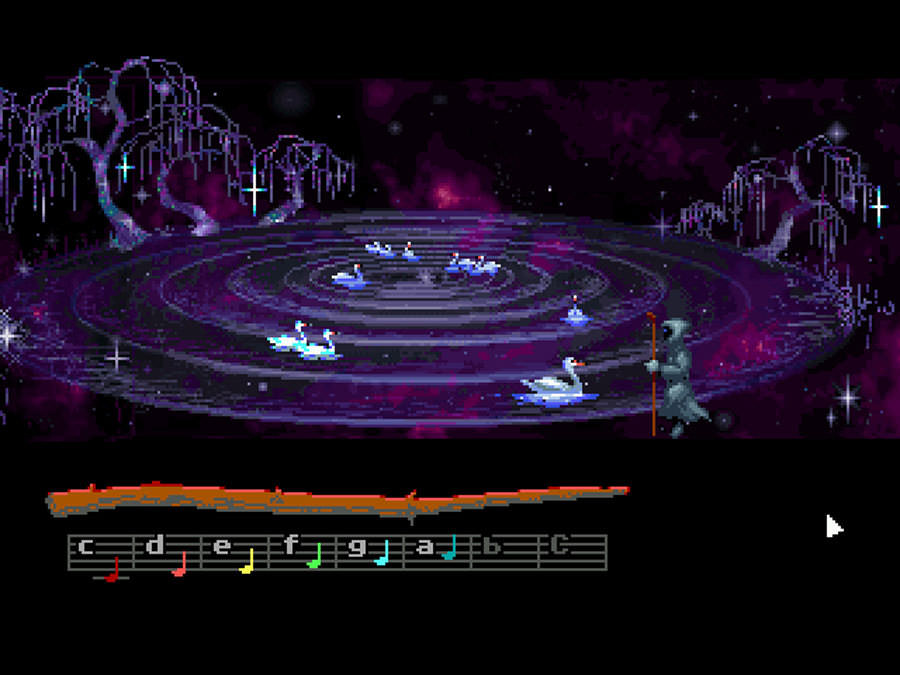
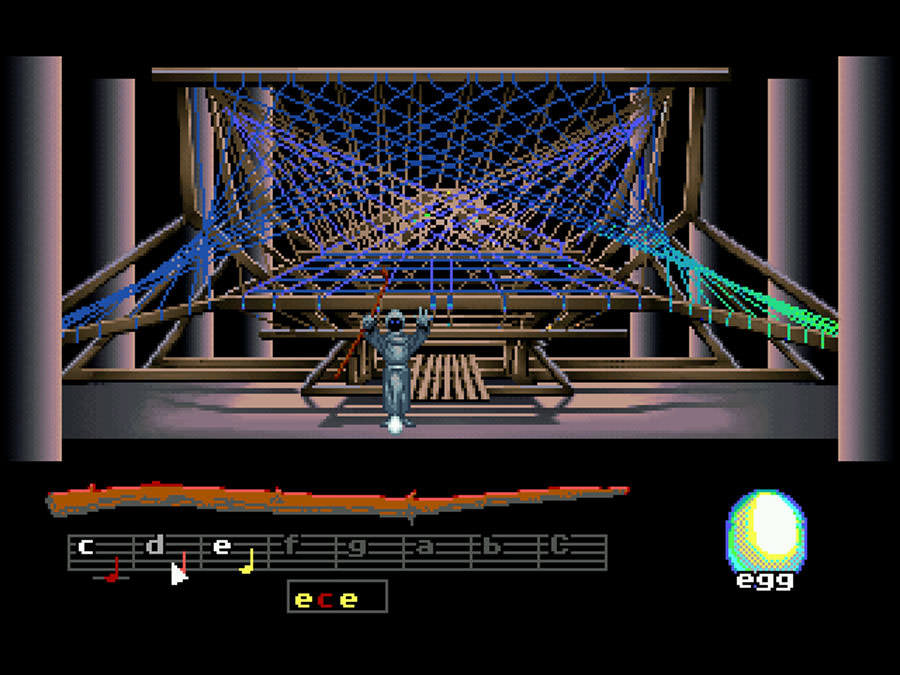
Bobbin’s problem is that he barely knows any spells. The Elders have prevented him from learning, but the midwife who cared for him has secretly taught him the basics. The player must now begin collecting new spells from the environment. The spells are always four notes long, and they are cast by pointing the staff at the target. This staff is the only item you carry, and in practice every task and obstacle is solved through it.
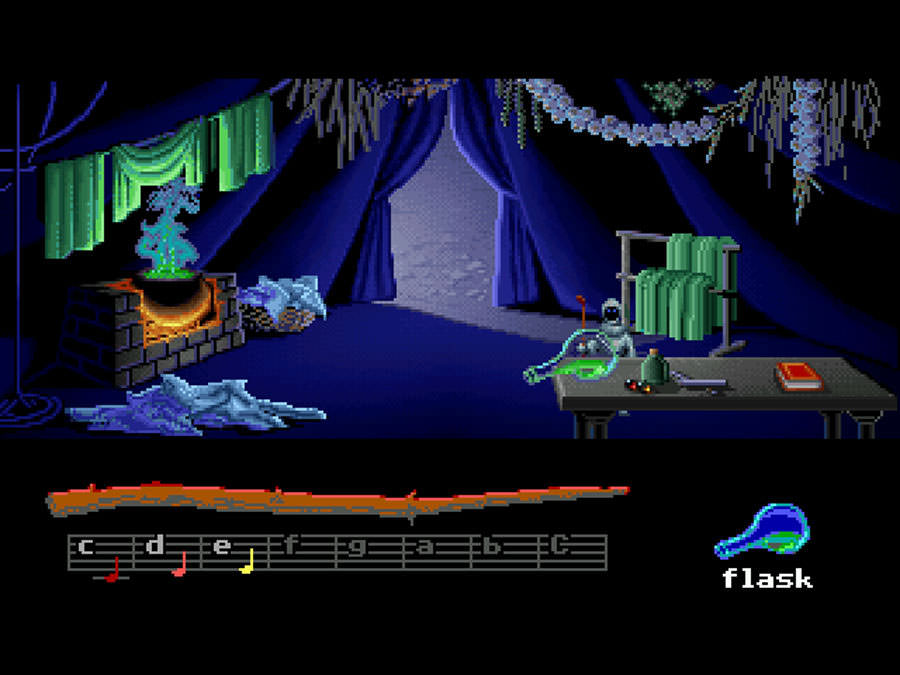
Loom offers three difficulty settings. I played on the easiest one, and even then the game proved too difficult for me. I could not fully internalise the way of thinking it demands. That feels slightly embarrassing, as I initially dismissed the game as something for children and assumed it would be overly simple. Collecting spells from the environment is not difficult: they simply have to be written down immediately when heard, using pen and paper in a very literal sense. Working out what each spell actually does is another matter. Some spells can even be played backwards to produce the opposite effect, which was not an obvious insight to me.
On the easiest difficulty setting, the game displays a musical staff with the notes labelled as letters (C, D, E, F, and so on). Spells are cast by clicking the correct pitches on the staff. On higher difficulty levels, the player must rely entirely on listening and “play” the spell by clicking different positions along the staff.
Verdict
The one-item mechanic and the puzzles, which require a very particular form of reasoning, make Loom unusual. It undoubtedly belongs in collections that focus on the gems of the adventure genre. Still, because I struggled so much with it, I suspect it may not be entirely successful in its uniqueness.
The meta-level narrative is a rich fantasy construction, but it did not resonate with me. Afterwards, I reflected on its coherence and meaning, yet was left largely unsatisfied, especially because of the ending. A sequel was once planned, but it is unclear whether even that would have justified everything. Should fantasy be taken this seriously? In my view, yes.
Taking the game’s age into account, I give Loom an overall score of 70 out of 100.
Availability
Loom is available for modern operating systems (Windows, macOS, Linux), at least via GOG.com and Steam.