
The Longing (2020)
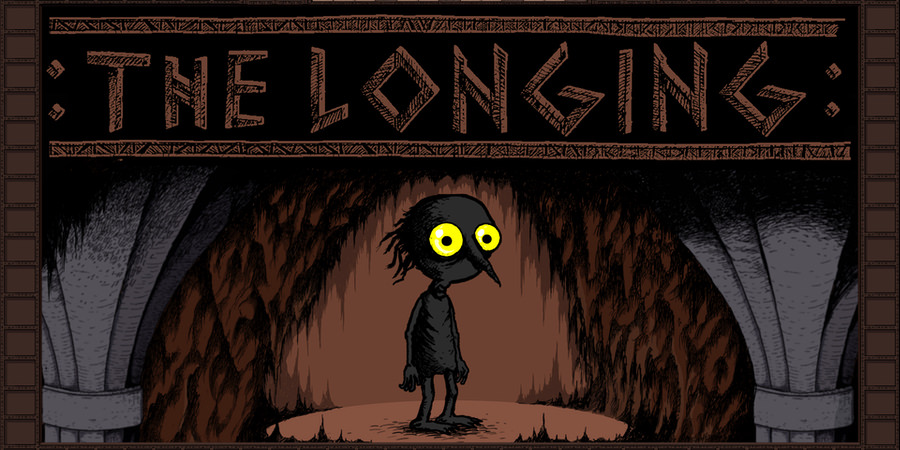
Released in 2020, The Longing is an idle game built around slowness, patience, and deliberate waiting. The king of the underground has fallen into a sleep that will last 400 days, and his servant, Shade, is left alone to pass the time with no obvious purpose. The game arrived at a fitting moment, during the COVID-19 pandemic, and many players found points of contact with their own situation. Shade lives as if in quarantine. He has no access to the surface world — or does he? The player’s task is to explore the vast cave system and uncover its secrets. I have nothing against The Longing, but little to argue strongly in its favour either. It is nevertheless a memorable experience, quite simply because its slowness places it in a category of its own.
The idea and almost the entire execution of The Longing are the work of Anselm Pyta. His three-person studio, Studio Seufz, was founded in Stuttgart in 2017 and produces both games and animation. Development of The Longing began in 2014 and took six years, so the pandemic was not its original inspiration. Instead, Pyta drew from the Kyffhäuser legend and from a visit to the Barbarossa Cave in Thuringia, Germany. The legend centres on Holy Roman Emperor Frederick I Barbarossa, who is said to sleep in a cave with his knights until the time comes to restore Germany to its former glory. This nationalist myth belongs to a broader, ancient tradition of a king or hero sleeping inside a mountain, known across many cultures. Pyta’s interest, however, was not in the emperor himself, but in his servant — a boy or a dwarf — and from this perspective the player-controlled Shade was born.
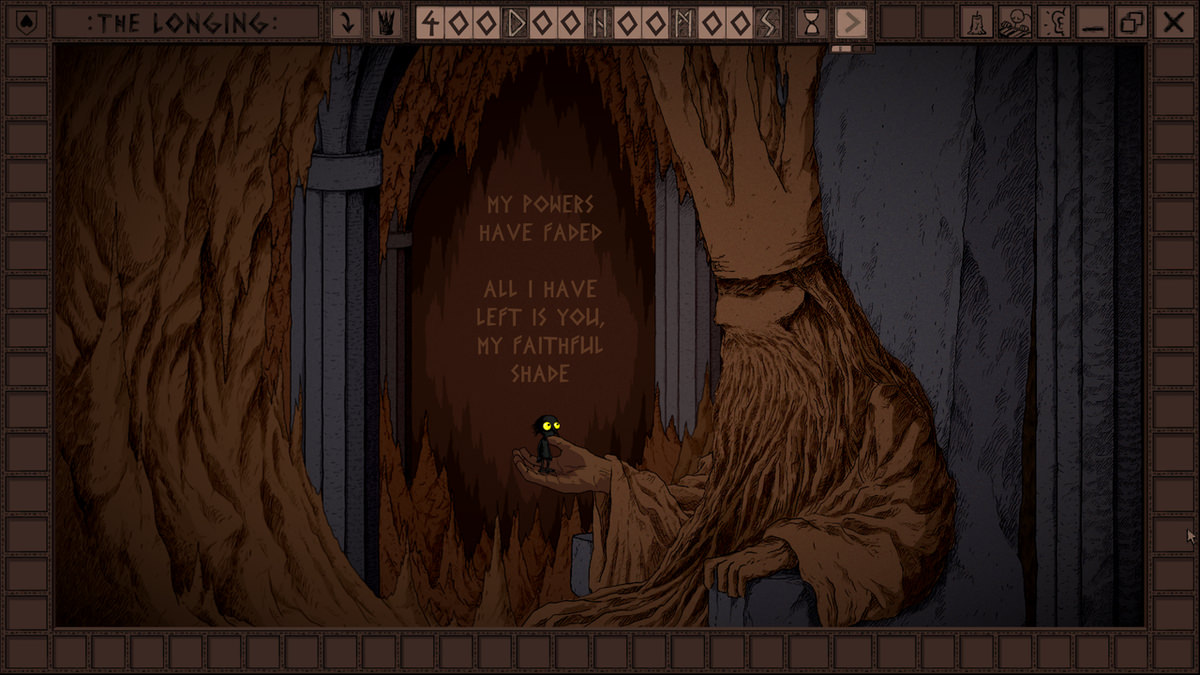
Slowly wandering towards...
The Longing rests largely on its melancholic atmosphere. A sense of loneliness permeates everything. Time seems almost frozen, and nothing of note happens unless Shade actively initiates it. One possible ending can be reached simply by waiting out the full 400 days without doing anything at all, but it felt natural to explore the surrounding world instead. The in-game days correspond directly to real-world days, and time continues to pass even when the game is not running. Certain actions can slightly accelerate the passage of time, but the effect is limited.
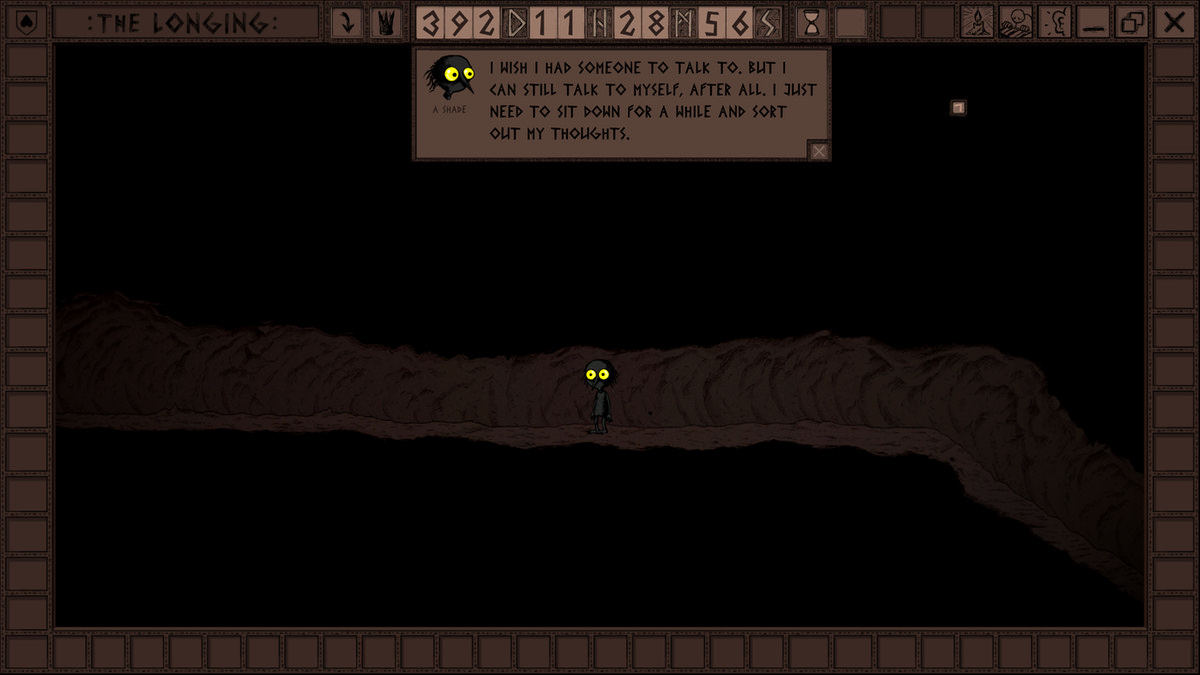
Shade’s walking pace is slow, and running is not an option. He trudges forward at the same unhurried rhythm everywhere. The ear becomes attuned to the sparse but evocative sound effects — above all, the soft slapping of Shade’s bare feet against the cave floor. There is music, but silence itself also functions as part of the soundscape. The occasional drip of coal fragments from the ceiling forms a distinctive rhythmic element.
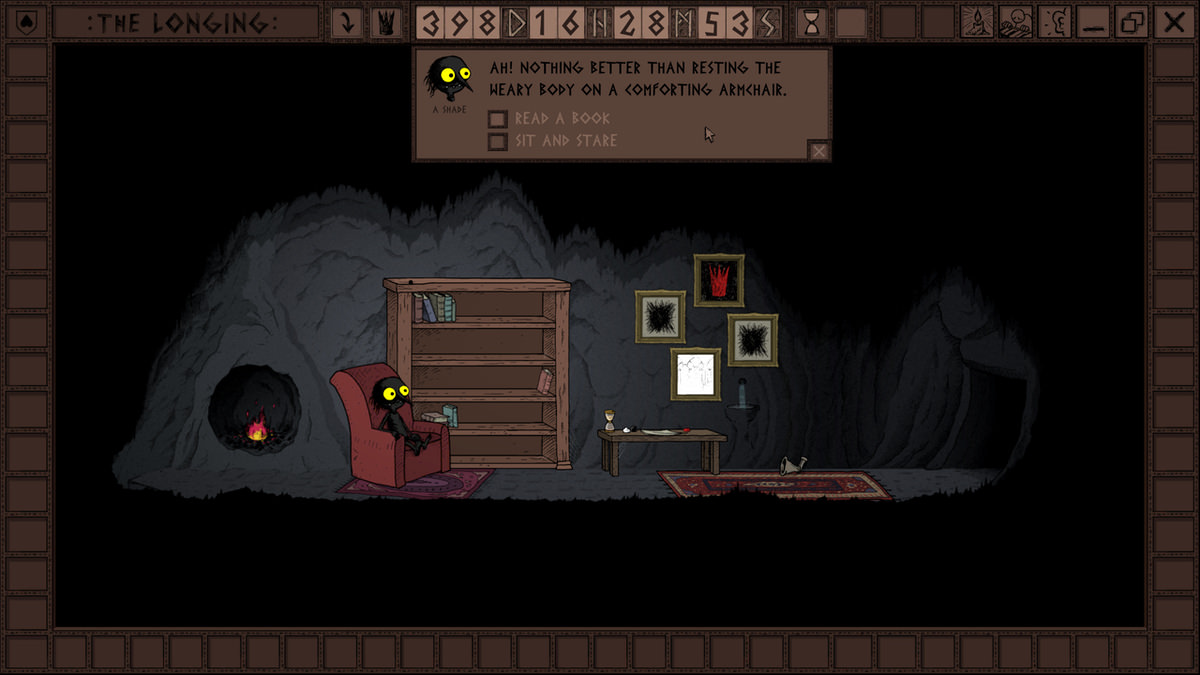
The player is free to set their own goals, and in that sense The Longing resembles a sandbox game. The most immediate task, however, is to make Shade’s home more comfortable. He can acquire more reading material, collect coal to burn in the fireplace, hang his own drawings and other decorations on the walls, and even expand the living space itself. All of this requires exploration of the cave system. Progress eventually comes to a halt at puzzles that demand waiting: water dripping, spiders weaving webs, mushrooms or moss growing. One process may take a day, another two weeks.
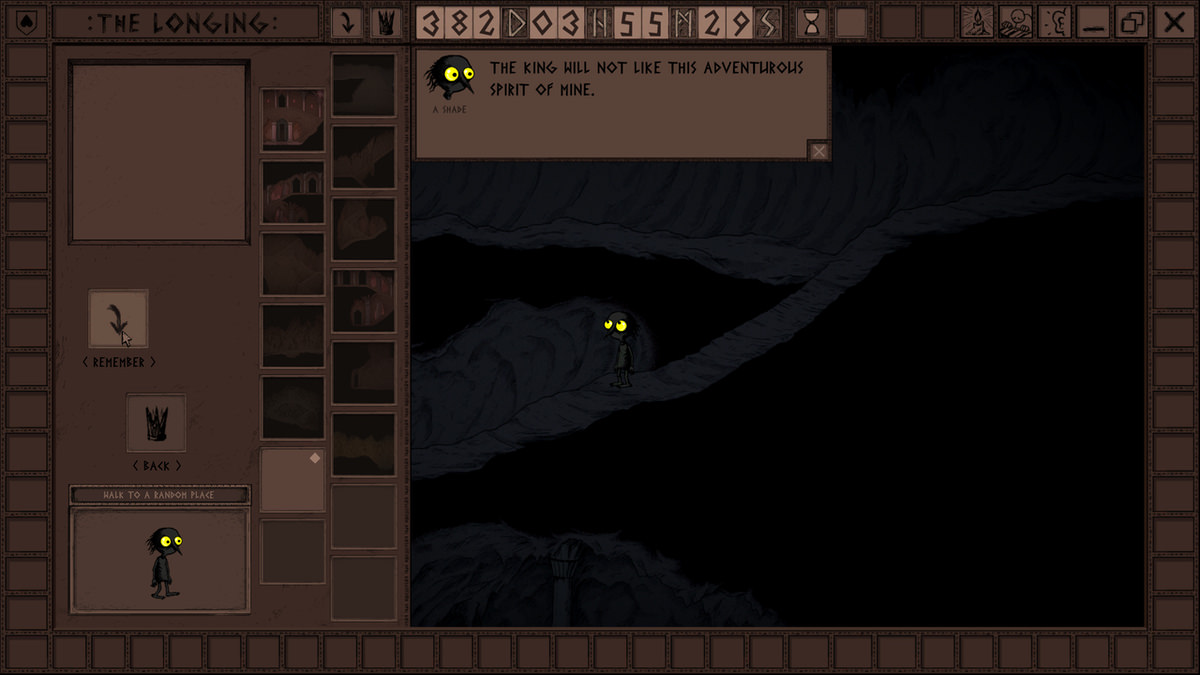
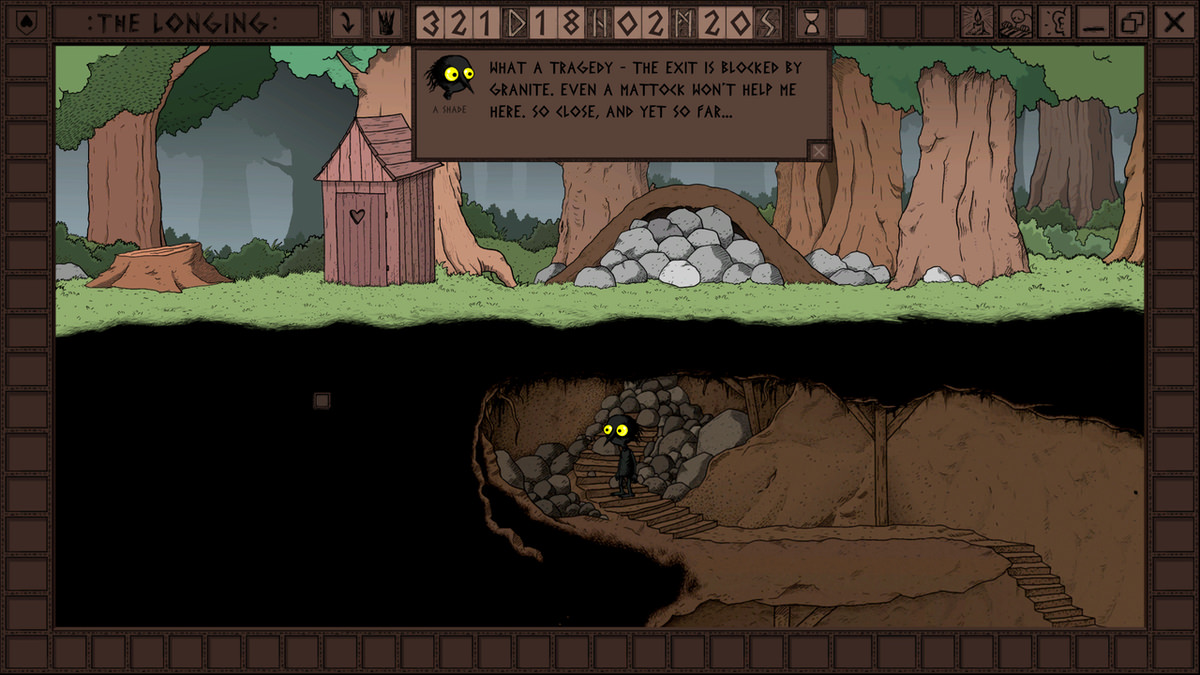
I did not limit myself to waiting for the king’s awakening in the comfort of Shade’s home, but instead assumed that reaching the outside world might be possible. As a result, my playthrough became a search for escape. Pyta clearly intended the game to have a narrative progression, but I am not entirely convinced that it came across clearly to me. The cave contained many things, yet much of it felt disconnected. I also failed to find a way out, even though I reached the very edge of the surface and could see above it.
In addition to decorating the home, waiting, or searching for an exit, players can also focus on collecting Steam achievements. All of them require the same thing: exploration of the cave. I am not particularly devoted to achievement hunting. I have only completed a handful of games in that sense, and rarely has it required serious dedication. The Longing does. To pursue everything it offers, one must truly be committed, even if its atmosphere drags heavily.
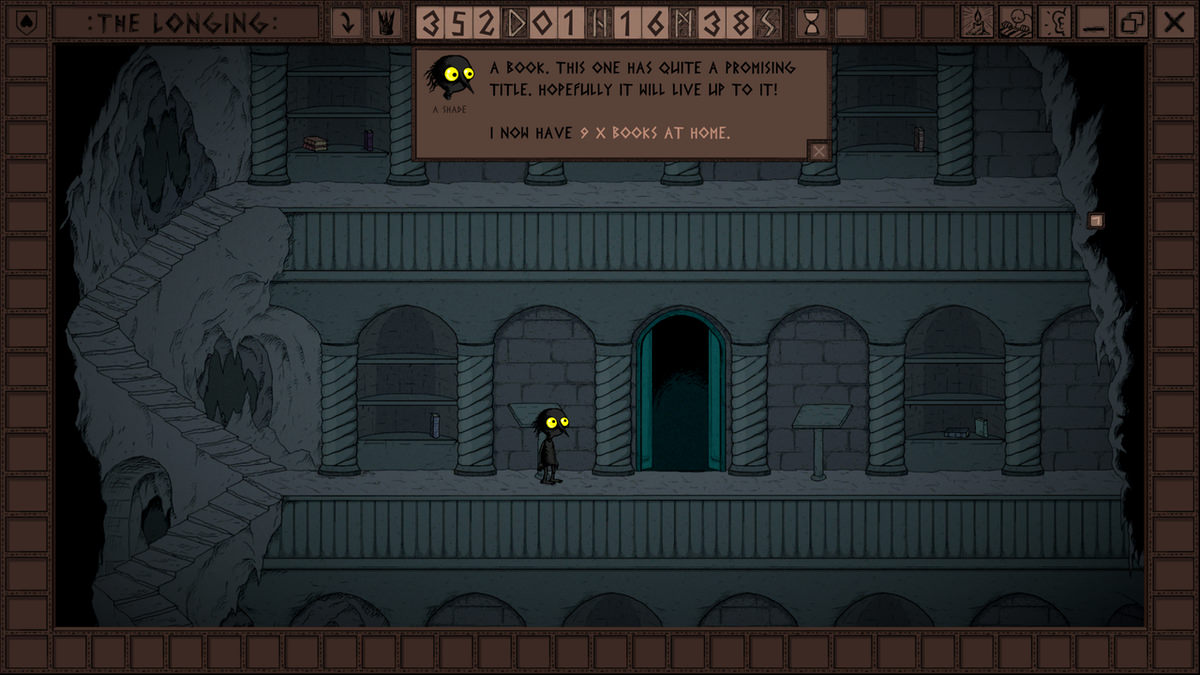
Visually, The Longing is as monotonous and as varied as its sound design. Dim, nearly unchanging stretches of cave sometimes felt excessively long — not to mention minutes spent walking in complete darkness — but before I seriously committed to reaching the surface, I did find the game fairly rewarding in terms of discovery. I located the library, a temple, and a mine, learned how to cultivate mushrooms, collected various minerals, and so on. My individual play sessions typically lasted around an hour and ended with waiting.
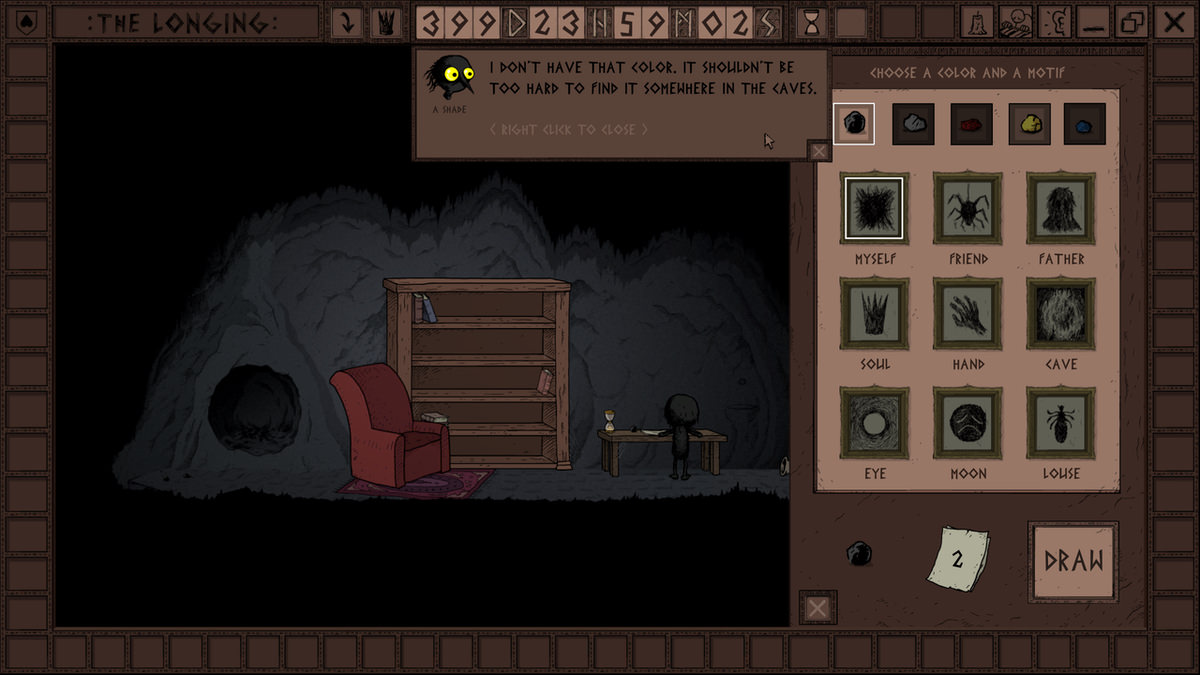
In this game’s case, it is perfectly acceptable to forget about it for a few days or even several weeks. After clocking 23 hours of active playtime, I am content to simply wait outside the game for the remaining 400 days and abandon the search for escape. I am aware that the game contains multiple endings. As an adventure game, The Longing is not difficult. It provides sufficient hints for its puzzles. Its challenge lies instead in its sheer sluggishness.
Verdict
Thematically, The Longing feels like a metaphor for life. Something within us — a king — has fallen asleep, and we wander or repeat routines without a clear goal. We are prisoners of ourselves. Our consciousness is a mere shadow that does not know light. Yet Shade’s eyes shine like small lamps, offering a hint of hope. We can see our own “cave” and confront the darkness. I would not describe The Longing as particularly psychological or philosophical. It is a calm, melancholic experience, a living image that lingers in the mind. For my taste, it was perhaps simply too bleak. The option of suicide is present as well. I give my overall experience a score of 60 out of 100.
Availability
The Longing is available for Windows, macOS, and Linux, as well as on Nintendo Switch.