
The Curse of Rabenstein (2020)
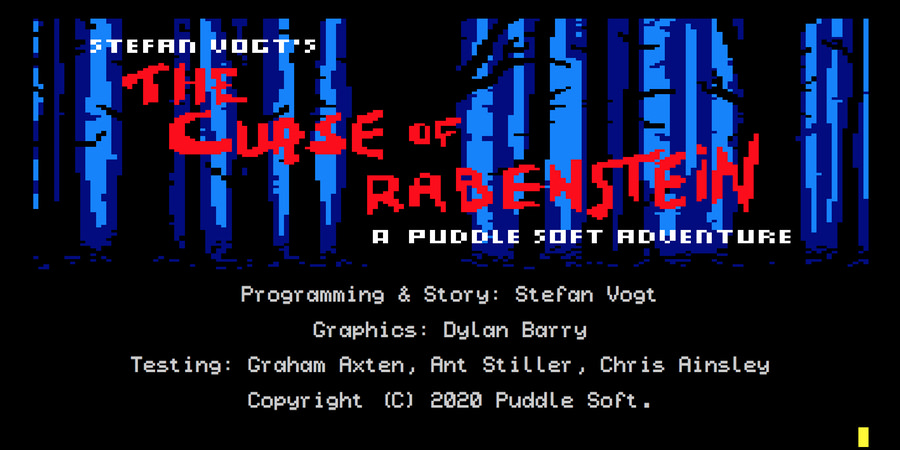
Released in 2020, the text adventure The Curse of Rabenstein caught my attention when a point-and-click version for the Commodore 64 appeared a couple of weeks ago. I did not, however, play that C64 version. Instead, I launched the original game in its modern browser form, which runs effortlessly on a contemporary computer without the need for an emulator. The game is available on a wide range of platforms, from 8- and 16-bit Commodore machines to the ZX Spectrum, Atari, MSX, and DOS, so it can be experienced in a fairly authentic retro form. In practice, however, the browser version is essentially the same game. For me, The Curse of Rabenstein was a pleasant and light experience. The parser felt friendly and straightforward, and I never found myself banging my head against a wall. It felt like a warm-up before heavier parser-based encounters. The Curse of Rabenstein offers a classic horror story that lasts under an hour.
The Curse of Rabenstein was written and programmed by Stefan Vogt, with production handled by the Puddle Soft collective, whose aim is to pump new blood into old computers and to offer experiences from past eras to modern players as well. With The Curse of Rabenstein, they have succeeded in creating an accessible text adventure that avoids many “classic” problems of the genre. It is sufficiently pared down and logically straightforward. In 2021, Stefan Vogt and Puddle Soft also released another text adventure, Hibernated 1, which serves as the opening instalment of a series. I have tried Hibernated before, but eventually ran out of stamina and left it unfinished, even though it did seem interesting.
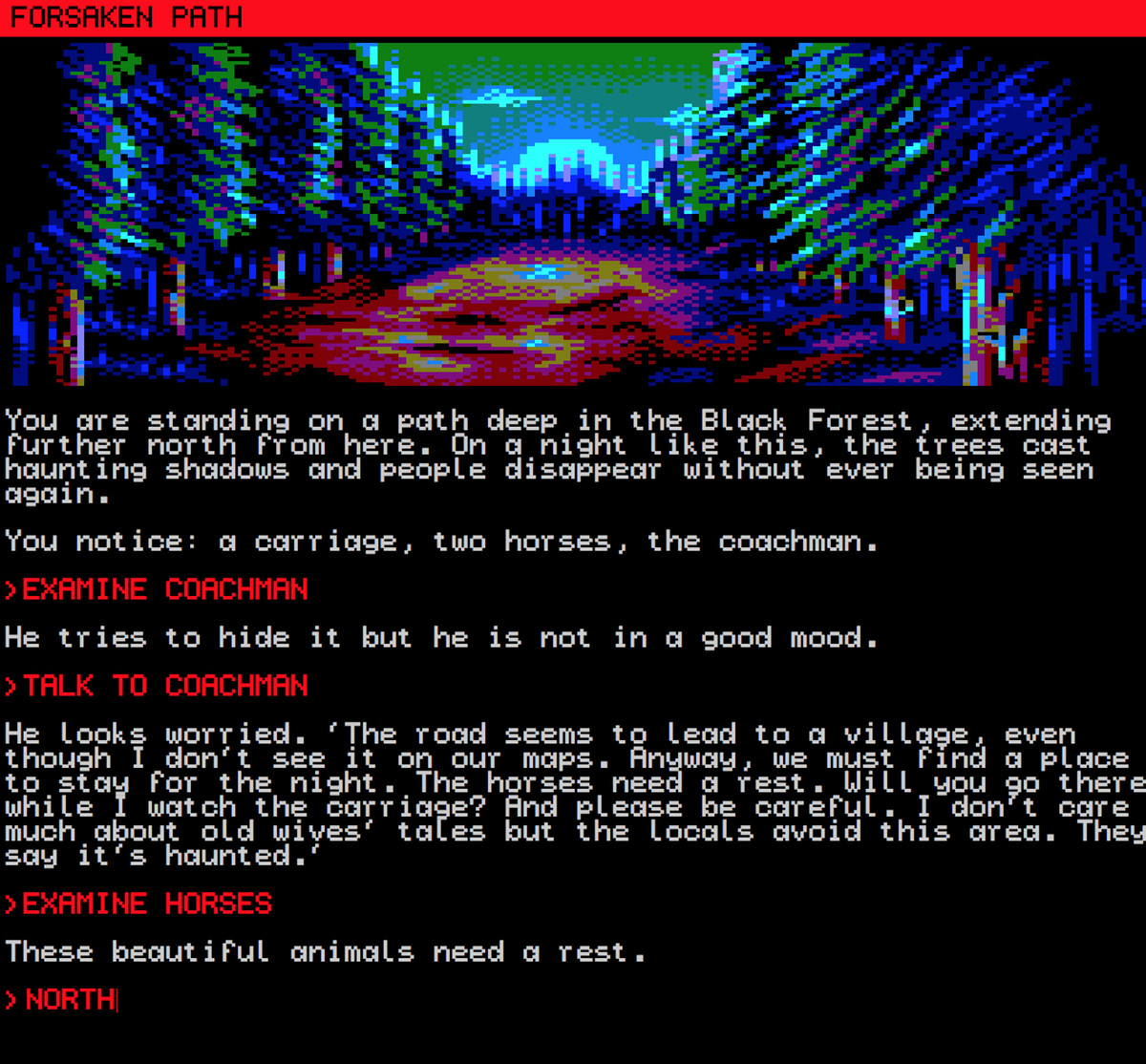
The Curse of Rabenstein is set in the nineteenth century. The player character is travelling through the dark forests of the Schwarzwald when the coach driver suddenly stops the carriage in confusion: they are lost. Although the map shows nothing, there is fortunately a village nearby. For a lost and exhausted traveller, finding an inn is a relief, but events soon take a troubling turn.
The player’s task is to uncover what is plaguing the village and to eliminate it. The narrative context is Christian in nature. The visit to the village feels fated, as if time itself had been waiting for this particular character to resolve the mystery. The player must gather suitable items and solve the puzzle one small step at a time. Parser games are generally merciful in that, even when the story presents an urgent or dangerous situation, the player is free to think calmly and try again without limits.
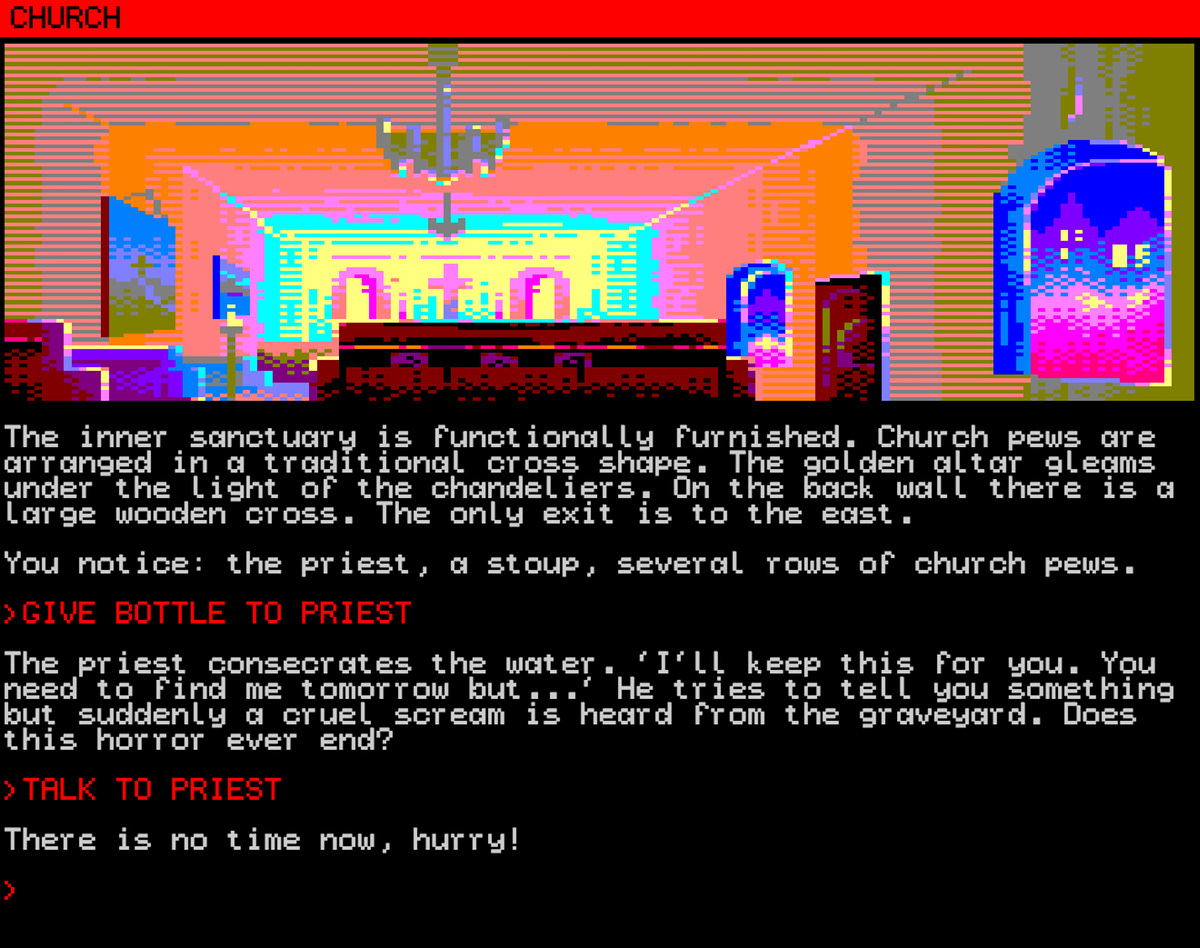
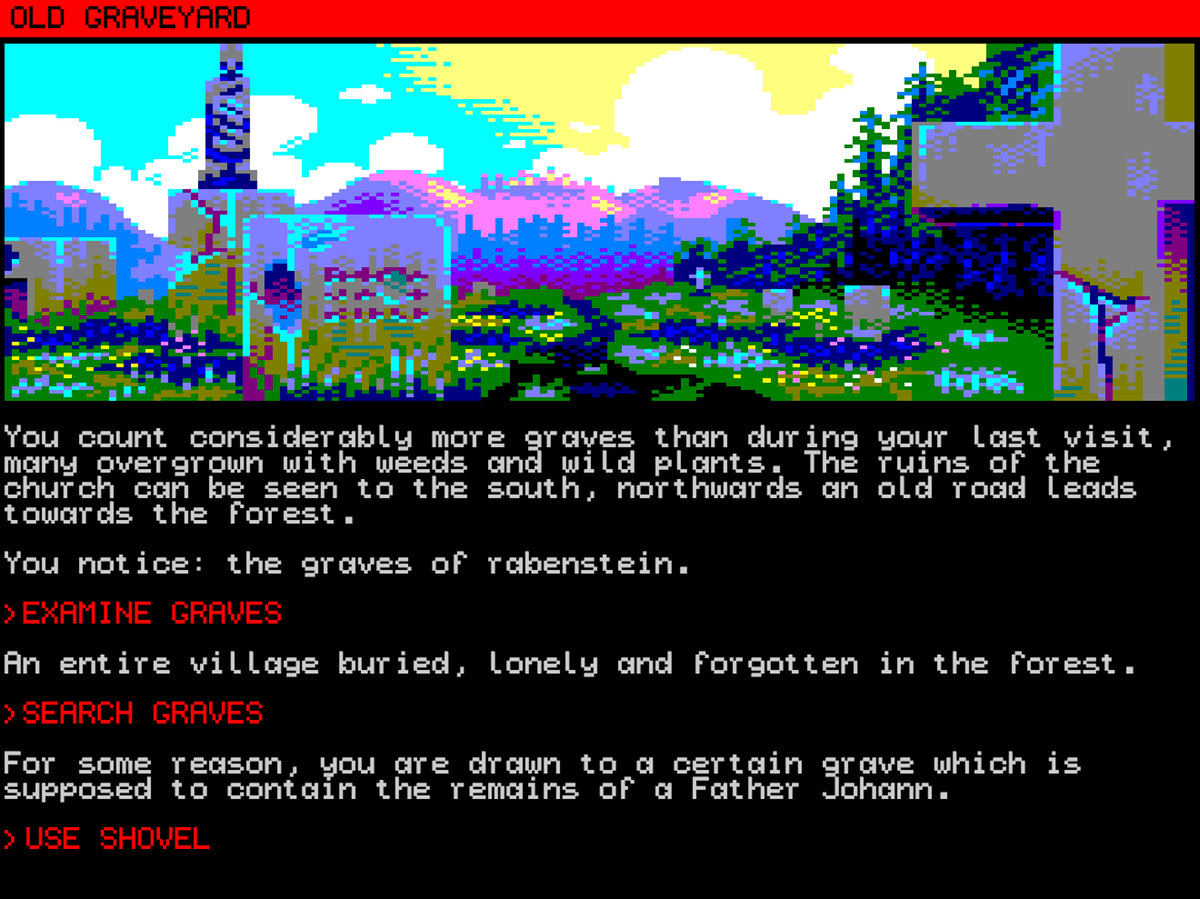
Commands are usually entered as two-word phrases, such as “take key”, “use key”, or “give key”. Characters can also be spoken to using the form “talk to” followed by their name. One important distinction in The Curse of Rabenstein is the difference between the commands “examine” and “search”. For example, “examine hay” provides a description of the haystack, while “search hay” checks whether there is something underneath or hidden within it. The “inventory” command lists carried items. Movement follows the four cardinal directions, with stairs used to go up and down.
If progress happens to stall, there are InvisiClues-style walkthrough hints available. Infocom famously published hint books for its games, in which answers were written in invisible ink beneath the relevant questions. This is where the name InvisiClues comes from. The booklet included a marker that revealed the hidden text. Over time, the effect of the ink faded and the hint disappeared again.
The artwork in The Curse of Rabenstein consists of perfectly serviceable and varied pixel graphics. Naturally, the colouring depends on the platform, as older computers have different and very limited colour palettes. I appreciated the game’s clear presentation and the sharp colouring of the browser version. The colour scheme creates a dramatic and somewhat unusual effect within the horror genre, where visual styles are typically dark. On the game’s itch.io page there are screenshots from different platforms, and the differences in colouring are striking. There is no music or ambient sound in The Curse of Rabenstein, although the new point-and-click version for the Commodore 64 is said to include music.
Verdict
Text adventures are wonderfully unhurried. When there are few stimuli – essentially just you and the parser – it is possible to slip into an almost meditative state. Playing a text adventure differs clearly from reading literature because of navigation and puzzle-solving: in the player’s mind, a sense of movement within an interactive space emerges. Fortunately, The Curse of Rabenstein does not keep score and the player cannot die. Unlike some program versions, the browser edition also does not count “turns”, meaning the number of commands used. The story is linear, with no alternative solutions. I recommend it. Based on my experience, I give the game an overall score of 60 out of 100.
Availability
The Curse of Rabenstein is available for a pay-what-you-want price on the Commodore 64 and Plus/4, Amstrad CPC, ZX Spectrum, Commodore Amiga, Atari ST, MSX, DOS, and as a browser-based version for modern devices.