
Strangeland (2021)
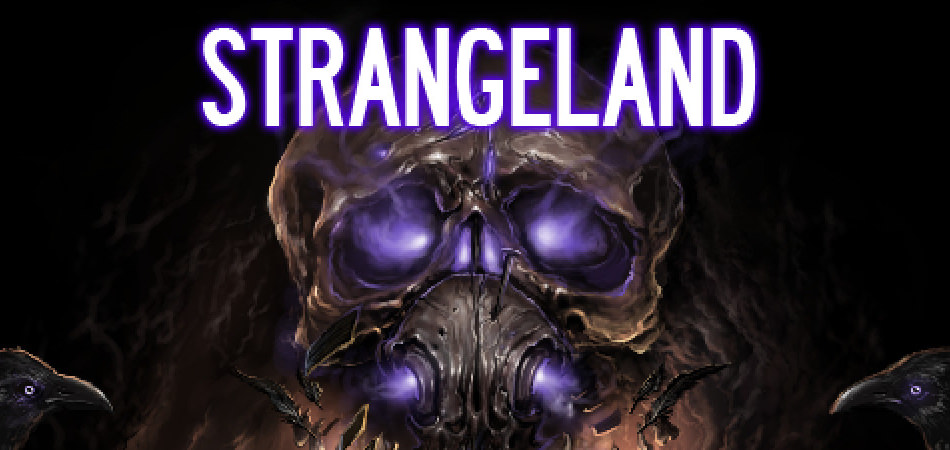
Released in late May 2021, Strangeland promises fantastical psychological horror. It is the long-awaited new title from Wormwood Studios, best known for the adventure game Primordia, and published by Wadjet Eye Games. Expectations among fans were likely quite high, and I myself have fond memories of Primordia. I am also a long-time admirer of Wadjet Eye Games. Still, I cannot praise Strangeland without reservation. The game strongly reminded me of the late-1990s release Sanitarium, and I could not avoid comparing the two — to Strangeland’s detriment.
Strangeland was written by the American Mark Yohalem. In the developer commentary included with the game, he describes Strangeland as autobiographical, or at least as being based on experiences he has lived through or knows closely. The commentary also features observations from the game’s Australian artist and Greek programmer, and may be of particular interest to those who make games themselves. These three form the core of Wormwood Studios. It is interesting — and perhaps encouraging — that the creators are spread across different parts of the world. A large local studio is not required to produce a competent adventure game. Strangeland was made using Adventure Game Studio, which remains a perfectly viable platform for point-and-click adventures.
A mystery that is hard to recognise as a mystery — and that remains a mystery as if no mystery had ever existed
In Strangeland, the player controls a nameless stranger who finds himself in a bizarre world. The straitjacket he wears seems to point quite directly to mental illness, or at least metaphorically to some suffocating, paralysing condition. The environment is a fantastical, dreamlike reality in which the boundaries between human, machine, and animal blur. The humanlike machines echo the thematic concerns of Primordia. In that sense, both games depict forms of dystopia, but Strangeland ultimately turns out to be an inward journey of a single individual.
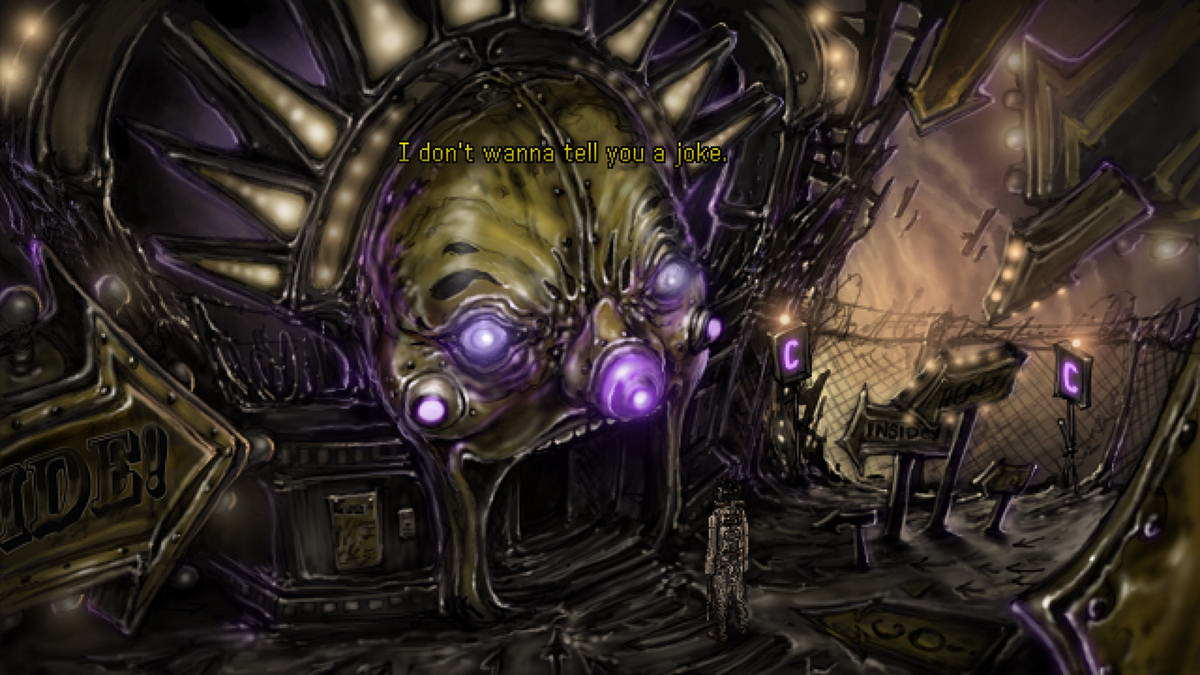
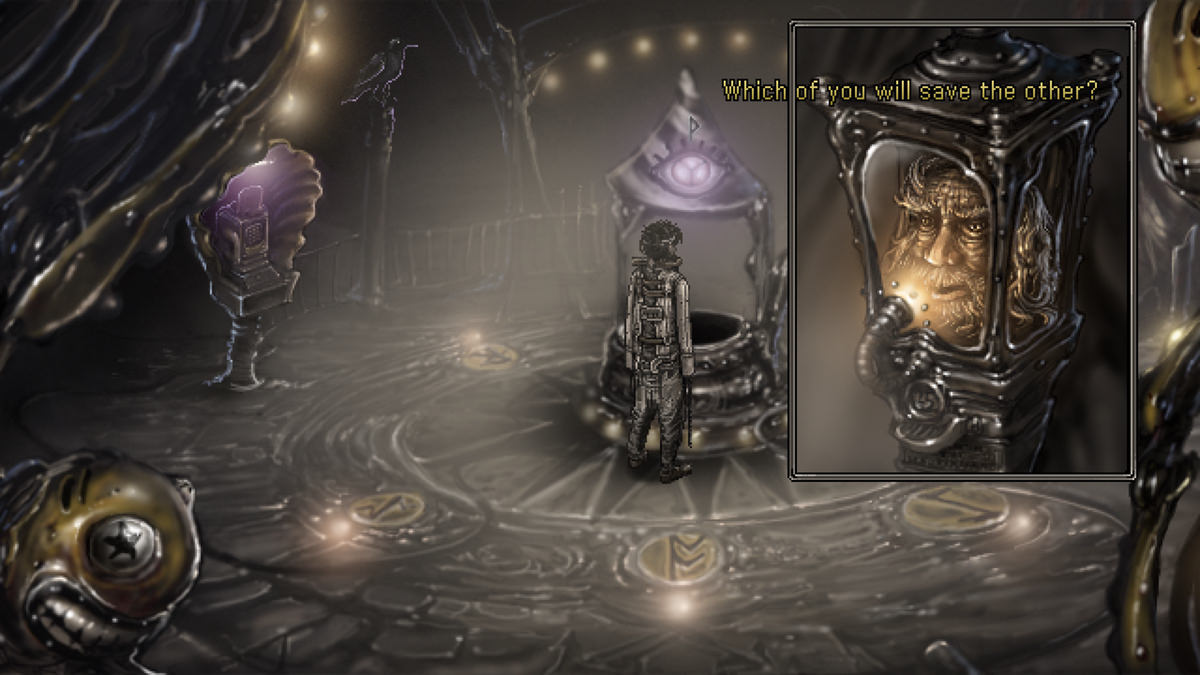
Everything begins when the stranger enters a carnival and witnesses a woman dressed in hospital clothing jumping into a well. He appears driven to save her — but who is she? The game does not explain her identity, nor does it explain the stranger’s, and the connection between them remains a large question mark. In attempting to save the woman, the stranger seems instead to be saving himself. He is entangled in the webs of his own mind, with a vast unknown darkness lurking like a spider.
I believe some players may experience a strong emotional response if they are able to identify with the situation. I did not. What troubled me most was how weak the presented mystery felt. I was simply dropped into this strange carnival at the beginning, with no real foothold. Completing the tasks was straightforward enough, but it felt as though there was no clear objective. What exactly was I doing, and why?
There is room left in Sanitarium’s shoes
The references to Sanitarium were unmistakable. In Sanitarium, however, the mystery was strong, clearly presented, and ultimately resolved. I have previously covered Sanitarium in Samooja. Strangeland is, in a sense, too inward-looking and lacks external concreteness. I also found Sanitarium’s game world more imaginative and impactful. A major factor here is the visuals. While Strangeland features high-quality pixel art and painterly close-ups, it is relentlessly dark, and in my view the creators’ imagination does not reach the level achieved by the makers of Sanitarium.
It is interesting that I nevertheless experienced Sanitarium as somewhat immature. Perhaps it is simply an authentic product of the 1990s, and the age of its creators has nothing to do with the impression, but Strangeland, by contrast, is clearly the work of a mature designer and a product of the 2020s. Perhaps the conclusion is simply that Sanitarium is a nineties classic, whereas Strangeland will not become a classic of the 2020s.
Book learning was only noise to my ears — but the many selves spoke to me
The way Strangeland handles its themes also failed to resonate with me. The countless references to literary classics and mythology felt meaningless and even made the game seem like a test of the player’s cultural literacy. Fine, if someone enjoys this kind of “spot the quotation” challenge, but to me it all came across as the ramblings of a confused mind. Strangeland does contain a reasonably interesting approach to its puzzles, but because I did not grasp their underlying purpose, completing them felt more compulsive than enjoyable.
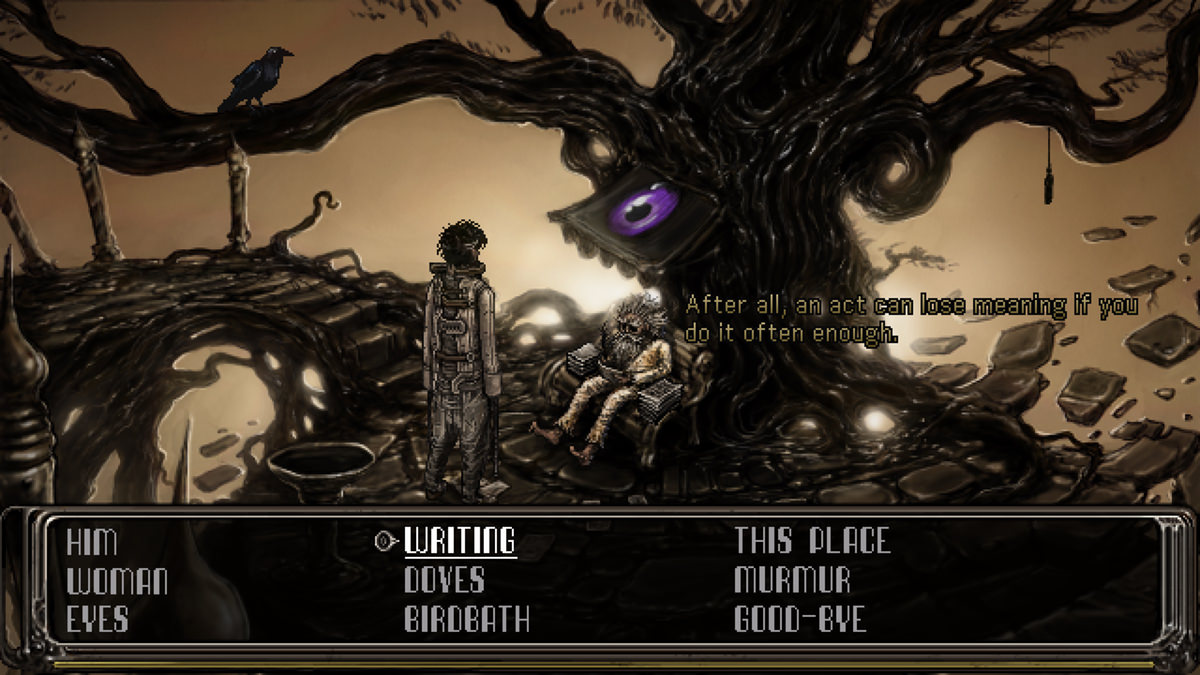
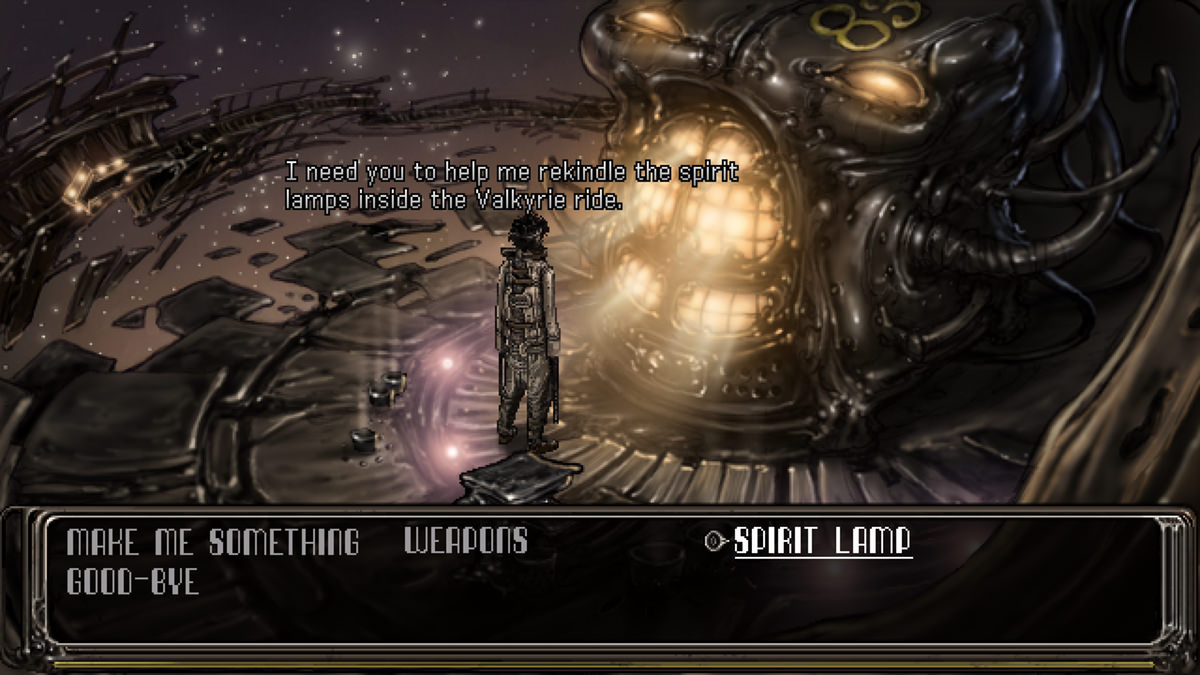
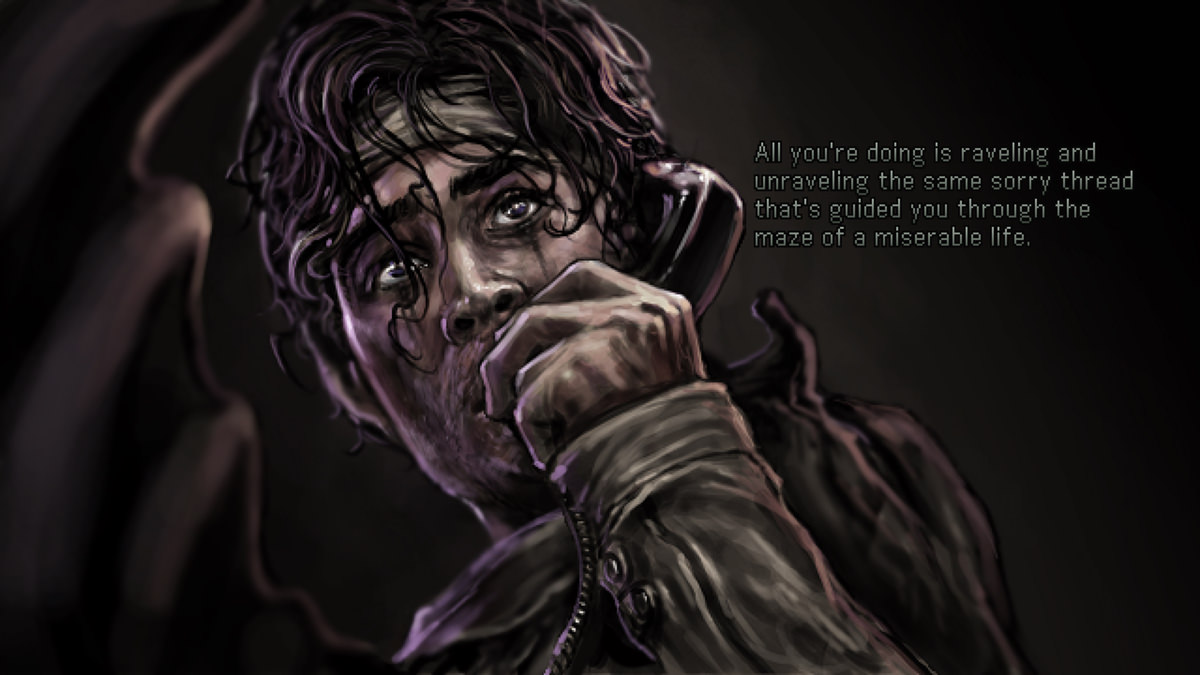
The idea that, by talking to the many characters in the carnival, the stranger is in fact talking to himself — to different aspects of his own being — is undeniably interesting. The game presents this in various forms, combining personal imagery with more collective mythology. One could even say that Strangeland flirts with Jungian psychology. This gave rise to some enjoyable puzzles. I was particularly taken with the coin-operated oracle head, the ravens, and the insulting hint phone, which is an especially successful in-world implementation of a walkthrough.
Strangeland is fully voiced, featuring familiar voices from earlier Wadjet Eye Games releases. I felt the protagonist’s voice sounded too mature for a stranger who, judging by the graphics, appears to be around thirty. Otherwise, the voice work felt more appropriate. The music was serviceable, but not especially striking or memorable.
Verdict
Strangeland was too verbal and too quote-driven for my taste. I did not find the game world oppressive or anxiety-inducing, but the negativity encountered by the stranger was exhausting. What bothered me most was the weak mystery. In my view, the mystery should have been the game’s guiding thread, intriguing the player and carrying them through to the end. Instead, the woman who jumped into the well kept fleeing until the very end, leaving too much for the player to piece together alone. I rate my experience at 62 out of 100.
Availability
Strangeland is available for Windows PCs.