
The Samaritan Paradox (2014)
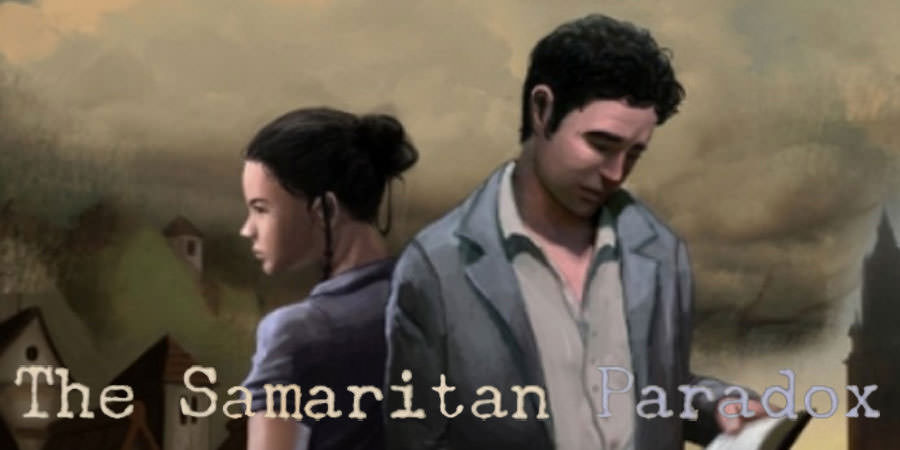
Released in April 2014, The Samaritan Paradox is a retro-styled adventure game set in 1980s Sweden, dealing with social and moral themes. It is the first production by the Swedish studio Faravid Interactive and, as such, an ambitious and wide-ranging project. At the same time, it suffers from uneven quality in its puzzles, writing, and audiovisual execution.
Petter Ljungkvist, the person behind Faravid Interactive, created The Samaritan Paradox almost entirely on his own, which certainly deserves recognition. The game was built using the AGS development system. Ljungkvist did not compose the music himself, and the voice cast adds an extra layer to the experience.
The hunt for a hidden manuscript
Ord Salomon, who lives in Gothenburg, is preparing a doctoral thesis titled “Codes in Fiction.” During the process he has withdrawn into his dim apartment and lost his inspiration. His friend Magnus tries to cheer him up by giving him a crime novel to read. Although Ord respects the author as a critical journalist, he approaches the book with prejudice. Still, he glances at it — and does not even make it past the first page before recognising a hidden message encoded in the book’s ISBN number. The message is addressed to the author’s daughter, Sara. It does not sound entirely healthy, yet The Samaritan Paradox remains a perfectly lucid story.
Ord contacts Sara, and the adventure begins. Her father, journalist and author Jonatan Bergwall, has allegedly committed suicide. As a final challenge to his daughter, he has left behind a riddle, at the end of which lies her inheritance. Sara is unwilling to take on the task herself and hands it over entirely to Ord. Thus begins the search for a hidden mystery manuscript — a journey that uncovers not only large-scale illegal arms trading but also disturbing family secrets.
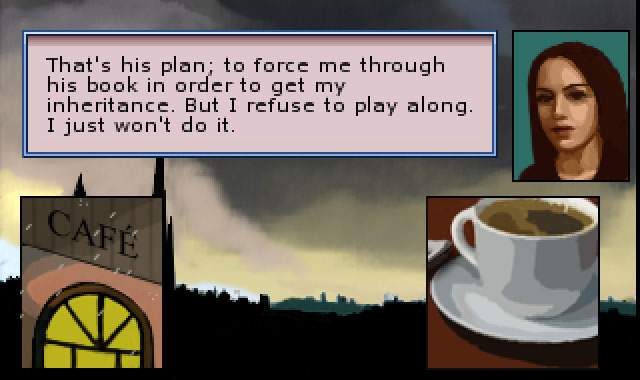
The arms-trade plotline lends the game a social dimension by directly commenting on Sweden’s extensive weapons exports. Moral themes emerge in particular when arms are sold to questionable dictatorships. Elements of religious corruption are also woven into the narrative.
Between reality and fiction
The game’s narrative perspective is intriguing. In addition to the main character, codebreaker Ord Salomon, the player — through him — also controls the protagonist of a fictional manuscript. Over the course of the game, the goal is to find Bergwall’s three-part manuscript. Whenever a part is discovered, Ord can read it, transporting the player into a fictional story within the story.
This inner narrative follows a young shipwrecked woman who has lost her memory and does not know where she is. She ends up confronting a dragon and dismantling an oppressive religious cult that holds power in a village.
Although the manuscript story resonates thematically with Ord’s real-world discoveries and Sara’s role, I found the fairy-tale-like sections strange and ill-suited. Why would a renowned crime novelist and journalist write something so clichéd and weak? These fairy-tale episodes may be intended as a tribute to classic fantasy games, but within this socially grounded mystery they felt deeply implausible.
Ljungkvist himself has described The Samaritan Paradox as a blend of a Stieg Larsson-style crime novel and a Grimm fairy tale. A poor combination, in my view.
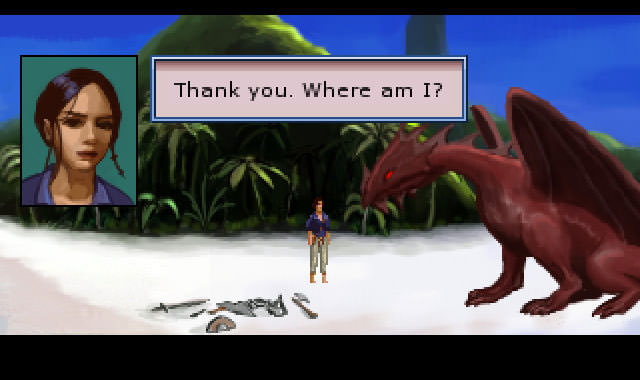
The audiovisual world
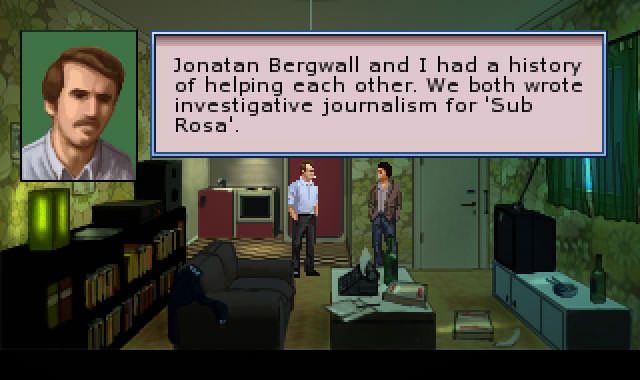
The 1980s settings are appealing, and for the most part The Samaritan Paradox is pleasing to look at. There are over 60 distinct locations in total. More than 20 characters can be spoken to, each with their own portrait. The music sets the mood effectively and works well.
Voice acting, however, is uneven. Female voices in particular felt amateurish, flat, and from the wrong era. I was disappointed that Swedish voice acting was not available; it would have added authenticity and might have elevated the overall quality.
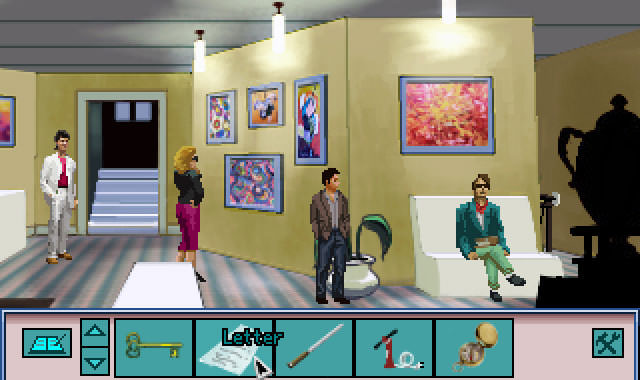
Gameplay and difficulty
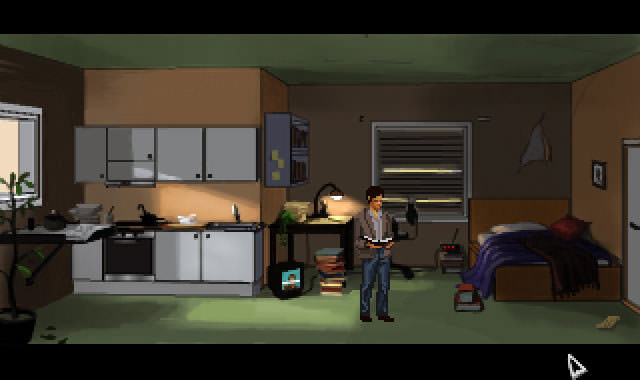
The Samaritan Paradox features a standard AGS adventure interface. In addition to location screens with clickable hotspots, there is an inventory and a notebook. The notebook also serves as a topic list during conversations.
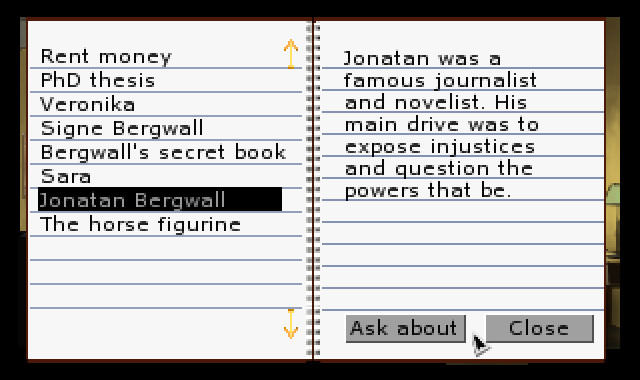
The game also includes phone calls, which add a nice extra layer. However, their narrative and mechanical potential is not used to any significant extent.
In a few places, the game requires fast real-time reactions.
I got stuck in the story several times and struggled seriously with some puzzles. While some tasks are well designed and aligned with Ord’s code-breaking abilities, I would argue that the difficulty stems less from challenge and more from poor game design. Hopefully Ljungkvist will take the feedback to heart. I am genuinely interested in seeing what he might do next, as The Samaritan Paradox offers a fresh perspective, setting, and subject matter that feel welcome in the adventure genre.
Verdict
The story improves towards the end. It becomes multi-layered and ultimately surprising. Despite its unevenness, I find The Samaritan Paradox an interesting adventure game. Its mature themes and Swedish 1980s setting create a distinctive indie experience.
Availability
The Samaritan Paradox is available for Windows and Linux. Android and iOS versions were announced but have not materialised so far. I personally played the game on a Mac via a successful CrossOver conversion of the Windows version.