
Chinatown Detective Agency (2022)
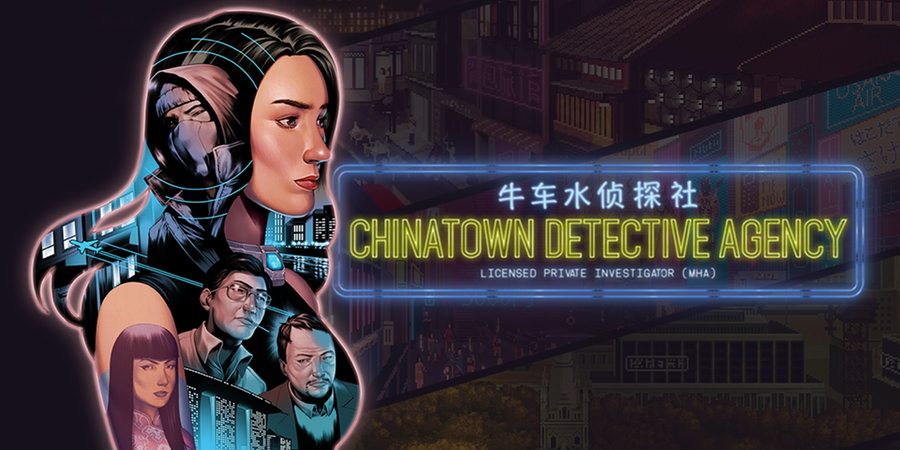
Released in April this year, Chinatown Detective Agency is a puzzle adventure set in near-future Singapore. You zip around the city by metro and occasionally fly abroad. The player character, the young Amira Dharma, is a former Interpol officer turned private detective. Her work consists largely of research and various puzzles that extend beyond the game into the internet. Even though Amira’s reality and the cases she solves, ranging from murders to corruption, tell a bleak story, the game is still warm-hearted, as Amira finds her own support group. Chinatown Detective Agency has its weaknesses and imperfections, but my play experience was smooth, and I liked the core idea a great deal.
Chinatown Detective Agency was made by General Interactive Co., whose founder Mark Fillon served as its lead designer. The studio began operating in Singapore in 2016, and before Chinatown Detective Agency it released Terroir, a wine-growing simulation. Chinatown Detective Agency spent five years in development. In 2020, a demo was released, followed by a successful Kickstarter campaign. The game has two publishers: the Chinese WhisperGames and the American Humble Games.
Tough exterior, warm heart
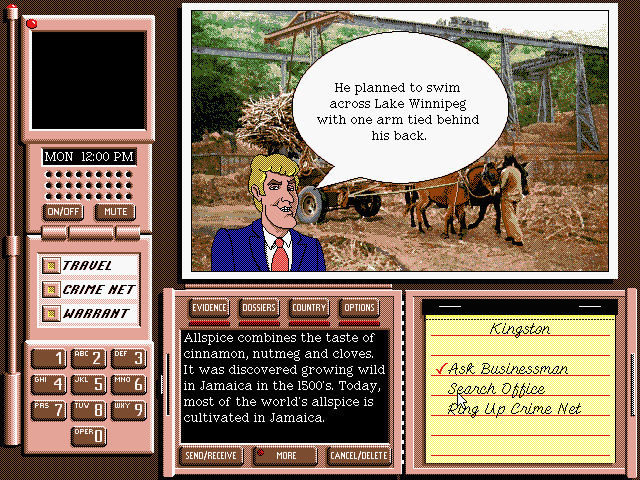
Chinatown Detective Agency strongly reminded me of the educational game Where in the World Is Carmen Sandiego? from years past. When I later read more about it, I found confirmation of that impression, as the game is indeed said to have been an inspiration. Mark Dillon has described how he grew fond of the 1992 deluxe version of Where in the World Is Carmen Sandiego? Compared to its predecessor, however, Chinatown Detective Agency is far more developed, with a mature noir and cyberpunk story.
Chinatown Detective Agency is a fresh take on hard-boiled detective fiction. Private investigator Amira Dharma is a lone warrior in a corrupt society, yet a level-headed and less cynical young woman. Automation has produced unemployment and surveillance has grown harsher, even though I did feel that the state was losing its grip. Behind public life, a mysterious network — or networks — operates, better informed than the police and steering events from the shadows. AI, too, has advanced, and Amira’s main case is specifically about an AI that has gone rogue.
The prologue at the start, in which a man jogs through the city and is unexpectedly killed by a drone, foreshadows Amira’s biggest case. A voice droning on in the background tells a kind of warped creation story in which roles have been reassigned. The story draws, perhaps, on the most familiar AI nightmare scenario: it becomes conscious and begins eliminating humans. Does that make the game clichéd? Not in my view — or at least it did not bother me. The plot is perfectly workable, and the action and puzzles have been fitted to it well.
Chinatown Detective Agency branches, which increases the motivation to replay it. Early on, Amira must choose which client she will serve full-time. There are three candidates. I assume these different paths offer a selection of different tasks but ultimately lead to the same main case. My first playthrough took around six hours. Individual cases lasted about 30 minutes. If you explore all three paths and read all optional text content, you can easily spend over ten hours.
Learning for life
In her work, Amira deals with dirty and dangerous matters. Murders cannot be avoided, and Amira herself must use a gun — as an explicit gameplay mechanic. Chinatown Detective Agency is not a shooter, though. At its core it is a puzzle game whose tasks require research.
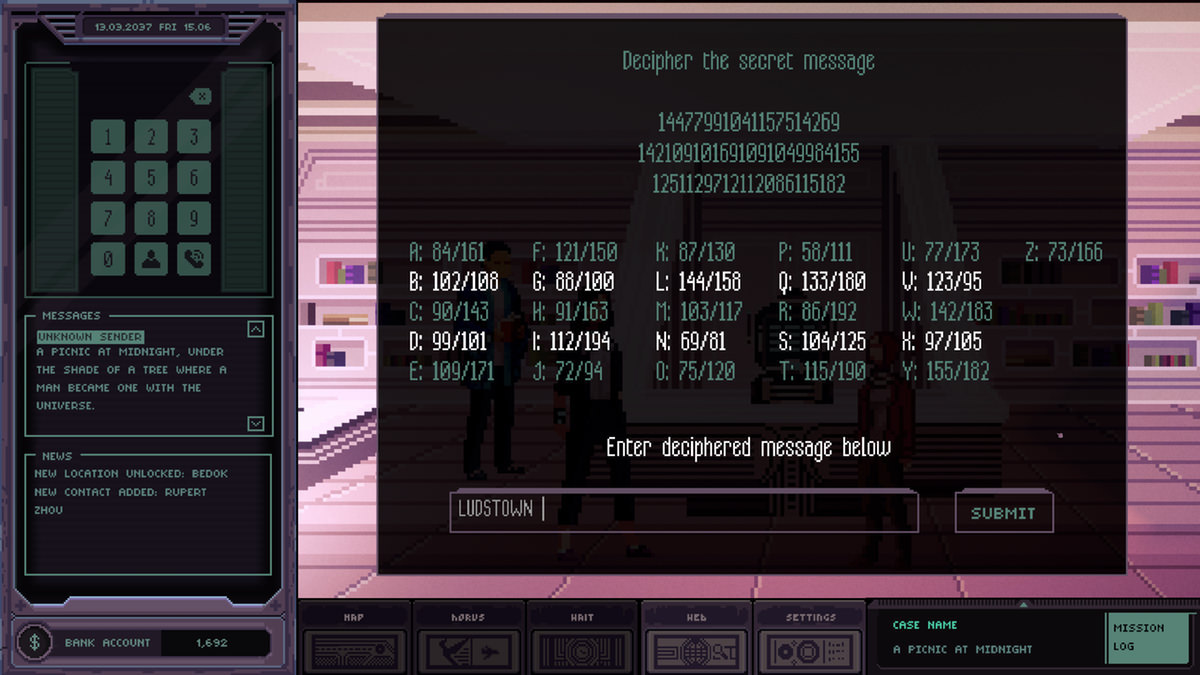
A typical pattern is that Amira receives a lead or a piece of evidence that is encrypted in one way or another. It might be a cipher, or an ancient language. Early on, I had to identify where old postage stamps had been sent from; the clue was the stamp’s motif and a fragment of a postmark showing a few letters of a city name. Later, I had to read up on Egyptian deities, among other things.
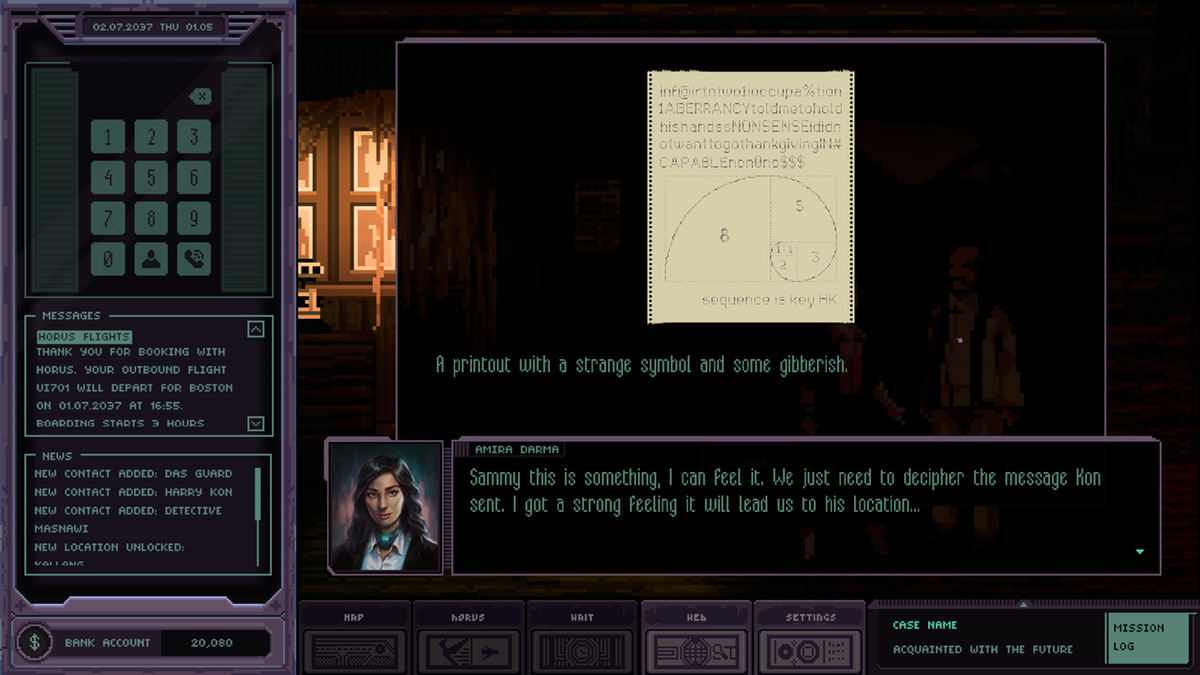
It is possible to know or deduce the right answers without using a search engine, but I at least had to verify my solutions online. The game also includes an internal hint bank / walkthrough in the form of the librarian. The librarian is one of the best built-in walkthrough systems I have encountered in games. The weak point, however, is the research itself. More than once, my search terms led me to guides for the game. That was clearly not the developers’ intention. It felt as though, to play honestly, I would have had to avoid these player-made guides like mines.
Some players may find the puzzles too school-like, like doing homework, but my school and university years are far enough behind me that it did not bother me. On the contrary, I admired the inventiveness with which research has been landscaped into the game. The tasks did not feel artificial. I have to admit that I even enjoyed the rougher Where in the World Is Carmen Sandiego?, so I may simply be receptive to educational games in general.
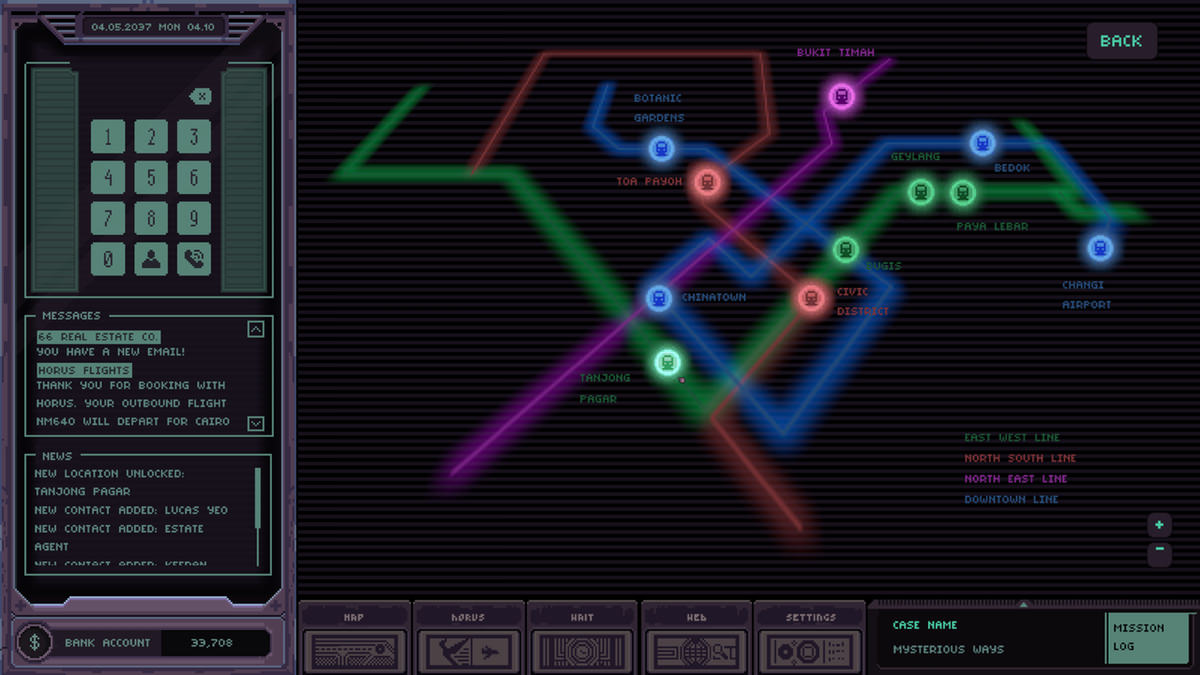
The information density of Chinatown Detective Agency is not limited to its puzzles. It also introduces Singapore neighbourhoods, each with a small info pack. These list real historical turning points and then continue them into a fictional near future. In addition to Singapore’s districts, the player has access to 24 cities around the world, though I did not visit all of them in a single playthrough. As with Singapore’s neighbourhoods, the world’s cities also come with info packs. Within a city you travel by metro, and you travel abroad by plane.
A half-hearted life sim
Chinatown Detective Agency also aims to be a kind of life simulation. Time passes continuously, and you have finances to manage.
Some tasks and meetings require keeping to a schedule, and it is possible to be late. Flights also run on timetables. I missed one flight early on, but after that schedules did not cause major issues. Rather, waiting frustrated me. The game includes a dedicated wait function that fast-forwards time in one-hour increments, and I had to use it a lot. Advancing time also functions as a puzzle of its own in the form of addition or subtraction. When I researched things online, I paused the game clock just to be safe by returning to the main menu. Although the passage of time is a critical factor for some events and actions, it does not feel particularly realistic overall. For example, Amira never needs to rest, and some places remain open regardless of the time of day.
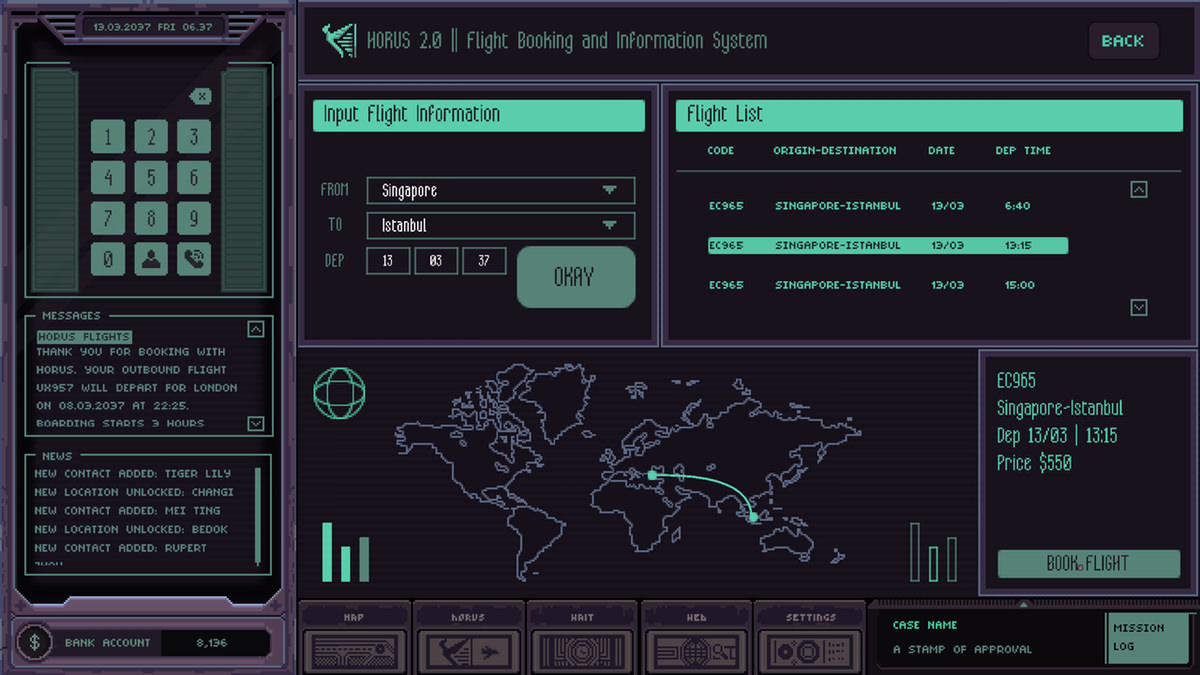
Amira must pay rent for her office space and buy plane tickets. She also pays the librarian a fee for their help, and later in the game she pays her assistant. Her income naturally comes from assignments she receives as a private detective. I never found myself short on money; it covered expenses easily. The cashflow therefore felt like an unnecessary mechanic. Paying rent did require a separate confirmation, and perhaps there would have been a due date — but I did not test deliberate delays.
Something new, something old, something borrowed... something cheap and unfinished
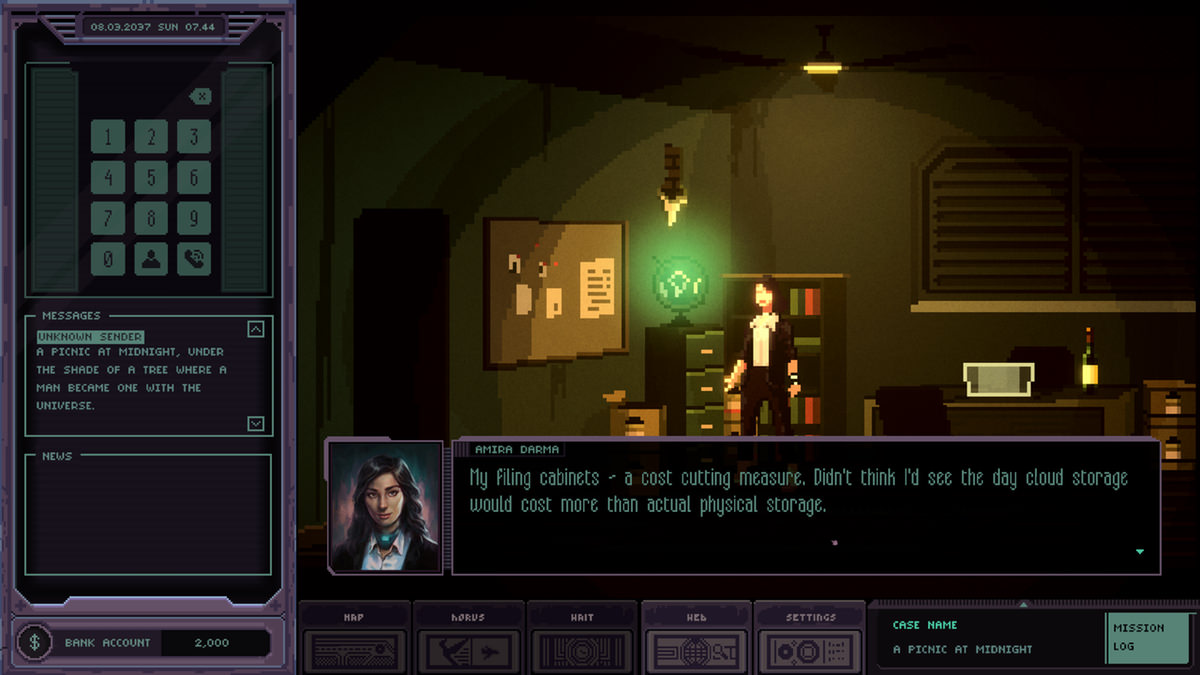
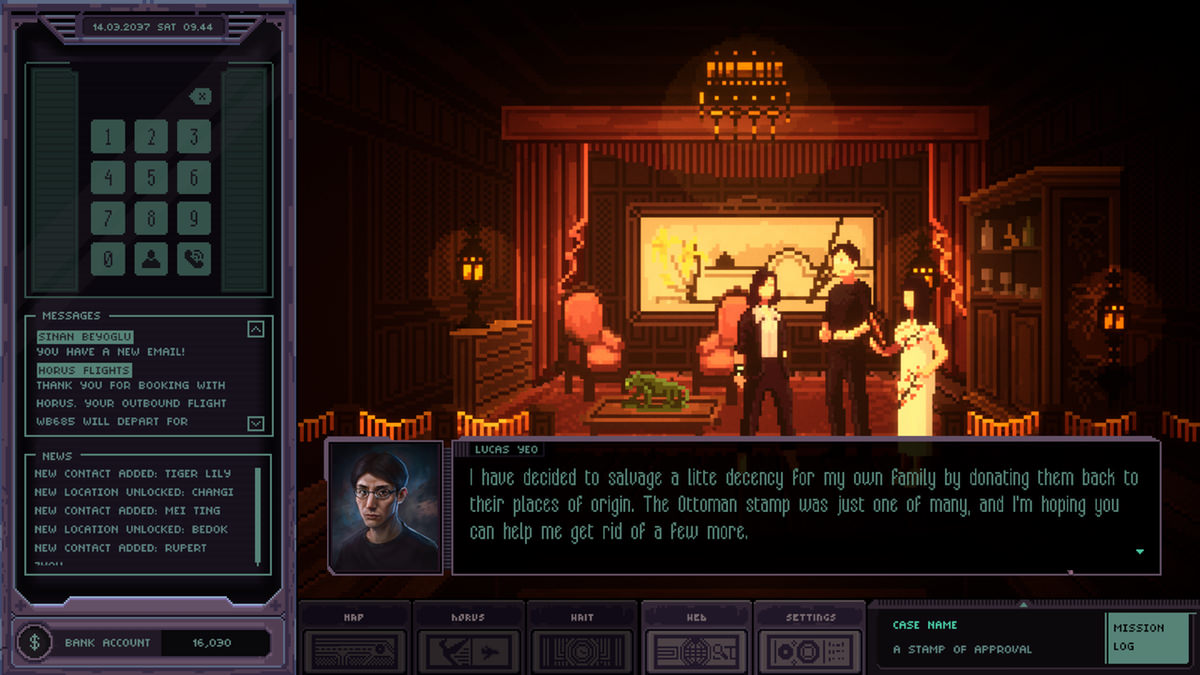
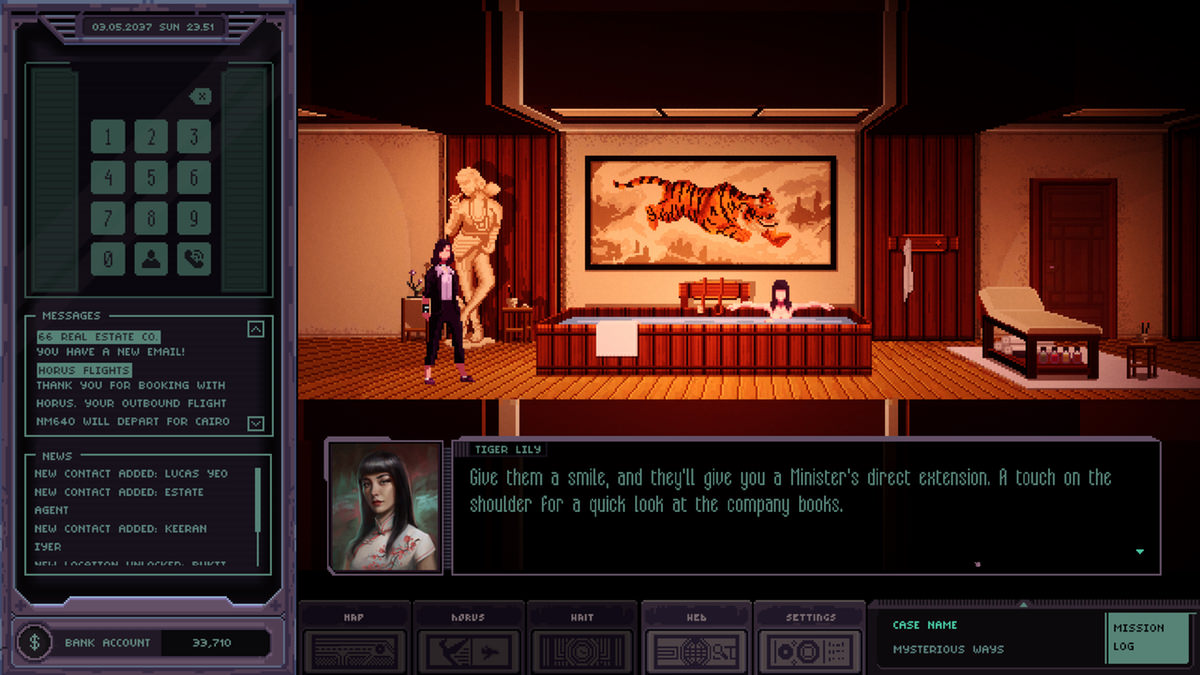
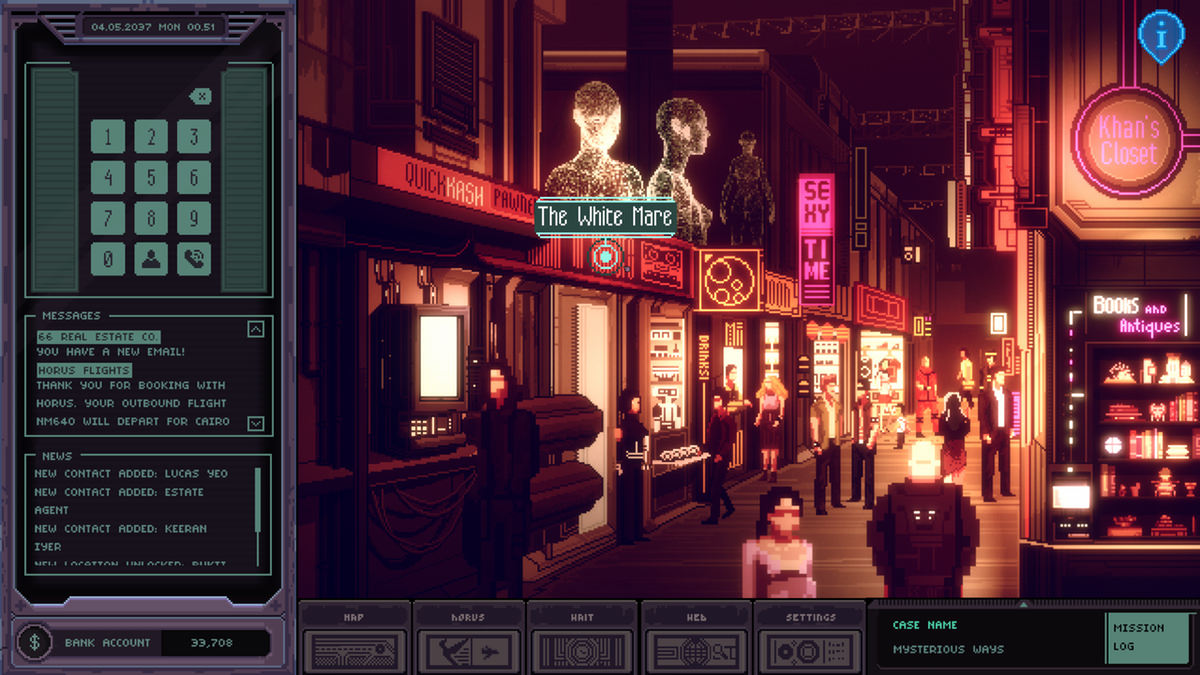
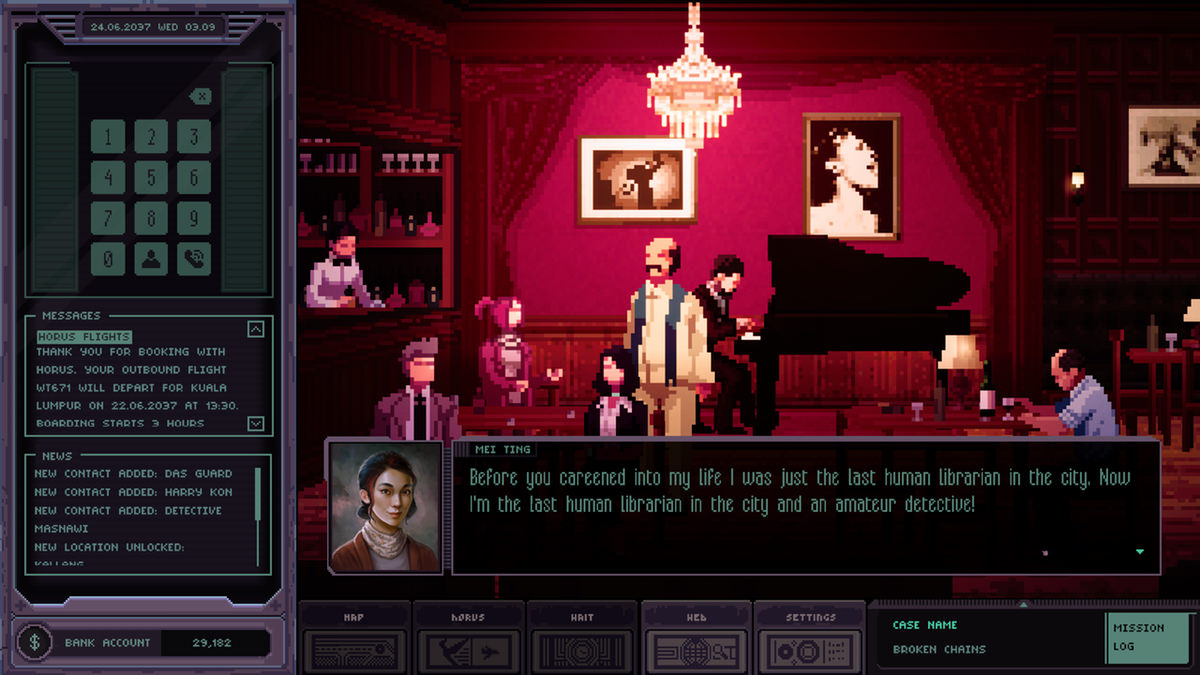
The visuals are a mix of rough pixel art in the game world itself, slightly less rough pixel art in interface elements and captions, and “normal” digital art in character portraits. I found the portraits pleasant to look at, but I am not entirely sure about the game world’s pixel art. Its roughness felt a little like an attempt to hide something — or to cut costs. There are plenty of different locations and city views, so the game does not skimp on quantity. I also liked the details in the environments, even if there were not many, as well as the colour work.
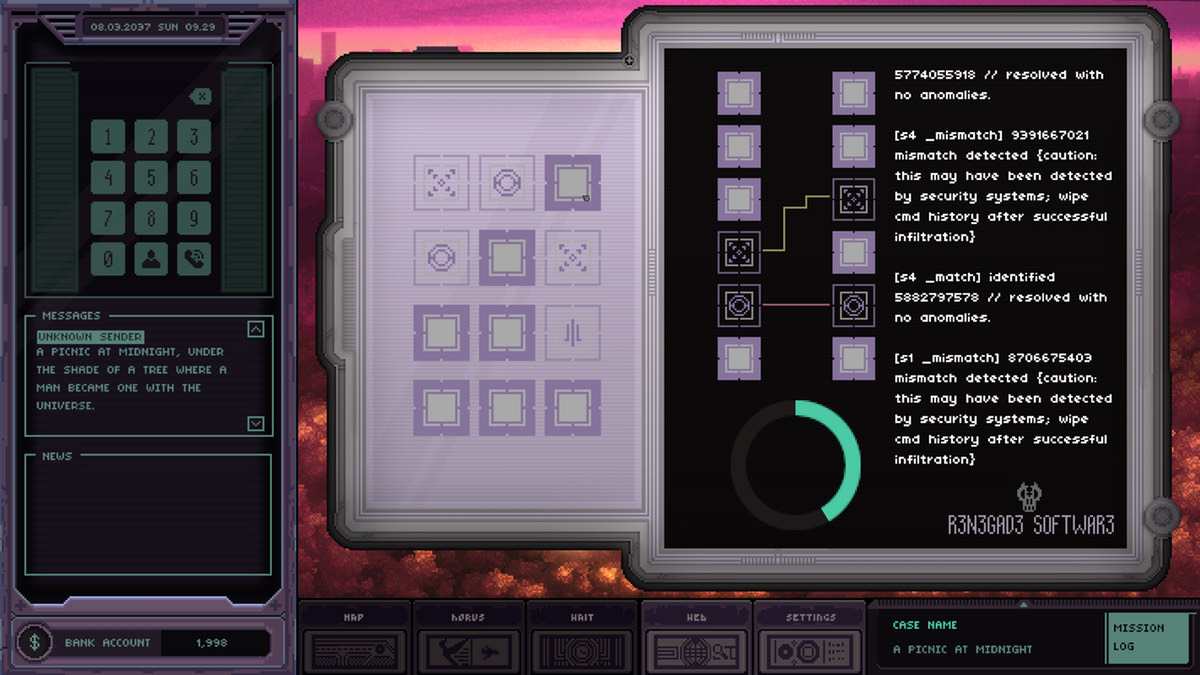
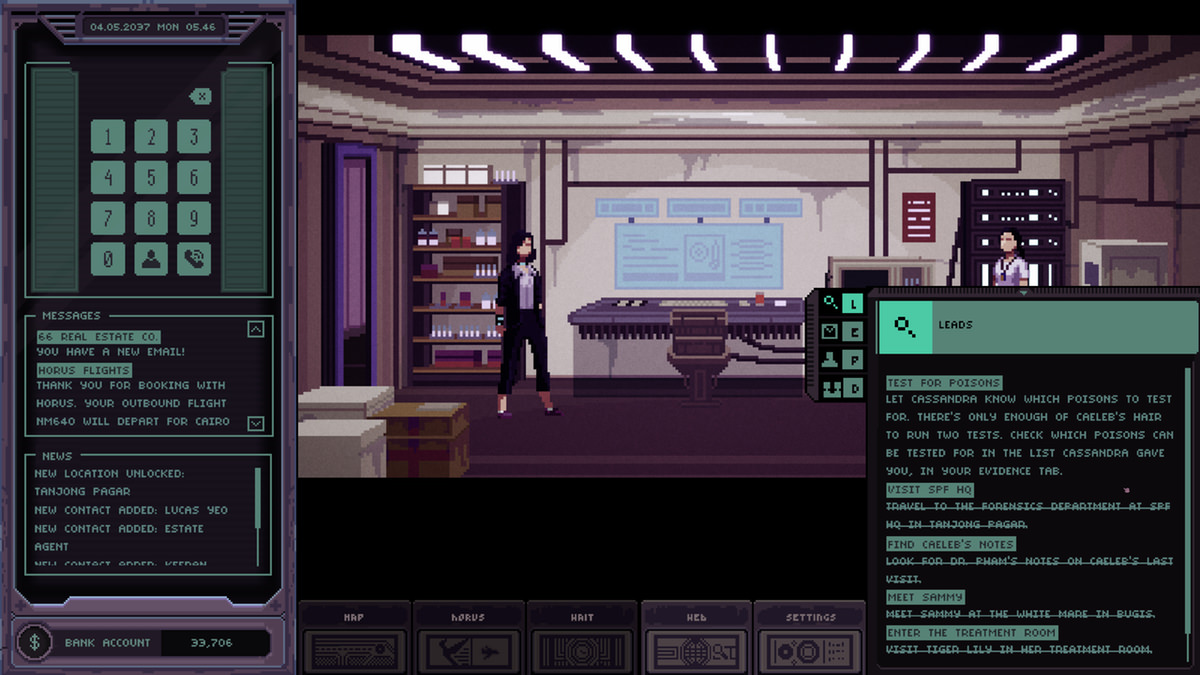
The interface is fairly clear — or at least I learned its essentials quickly. The mission log is the most important element, as it tells you what Amira should do next. The mission log also contains evidence you can return to and use as a reference for research alongside the task list. The bottom-row functions — the map, flight booking, the wait function, and the web (which opens a browser in the background) — are easy enough to understand, but the elements on the left side of the interface, below the phone — messages and news — confused me. Messages were presumably text messages, but news did not feel like news, as it mainly logged new contacts being added. Messages and news also became tangled up with email, which you can read in the game world via the computer in Amira’s office. Perhaps this is petty, since in real life we also juggle phones and computers, but I still think the interface could have been clearer.
For me, the layout of Chinatown Detective Agency and the digital “cruise music” playing in the background brought visual novels to mind. In some sense, perhaps it could even be classified as a visual novel, but it would be a remarkably complex one in terms of interaction. Amira is also controlled in a point-and-click style, which does not support the visual novel label.
Chinatown Detective Agency includes voice acting. What stands out, at least in the English version, is the local Singaporean accent — or rather, accents. Singlish also appears here and there in the vocabulary. Oddly, some characters had no voice acting even though Amira spoke with them face to face. Some portraits were also missing, but that probably has to be forgiven, since everything costs money and this is an indie production.
Verdict
This is said very fussily, but Chinatown Detective Agency is a bit of a mixed bag. It is that both in its systems and its visuals — and also in its voice acting, though mostly in a positive sense there. As a game, I do not think it is bad. I genuinely like the idea of research-driven gameplay, but I would want more clarity in the overall design. I give my play experience an overall score of 64 out of 100.
One last note on saving. The game autosaves only at the end of each individual case. This annoyed me early on, because I quit before the end of a case (which was fairly long) and had to start from the beginning the next time. Manual saving becomes possible at some point, but it is not freely available, which made it practically pointless.
Availability
Chinatown Detective Agency is available for Windows and macOS computers, as well as for Nintendo Switch and Xbox consoles.