
Framed Collection (2018)
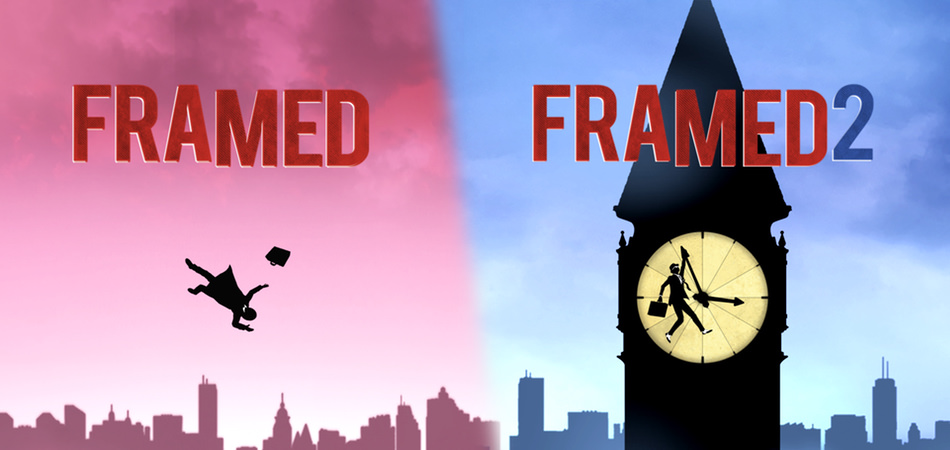
Released in 2018, Framed Collection kept me entertained for a little over four hours. The collection includes the originally touch-screen-based Framed (2014) and Framed 2 (2017). The unique mechanics and audiovisual polish of these award-winning puzzle games left an impression, yet the overall experience still felt somewhat superficial. The Framed games combine comics, animation, platforming, and puzzle design into a multi-stage chase narrative. The characters perform acrobatic feats in inventive urban and industrial settings, all set to swinging jazz. Stylistically, the games evoke 1960s crime and spy fiction.
The Framed games were developed by Loveshack, a Melbourne-based studio founded by four friends. They aim to break genre boundaries, boldly stating that “if you can say what genre a Loveshack Entertainment game belongs to, it is probably not a Loveshack Entertainment game”. Framed and Framed 2 are indeed genre fusions, but they are unmistakably puzzle games. What is unique is not the genre itself, but the particular kind of puzzle variations they offer.
The eventful journey of a mysterious briefcase
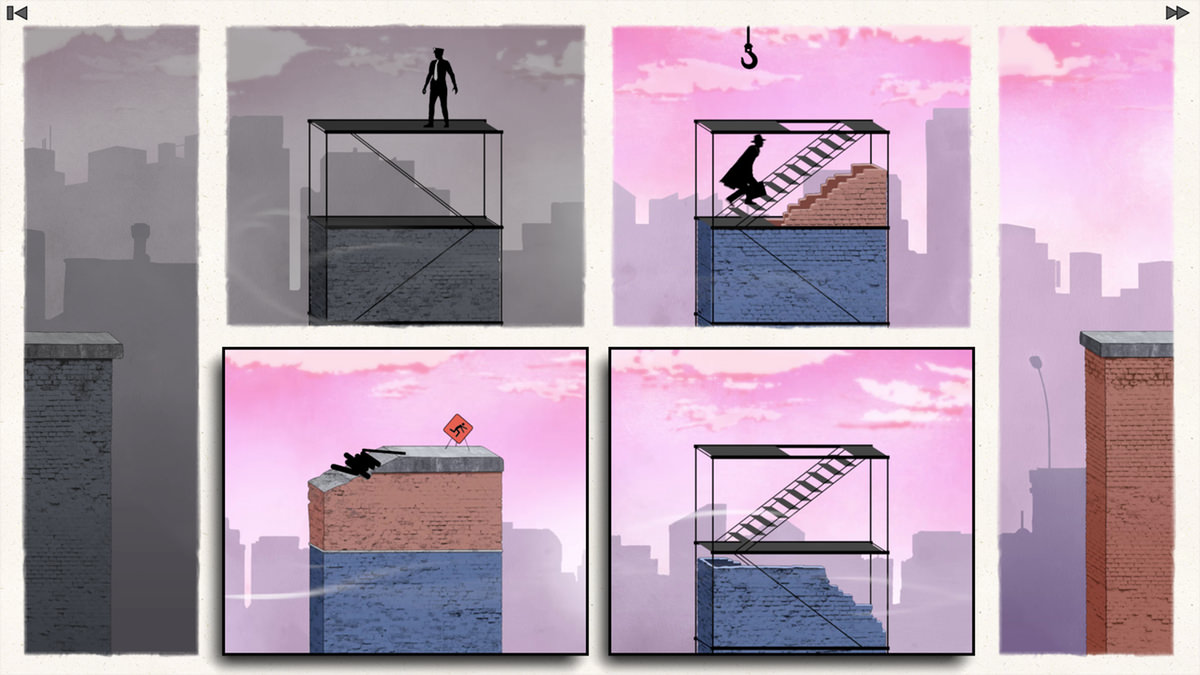
The story of Framed is one long chase. At its centre is a mysterious briefcase whose contents are never revealed. It is clearly stolen, but whether it is a mundane theft or the acquisition of secret documents remains unknown. I am nevertheless inclined to think that the protagonists are agents.
A lanky male character on the run tries to avoid both the police, who would arrest him, and various environmental hazards that cause accidents. He is soon joined by a small woman who is just as agile and tireless a climber. Most of the time the player controls the man, but occasionally the woman, and eventually both at once. The antagonist of Framed is an inspector whom the player briefly controls as well, though the main objective remains slipping through his grasp.
Failure as a path to success
On Steam, the game has received mostly positive reviews. I have made it a habit, however, to read negative reviews in particular. They reveal why I might not like a game, and together with the game description this is far more useful than reading praise — especially unsubstantiated praise.
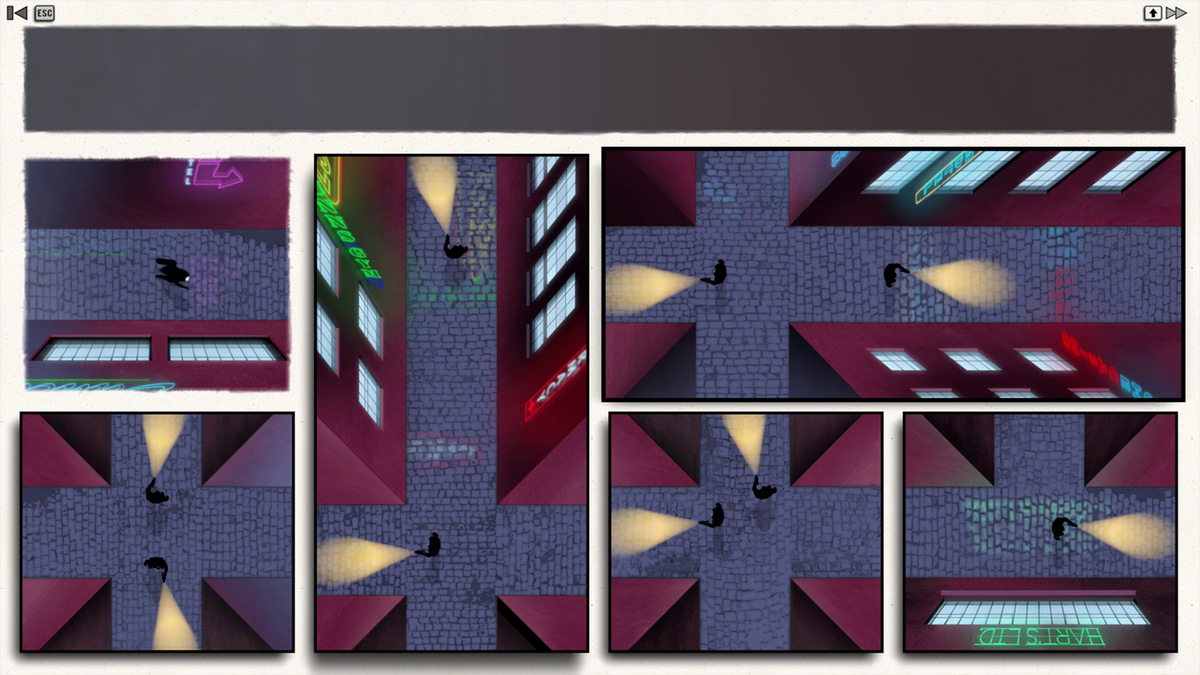
Framed Collection has been criticised for encouraging trial-and-error play and for not offering puzzles that require genuine reasoning. I understand the criticism. My own play was very much trial and error. A good puzzle game might be expected to require logical problem-solving or at least an understanding of event chains. I am quick to label myself stupid or lazy when I fall into trial-and-error habits. While playing Framed, however, I realised that the issue was not so much with me as with the game. But was it even an issue? I concluded that it was not a flaw, but rather intrinsic to Framed’s unique nature.
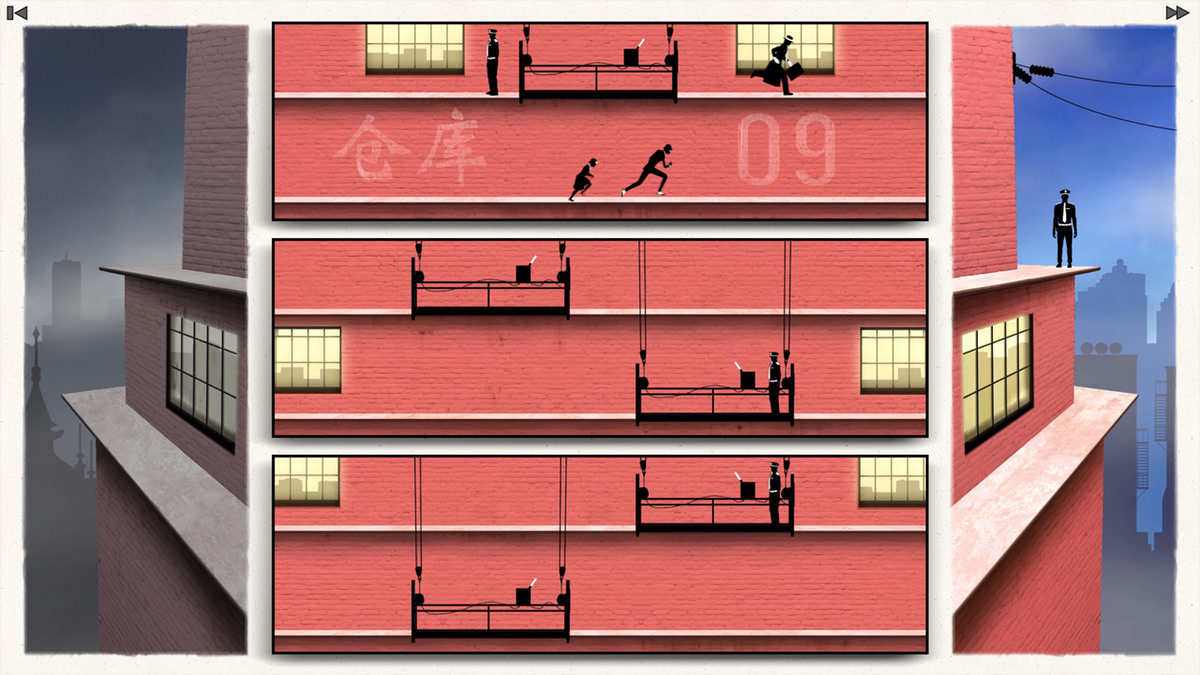
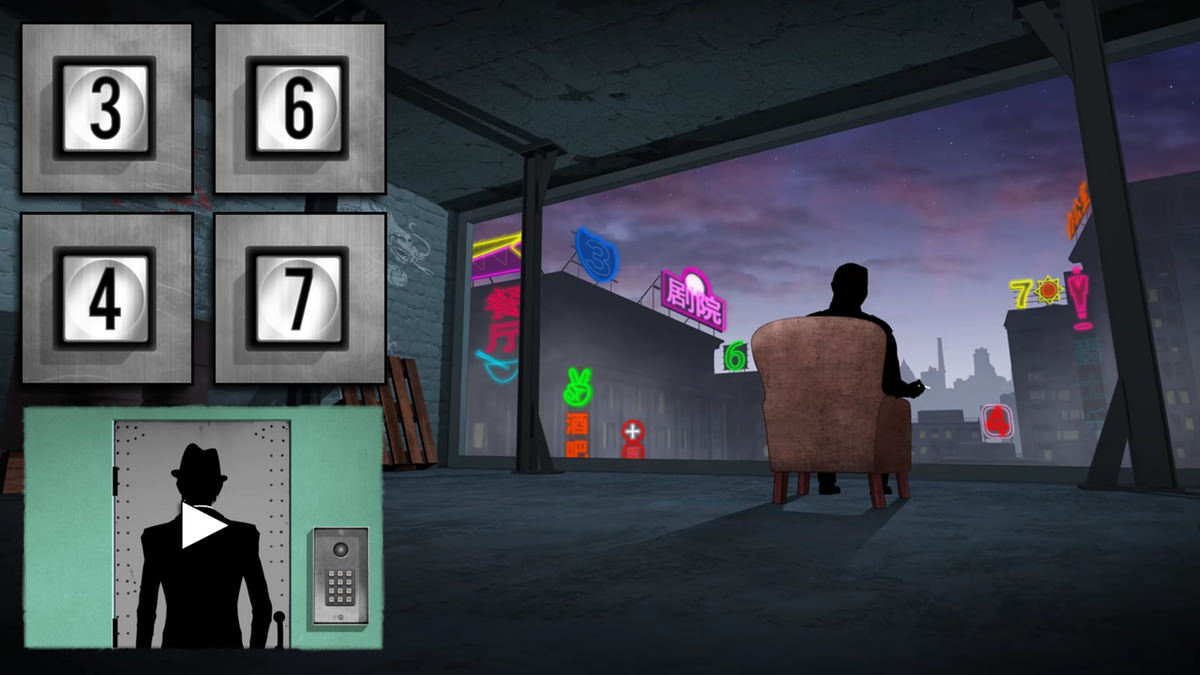
In Framed, the player’s task is to arrange panels into a short animated comic strip. At first, the panels show only static information. To truly understand what a panel does, the character must run through it, triggering the animation. Panels therefore need to be explored interactively before any reasoning about their order can begin. This already implies trial and error, as the player must witness repeated failures. Moreover, placing panels in different sequences can produce unexpected results. Each panel’s animation depends on the one preceding it. Even though the number of panels in Framed is small — sometimes very small — there are plenty of possible order variations. Later on, the ability to reuse panels within a single sequence adds further complexity.
I personally found enjoyment in the surprises Framed offers. As the game progresses, new functionality appears in the panels, and different arrangements can yield outcomes I could not always anticipate. This is unlikely to please fans of demanding puzzle games who seek long and intricate logical challenges. Balancing difficulty in puzzle games is a subtle and difficult task. Who is the intended audience? Can a designer who is highly skilled reach the average player? The reverse seems even less likely. All players seek a sense of achievement, which does not arise if one has to repeatedly consult walkthroughs.
Parkour to a jazz beat
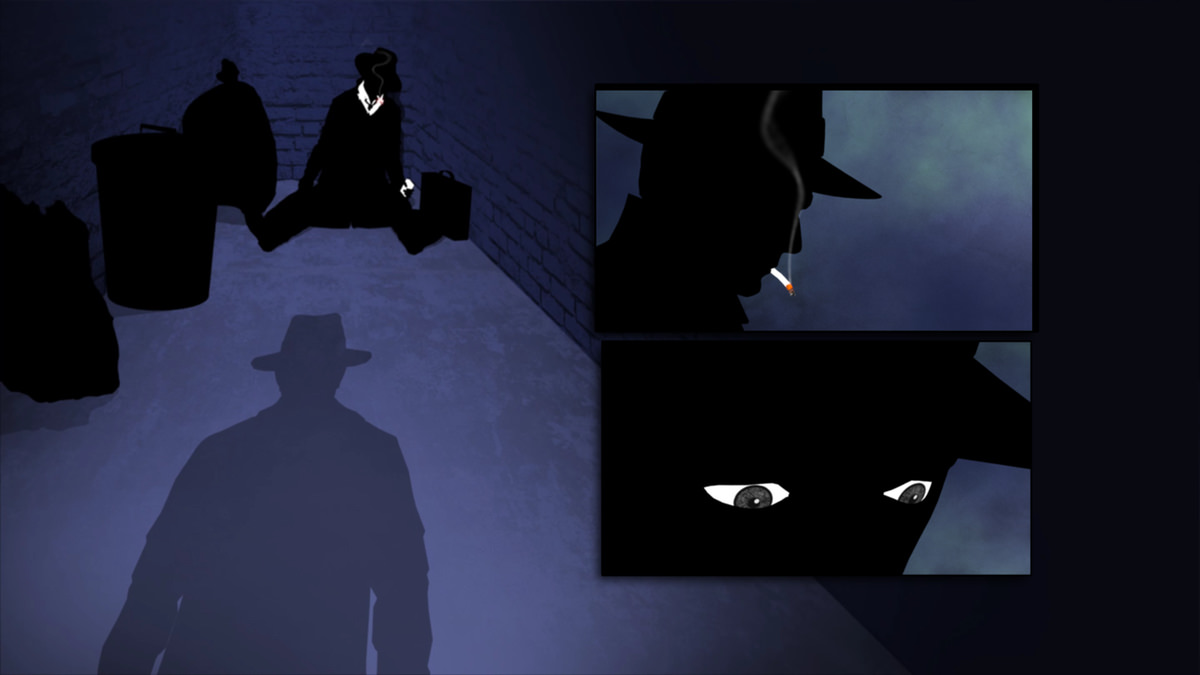
The graphics, animation, and music of the Framed games form a relaxed and fluid whole. Black, silhouette-like characters against colourful backgrounds are pleasing to the eye. I liked the colour palette, its harmonious richness, and gentle variation. The music is 1960s-style fusion jazz. In Framed 2, it becomes more electronic and slightly more modern. The animations are deliberately slowed down, as if to savour their smoothness. This even brings to mind older games such as Impossible Mission (1984) and Prince of Persia (1989), where animation speed was unintentionally limited by technology. The leisurely pace of Framed did not bother me at all. It was not excessive, and the game also allows easy fast-forwarding.
Verdict
Framed Collection offered me a swinging and stress-free escape. I approached it in a relaxed manner, and aside from a few more complex sequences, I never became frustrated. Trial and error is built into the game itself, and failures provide their own kind of animated entertainment. I would not call it fun — serious accidents are not fun to me — but Framed can be recommended as a distinctive puzzle experience and a calm pastime that still has its share of twists. I give the experience 70 points out of 100.
Availability
Framed Collection is available for Windows, macOS, and Linux, as well as for the Nintendo Switch. The game can be controlled with either a mouse or a game controller. I played on a computer with a mouse, and although the games clearly originate from touch-screen design, mouse control worked perfectly well. The original Framed and Framed 2 are also available separately for Android and iOS.