
Batman (1986)
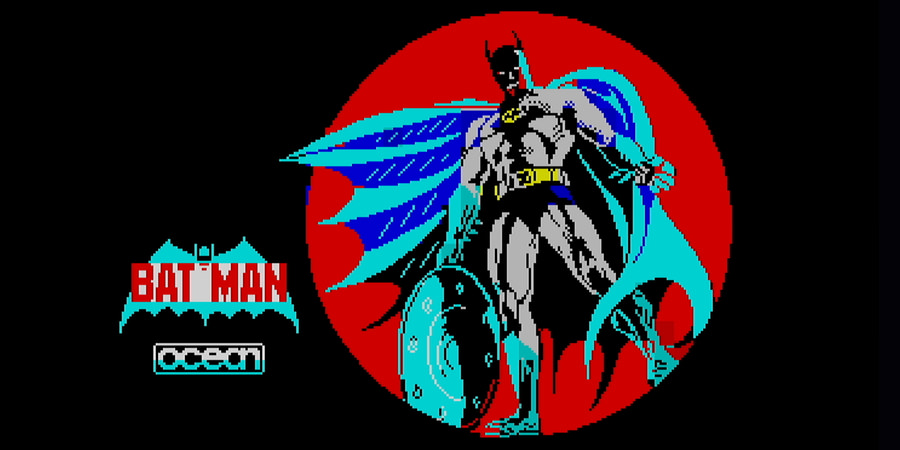
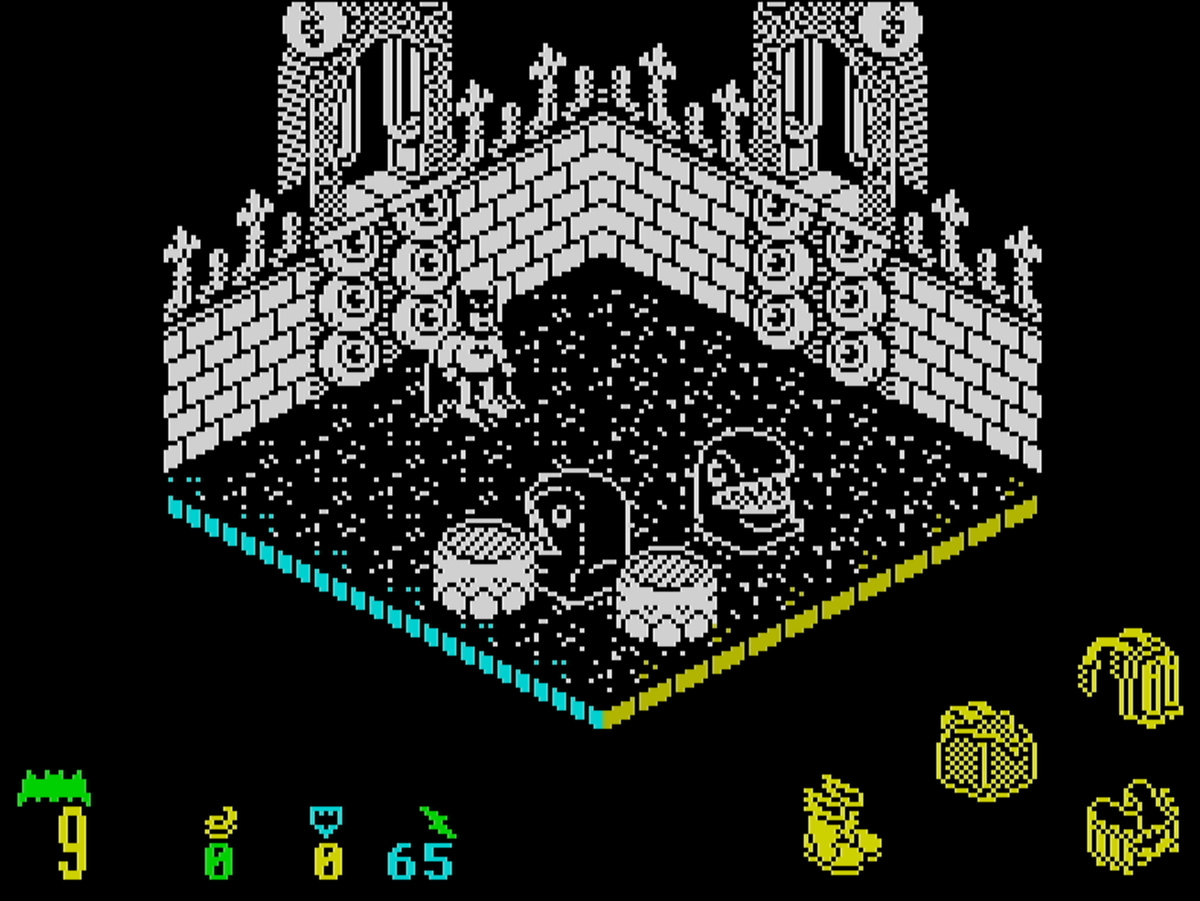
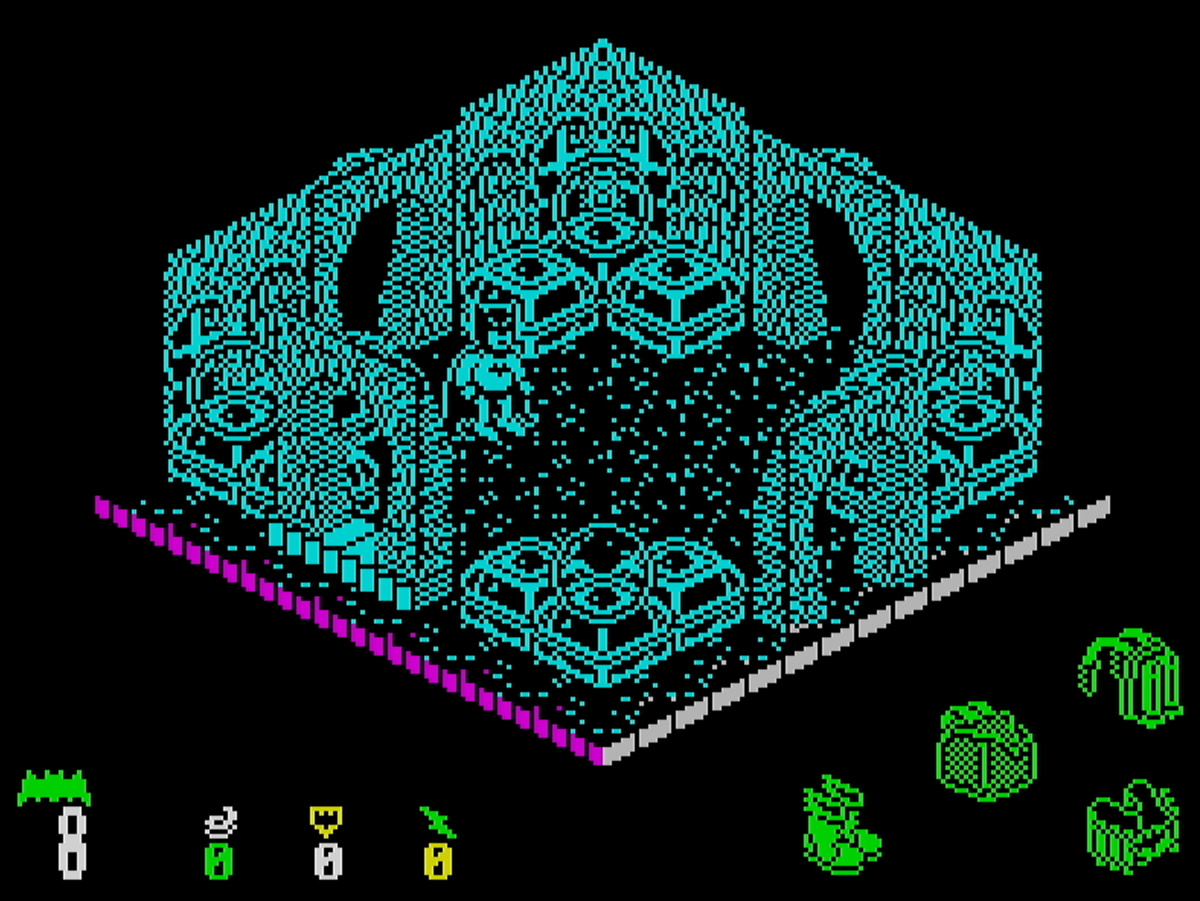
I recently bought Retro Games' The Spectrum console. I had previously played Spectrum games using a Windows emulator and become fascinated by their unintentional artistry. By artistry, I mean the colour clash and the distinctive style that emerges from simplicity. There is something childlike and charming about this aesthetic, and the game I am presenting this time, Ocean Software's Batman from 1986, is a perfect example of it. It is an isometric action-adventure featuring a vast world spanning 150 screens, a wide variety of enemies, and puzzle mechanics based on stacking and moving "boxes". The Batcave also extends across multiple vertical levels, creating a platforming challenge that demands precise timing and pixel-perfect control. For modern players, it can be a real test of patience. Batman is a true Spectrum classic, packed with pioneering ideas.TEST1
An affordable and hugely popular home computer
British Spectrum computers were manufactured between 1982 and 1992. They were originally produced by Sinclair Research Ltd and, from 1986 onwards, by Amstrad plc. During the 1980s, their main 8-bit competitors included the Commodore 64 and the Oric-1. There were, of course, many other machines as well, making the early years of home computing a remarkably diverse and fascinating era.
The Spectrum's greatest strength was its affordability. Its inventor, Clive Sinclair, wanted to create a small, simple computer assembled from as few components as possible. This proved to be a commercially successful strategy, with the Spectrum becoming a huge commercial success in Britain.
Several Spectrum models were released, but the ZX Spectrum 48K remains the most iconic and popular. The "48K" refers to the computer's 48 kilobytes of RAM, which are used for running programs and games. Another 16 kilobytes of ROM contain the operating system and the Sinclair BASIC environment. At its heart is an 8-bit Zilog Z80 processor running at 3.5 MHz.
The Spectrum's colour palette consists of 15 colours: seven base colours, each available at two brightness levels, plus black. Its native resolution is 256×192 pixels. The display is divided into 8×8-pixel attribute blocks, within which only two colours can be used simultaneously — one for the foreground and one for the background. Unlike the Commodore 64, the Spectrum has no hardware sprites, so the player character and other moving objects are highly susceptible to colour clash. Considering these severe limitations, it is rather amusing that the name "Spectrum" refers to the colour spectrum. It makes more sense, however, when you remember that Sinclair Research's earlier computers, the ZX80 and ZX81, displayed graphics only in black and white.
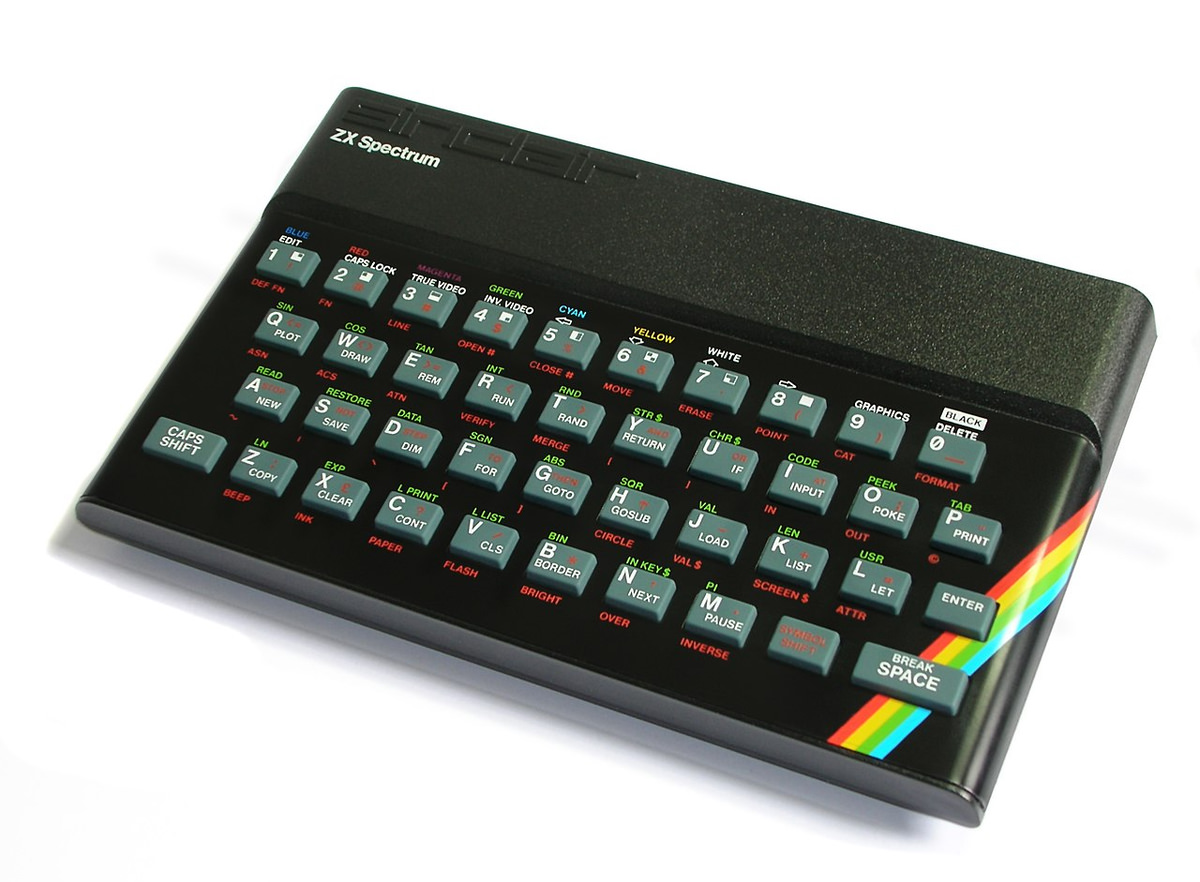
Visually, the Spectrum's rubber keyboard is quite unusual. The keys feel sticky, and at first glance the numerous labels can be rather confusing. The keyboard is designed not only for ordinary typing but also for programming in BASIC, as individual letter keys double as shortcuts for complete commands — for example, P inserts "PRINT" and J inserts "LOAD". The keys also provide access to mathematical functions. There are no dedicated cursor keys; games controlled from the keyboard typically use O (left), P (right), Q (up), and A (down). Most games allow players to choose between keyboard controls, a Kempston joystick, or another joystick interface.
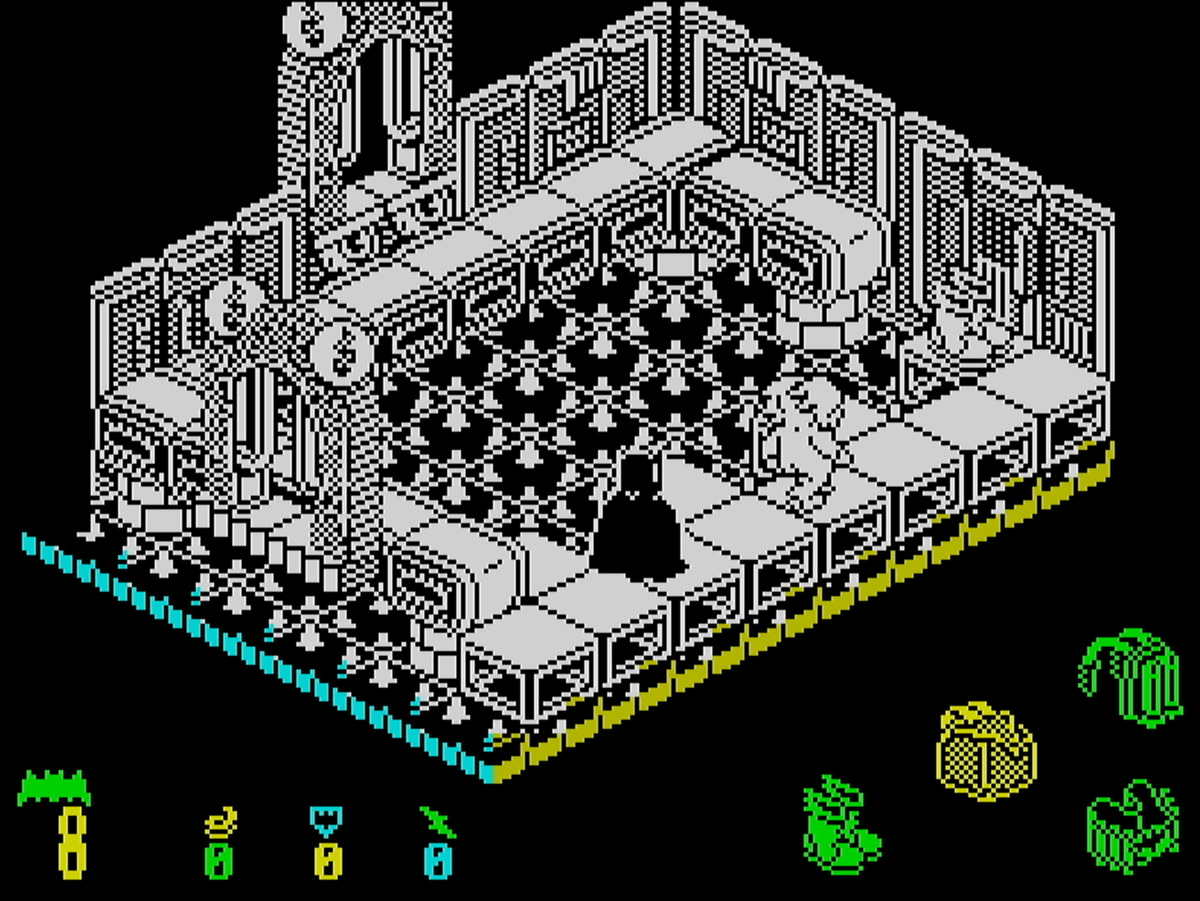
Robin Has Been Kidnapped and the Batcave Has Been Taken Over!
According to the game's backstory, Robin has been kidnapped. At the time of the abduction, he was repairing the Batmobile, which (perhaps) explains why its parts are scattered throughout the game world. The player's objective is to collect all seven of these parts in order to rescue Robin. Before that, however, Batman must first regain his abilities. Four collectible items represent these abilities: the Batbag for picking up and dropping objects, the Batboots for jumping, the Thruster for steering while falling, and the Batbelt for extending Batman's glide through the air.
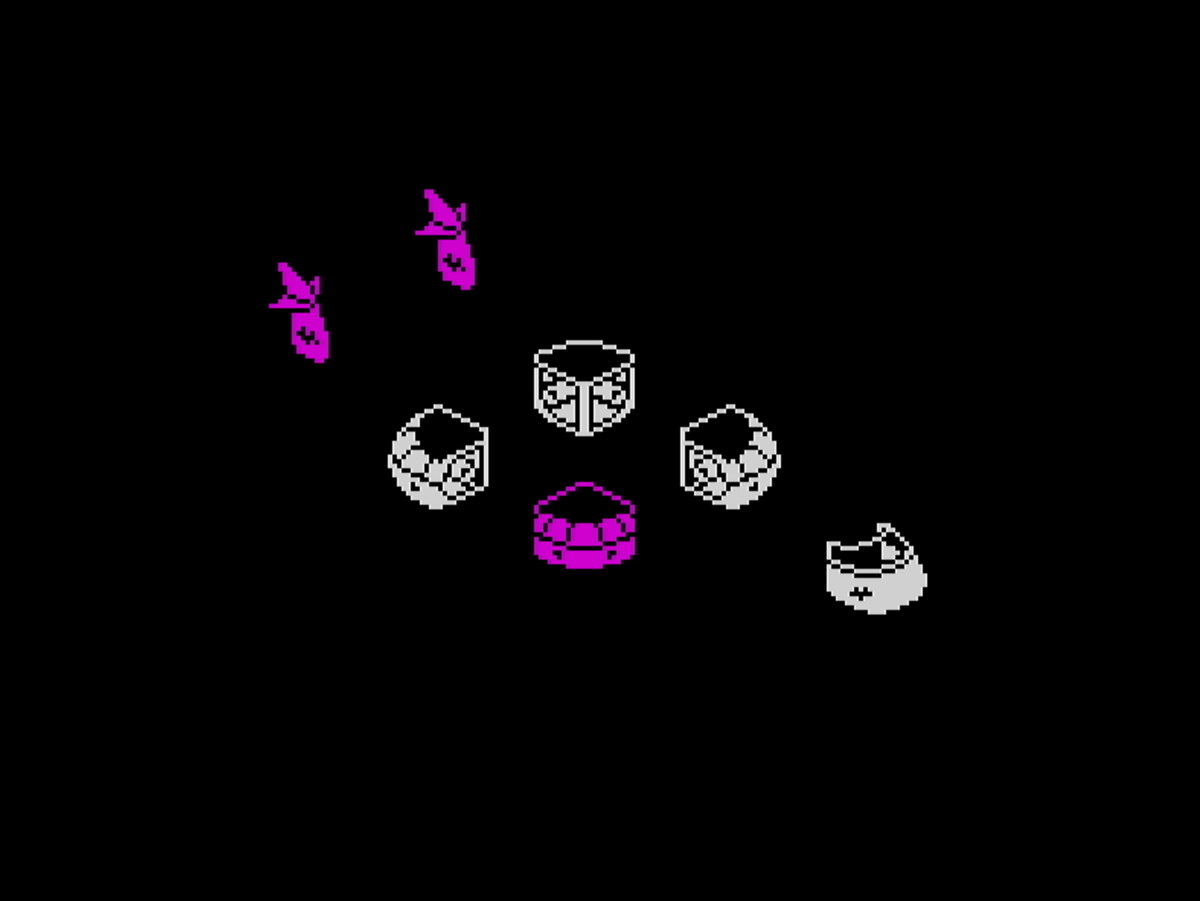
The game world represents the Batcave. It is rather curious, then, that it is teeming with enemies. Has the Batcave been taken over? Perhaps one of Batman's arch-enemies has invaded it with the help of all manner of bizarre creatures. The original game description never suggests anything like this, however. The game itself is non-violent, or at least Batman never resorts to violence. Instead, the player's task is to avoid enemies and deadly hazards. A lethal obstacle can be almost any seemingly harmless object. There is certainly no shortage of things trying to kill you! Trial and error is the key to success.
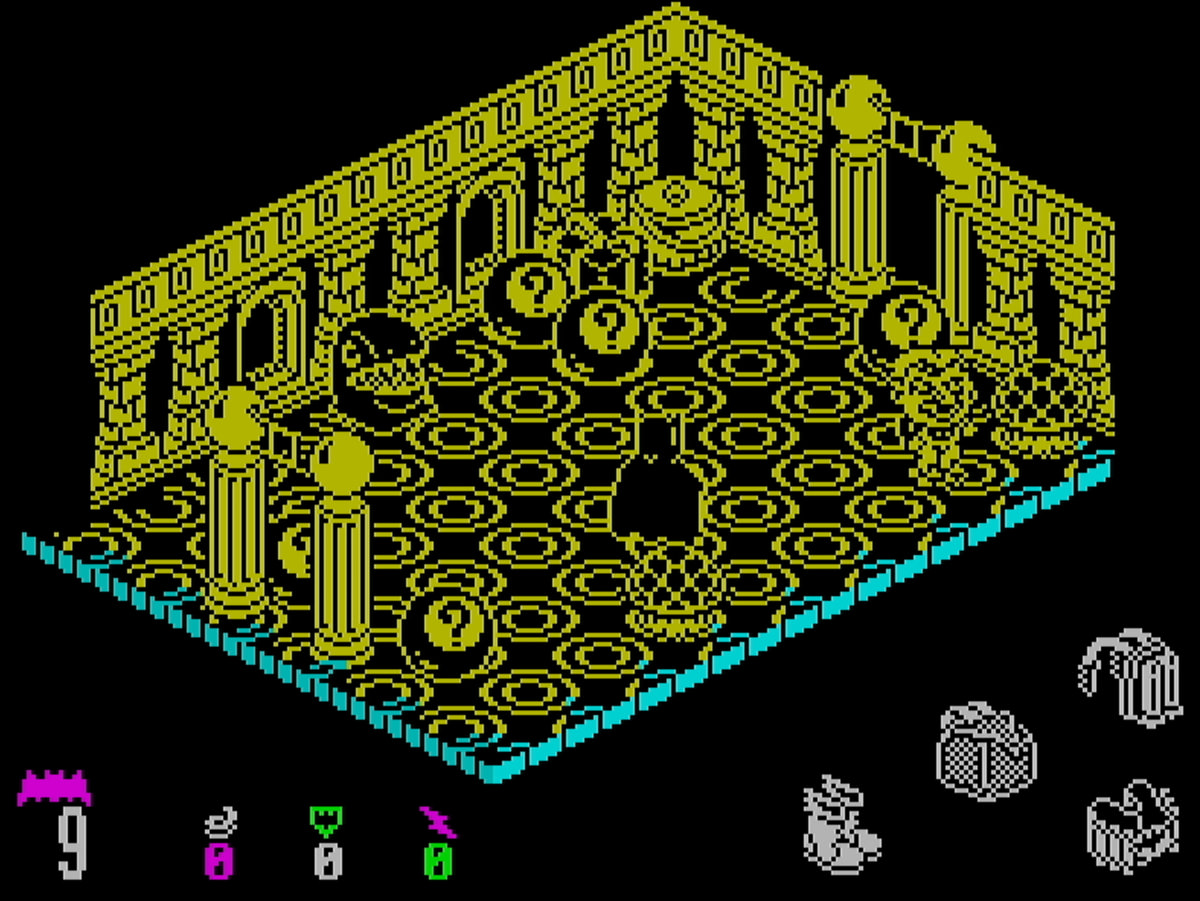
In addition to collecting Batman's abilities and the Batmobile parts, the player must dodge enemies that follow fixed movement patterns and avoid colliding with hazardous objects. The third major gameplay element revolves around using "boxes". A "box" may actually be something like an elephant-foot stool or a teapot. The important thing is that Batman can pick it up and drop it wherever he wishes. Only one box can be carried at a time, and boxes cannot be taken outside the current screen. Furthermore, every room resets to its original state whenever you leave and re-enter it — or if you get caught.
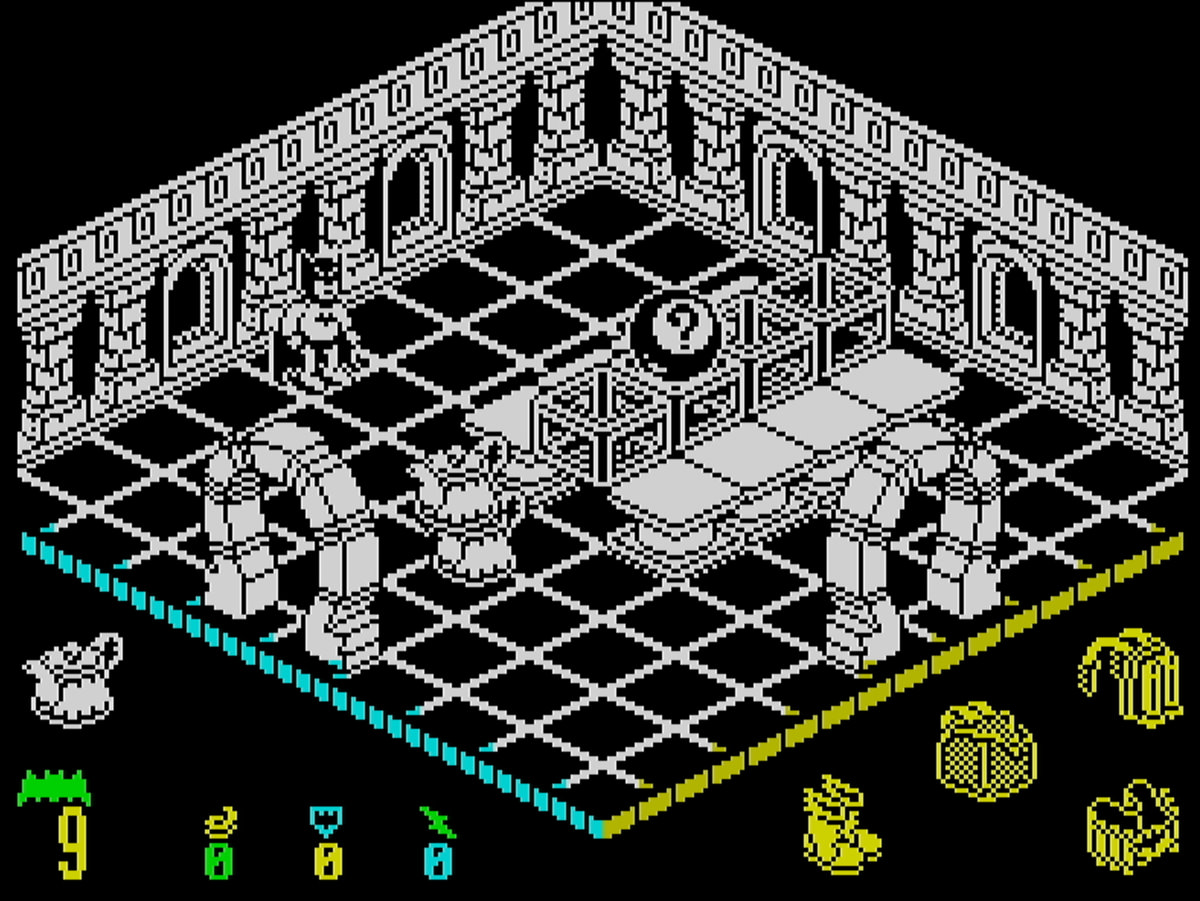
An Archaic Programming Marvel?
Both Batman's movement and that of the enemies are dynamic and remarkably smooth — astonishingly so, considering the hardware. Even when several objects are moving simultaneously on the screen, there is no noticeable stuttering or flickering. Batman's running animation is equally fluid, with short, natural-looking strides, despite the lack of hardware sprites. Every frame requires the previous image to be erased and the background beneath it restored before Batman can be redrawn in a new position. Equally impressive are the sheer size of the game world and the variety of its graphics. How on earth did they manage to fit all of this into a mere 48 kilobytes of memory?
It seems fairly obvious to me that 8-bit home computers were not originally designed primarily for gaming. Unlike the dedicated game consoles of the era, such as the Atari, NES, and Sega systems, computers were marketed as general-purpose machines for office applications, file storage, and programming. Only later did it become apparent that people mainly used them to play games. The game developers — and, for that matter, the players themselves — were the true heroes of the 1980s!
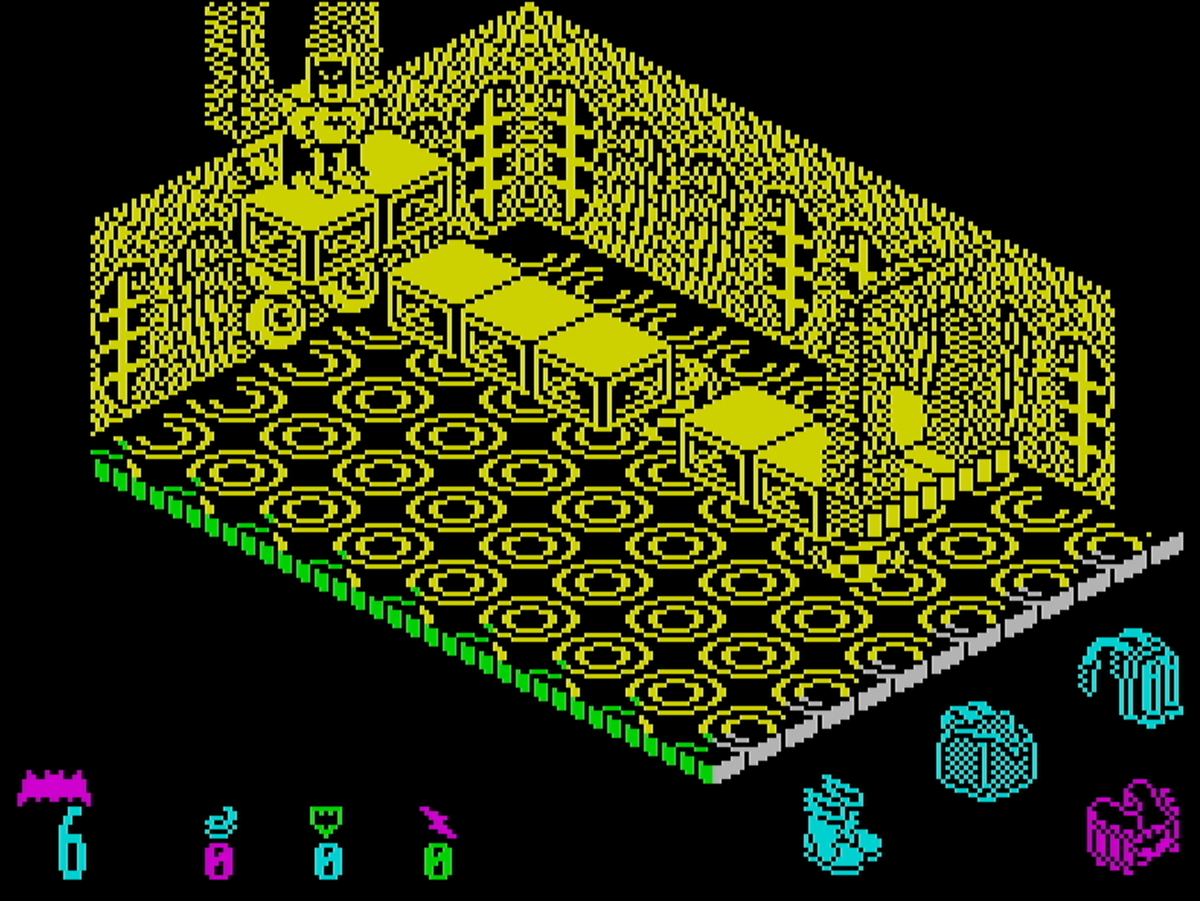
The isometric graphics are impressive and surprisingly functional, although accurately positioning Batman within the environment occasionally gave me some trouble. Pixel-perfect movement and precise timing of jumps and walking are fundamental to the gameplay. At times, making it through a room to the next one felt almost impossible — yet it never actually was.
You can — and should — make use of the temporary power-ups available throughout the game: invulnerability, enhanced jumping ability, and increased movement speed. Extra lives can also be collected. The most unusual and forward-thinking feature, however, is the built-in save system represented by Batstones. If you lose all your lives, you can continue from the location of the last Batstone you collected.
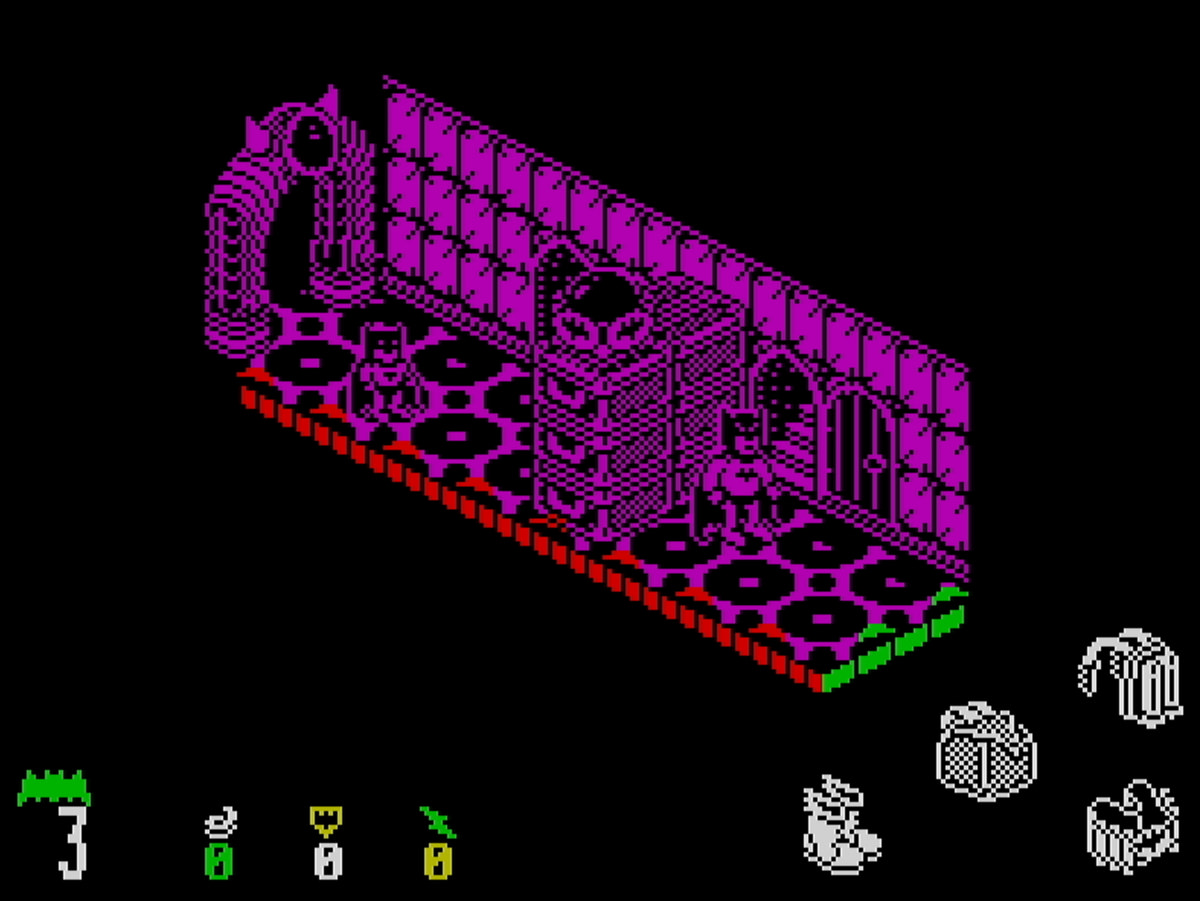
Batman himself is an endearingly childlike little character. The enemies are wonderfully imaginative, and it was fascinating to keep discovering ever more unusual creatures throughout the game world. The developers originally intended to include Robin as well, allowing players to switch between Batman and Robin. However, this two-character mechanic was not realised until their next game, Head over Heels, which is widely regarded as the finest Spectrum game ever made.
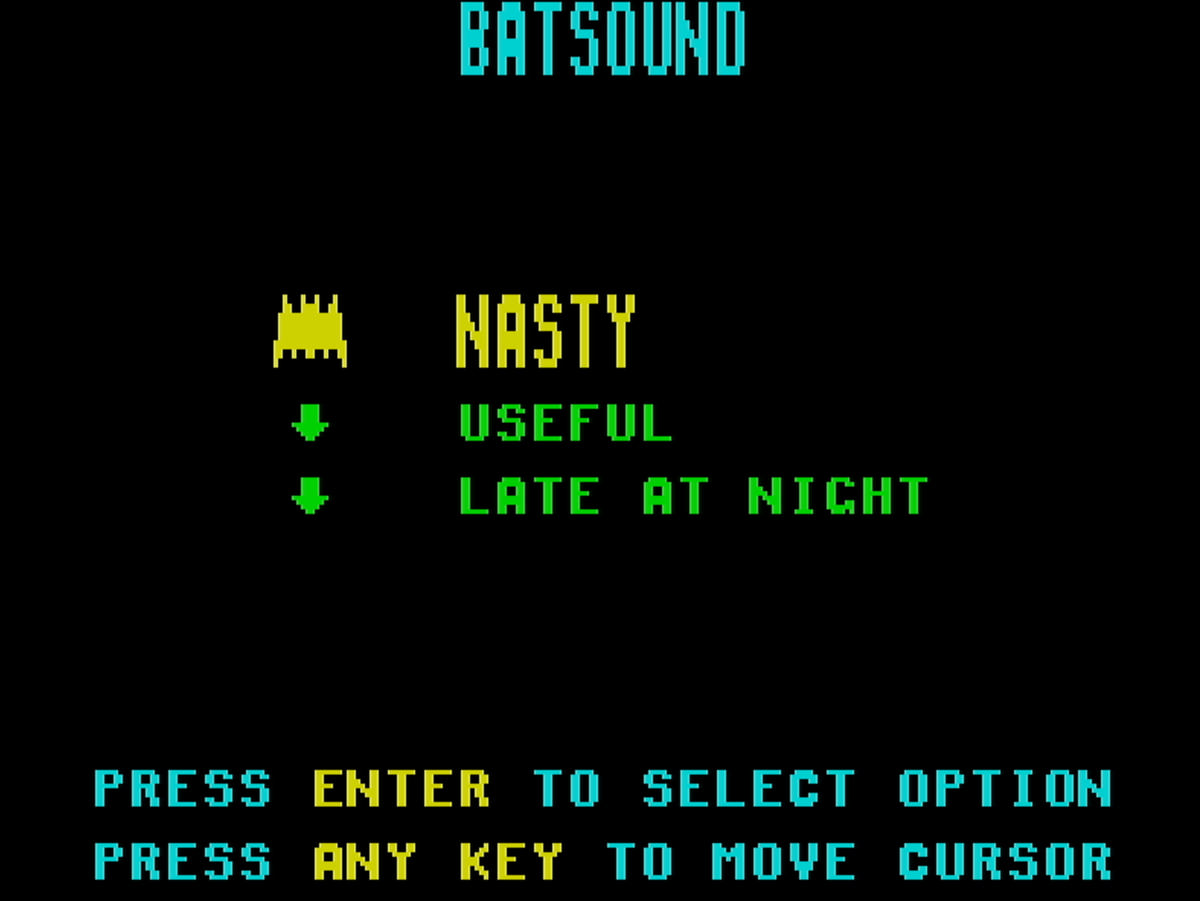
The music and sound effects are nothing to write home about. They consist of primitive beeps, yet I never found them irritating. On the contrary, they serve as an effective reminder of the era from which Batman originates. The earliest Spectrum models did not even include a dedicated sound chip. During gameplay there is no background music apart from the intermissions. Batman's footsteps produce a beeping sound, enemies make noises when they collide with one another, there is a distinctive sound when Batman is caught, and another fanfare when an important item is found. Quite impressively, the main menu even allows you to choose between different sound modes.
Verdict
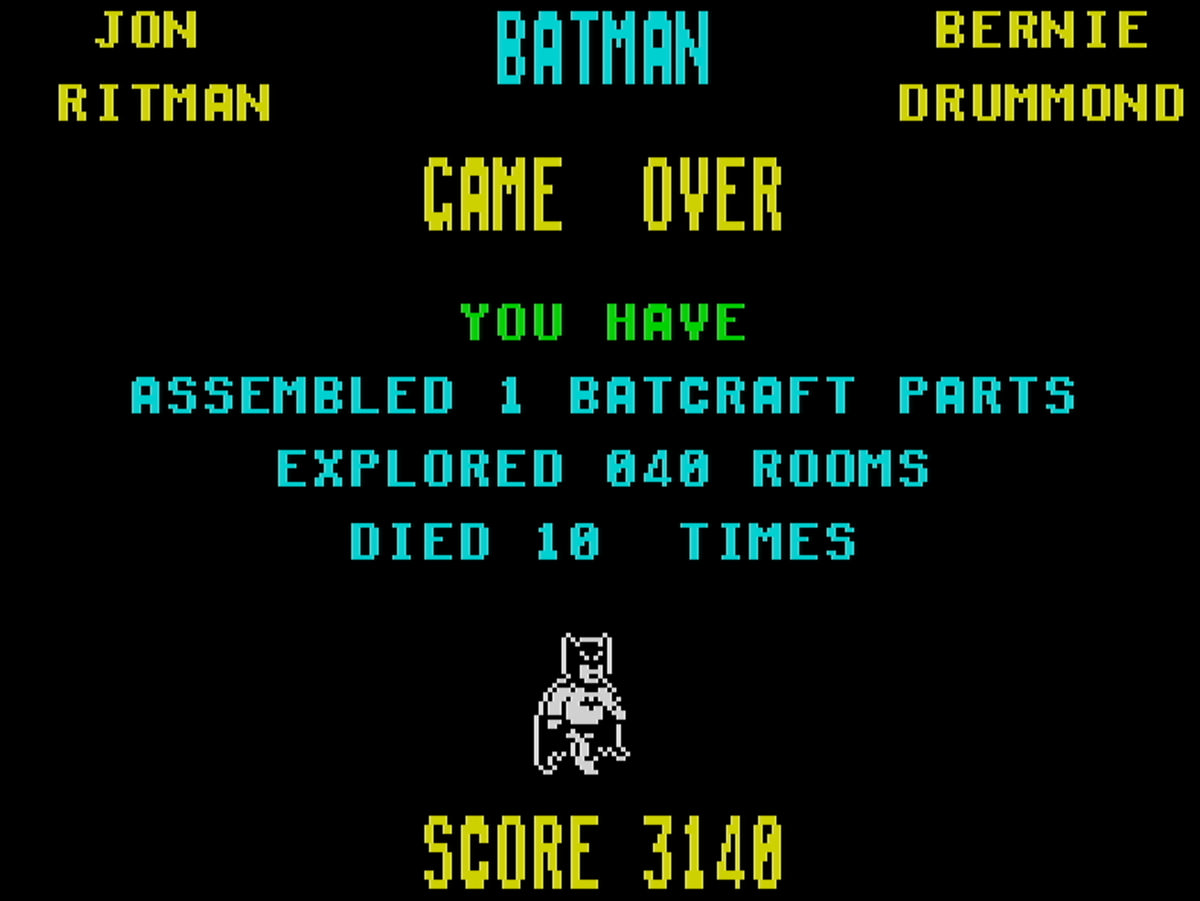
The very first Batman game, released in 1986, is an impressive achievement by programmer Jon Ritman and graphic artist Bernie Drummond. For today's players it is relentlessly difficult — brutally so, to be honest. I made extensive use of The Spectrum console's save-state feature, and I also consulted a playthrough video whenever I got stuck. Although the game can be completed in about half an hour in the video, my own playthrough took considerably longer.
My experience was both fascinating and frustrating at the same time. Batman belongs among the elite of Spectrum games, and its difficulty is pure 1980s. The game certainly delivers a memorable experience. I award it an overall score of 74 out of 100.
Availability
Batman can be played not only on an original Spectrum computer but also through emulators.