
Mystery Case Files: Huntsville (2005)
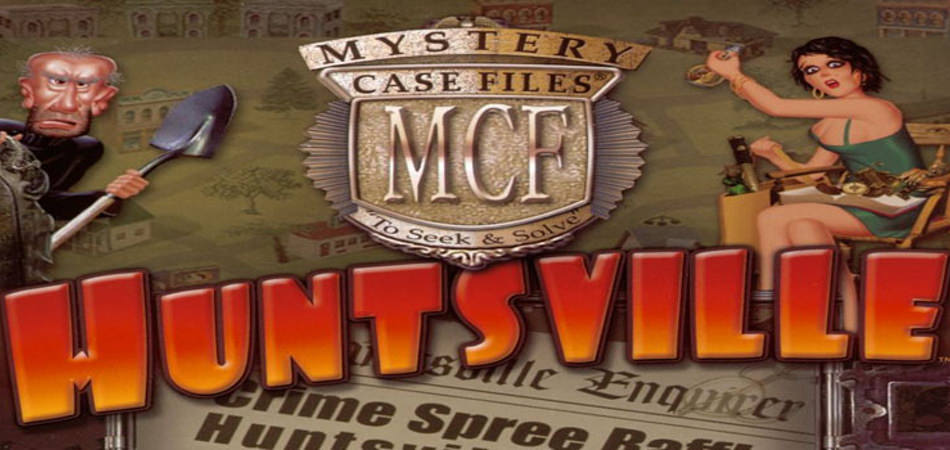
In my previous post, I found myself venting about the evolution of hidden object games — about how they have gone badly off course. That led me to return to the roots, to see what those early hidden object games actually felt like and what they did well. I have previously reviewed the fourth entry in the Mystery Case Files series, Madame Fate, which is a personal cult classic for me. Madame Fate was released in 2007. But what came before it? The first entry in the series, released in 2005, is sometimes described as the game that started the entire genre. I am not taking a stance on whether everything truly began with Huntsville, but the Mystery Case Files series is in any case a useful subject when examining the development of hidden object games. A new entry appeared almost every year, most recently in late 2021. The series currently consists of 23 games.
The Mystery Case Files series is published by the American company Big Fish Games. Up until Shadow Lake and the year 2012, Big Fish Games was also responsible for developing the games internally. Since then, development has been handled first by the Russian studio Elephant Games, then by Serbia-based Eipix Entertainment, and most recently by Ukraine’s GrandMA Studios. The misguided direction I criticise cannot be blamed on these later developers — the shift began under Big Fish Games itself.
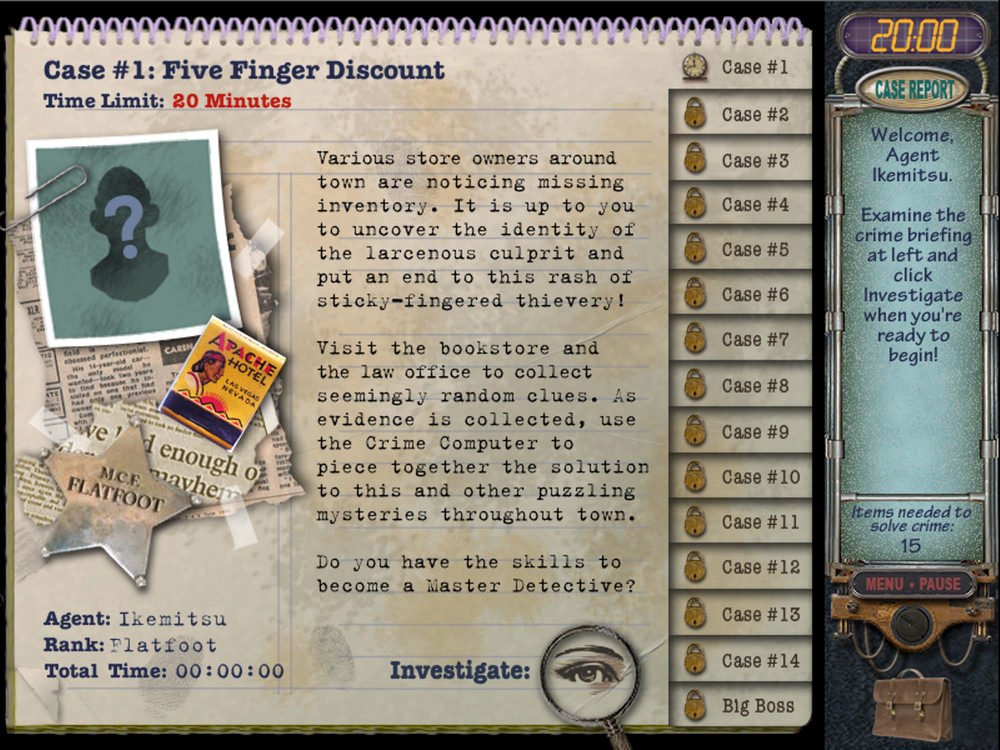
The Mystery Case Files games are paranormal — or at least slightly eccentric — detective stories. Huntsville is a humorous, grotesque whodunit. It resembles Madame Fate, but the comparison also highlights how much more developed Madame Fate already is as a hidden object game, particularly due to its inclusion of minigames. Huntsville contains only a single repeatedly used auxiliary mechanic, and I would hesitate to even call it a minigame, as it is in fact central to the game’s core mechanics.
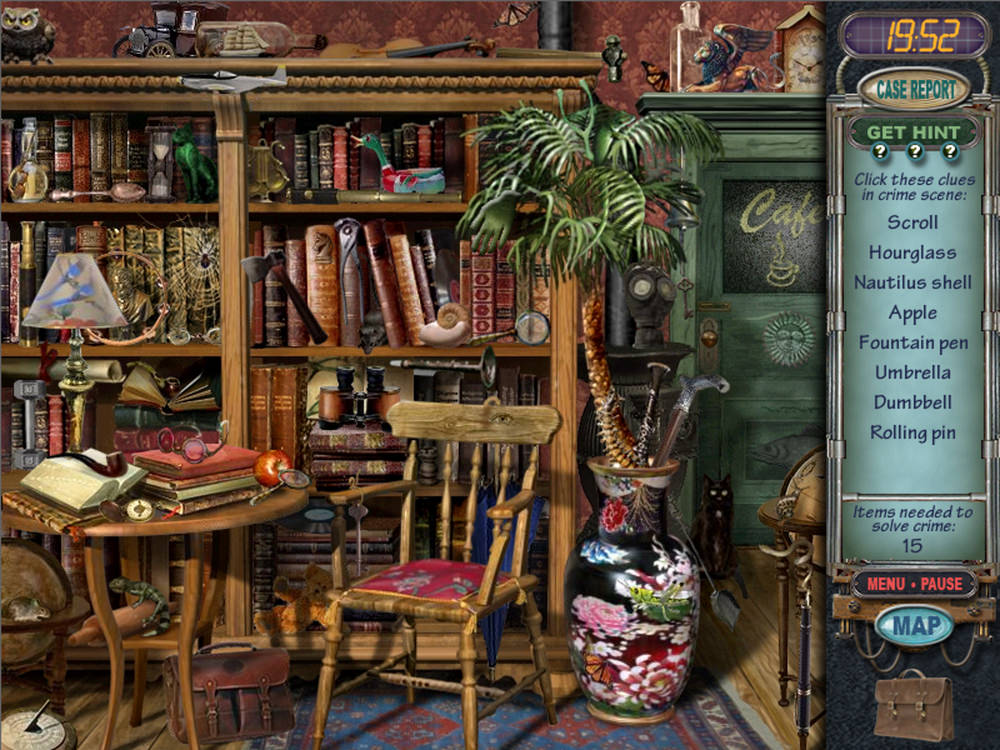
In Huntsville, the focus is squarely on finding objects in cluttered scenes. More recent hidden object games use silhouettes alongside word lists, and search scenes may include other interactive elements. Huntsville, however, relies solely on word lists. It is very basic — and, in my view, basic in a good way. That said, Huntsville lacks the imagination of Madame Fate, and it does nothing to challenge that game’s cult status.
Straightforward crime-solving
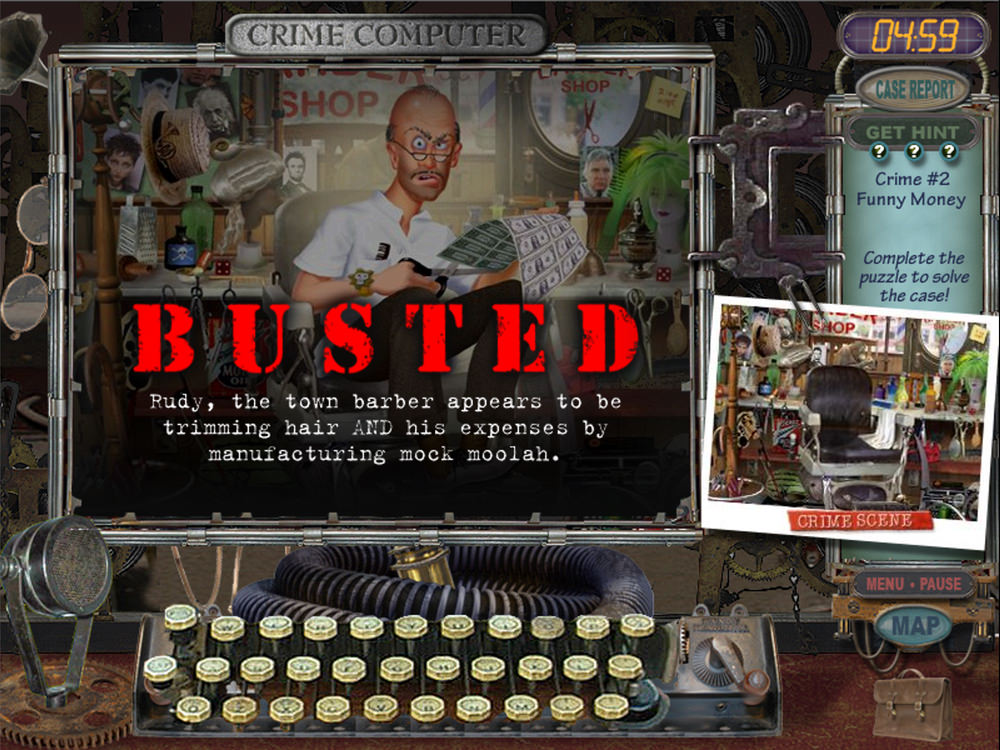
Huntsville is a small town of a few thousand inhabitants, plagued by a string of crimes. The player arrives to solve them. The game consists of fourteen cases, each of which is resolved by finding a required number of clues and then using a curious crime computer. Clues must be found across multiple locations per case. These locations are shops and institutions shown on the town map. They are absurdly cluttered, as is customary in hidden object games. Once enough “evidence” has been collected, the crime computer is activated. In practice, this is a cube puzzle: the player must arrange the blocks to form a complete image that reveals the culprit.
Each case has a strict time limit, usually a little over twenty minutes. If the player fails to complete the case in time, they are mercilessly returned to the starting point. All clues must be found again — with newly randomised lists — and the puzzle must be solved from scratch.
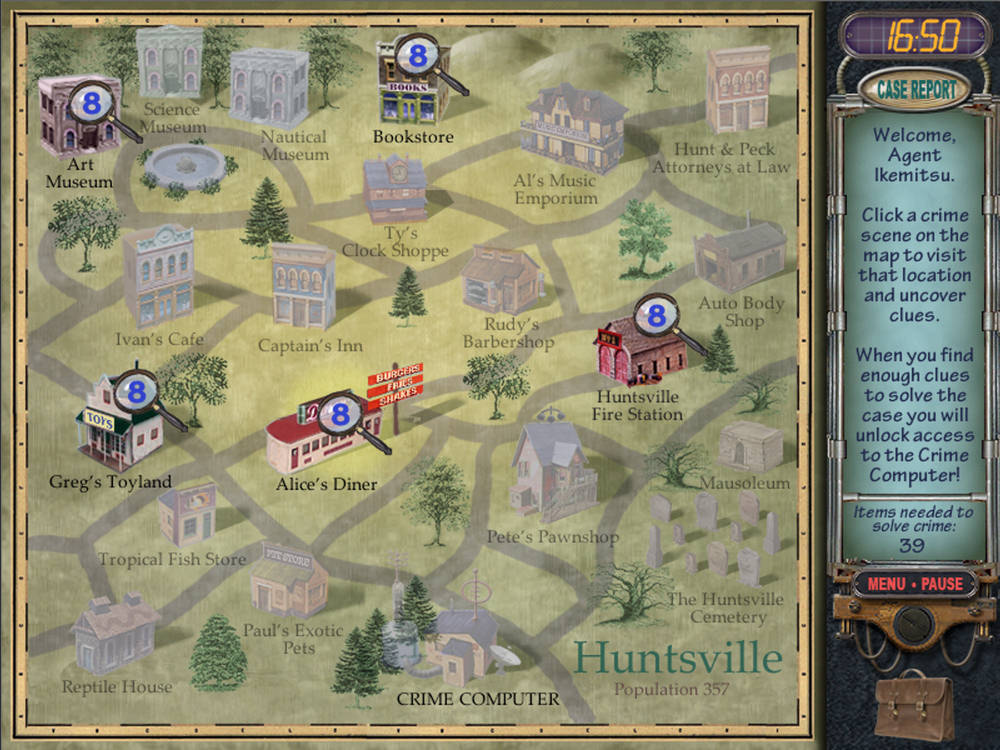
Huntsville’s world is grotesque but harmless. The crimes are played for laughs. The culprits are eccentric characters, somewhat reminiscent of the cast of Madame Fate. I appreciate the distinctive style, even if this particular brand of humour does not fully land for me. Huntsville feels like a blend of the 1950s, the 1980s, and the early 2000s. It has a sense of a bygone era, even though it is not historical in any clear or consistent way.
Crude in a bad way — or a good one?
The question, then, is how well Huntsville has aged, and what might bother a modern player.
First, the graphics are not HD. But much like with Madame Fate, I can honestly say that the slight muddiness did not bother me. Only once or twice did I struggle to identify an object due to the low resolution. In hindsight, one could argue that by 2005 graphical fidelity had only just become barely sufficient for hidden object games — which may explain why the genre experienced a renaissance at that point. On paper, hidden object puzzles had existed long before, and they were not a new invention. In the 1990s, such puzzles appeared on CD-ROMs, but as standalone games they truly broke into the digital market only in the 2000s.
Huntsville’s music is not HD either, nor particularly varied. But given how formulaic the game is overall, the repetition did not bother me. It even felt oddly pleasant in a near-acoustic sense. The sound effects fall far short of Madame Fate’s fireworks, but since Huntsville lacks minigames, there is little room for elaborate audio design anyway.
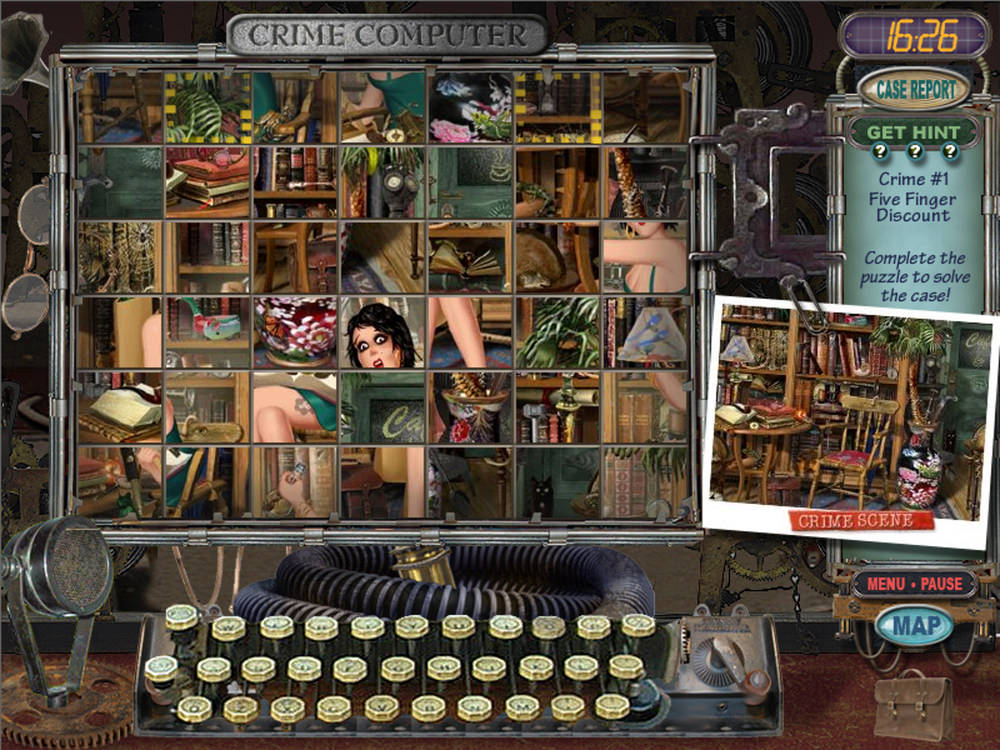
What about the mechanics? They work like an old-fashioned railway toilet: brutally simple and rigid. Huntsville is not burdened with poorly integrated adventure-game elements, nor does it include the risks associated with minigames, which are supposed to be imaginative, clever, and appropriately challenging for a wide audience. Mobile games may have lowered players’ expectations compared to computer games, but Huntsville’s rough simplicity is unlikely to impress players accustomed to complex role-playing games — at least not in a positive way. Then again, Huntsville is a puzzle game. Expectations should shift accordingly.
Modern players may be irritated by the repeated visits to the same locations and by evidence lists that often contain the same recurring objects. That did not bother me at all. On the contrary, I enjoyed learning the environments and becoming faster and more efficient. This was essential to my enjoyment of the game.
A slight input lag that prevents rapid clicking may frustrate impatient players, but I tend to think that one of the core functions of hidden object games is precisely to calm the player down. In Huntsville, the clock is ticking, but not so aggressively that one cannot settle into the act of searching.
Verdict
I spent five and a half hours completing the game. This includes replaying several cases after failing to solve them within the allotted time. The beginning was more difficult, but as the locations became familiar, my pace improved. That sense of personal progress was genuinely satisfying.
I recommend Huntsville as a retro, almost pure hidden object experience. I would rate my overall experience at 60 out of 100.
Availability
Mystery Case Files: Huntsville is available for Windows and macOS.